

Sanofi's Brain-Penetrant BTK Inhibitor SAR442168 Demonstrates Significant Reduction in Disease Activity in Phase IIb Trial for Relapsing Multiple Sclerosis
Apr 24, 2020 13:56
CST Updated
13:56

Sanofi
Pharmaceutical R&D Developer

April 24, 2020 /Bio ValleyBIOON/ -- Sanofi recently announced that its investigational drug SAR442168 (formerly known as PRN2246) met both primary and secondary endpoints in a Phase IIb study for the treatment of relapsing multiple sclerosis (RMS). Magnetic resonance imaging (MRI) showed that SAR442168 significantly reduced disease activity associated with multiple sclerosis (MS), with a relative reduction of ≥85% in the number of new gadolinium (Gd)-enhancing T1 lesions and new or enlarging T2 hyperintense lesions. In this study, SAR442168 was well tolerated, with no new safety findings identified.
SAR442168 has the potential to become the first disease-modifying therapy addressing the sources of multiple sclerosis (MS) damage in the brain.Sanofi to Initiate Four Phase III TrialsClinical Trials, evaluating SAR442168 for the treatment of relapsing and progressive multiple sclerosis.
The Phase II study aimed to evaluate the dose–response relationship after 12 weeks of SAR442168 treatment by measuring the number of new brain lesions on magnetic resonance imaging. The study assessed four doses (range: 5 mg to 60 mg) administered over 12 weeks, incorporating placebo data obtained from a 4-week placebo treatment period. For the primary endpoint of measuring the number of new gadolinium-enhancing T1 hyperintense lesions, a multiple comparison procedure and modeling approach were applied to the dose–response data, demonstrating that an exponential model provided the best fit (p=0.03).Compared with placebo, the 60-mg dose of SAR442168 resulted in an 85% relative reduction in the number of new gadolinium-enhancing T1 hyperintense lesions.For the secondary objective of measuring the number of new or enlarging T2 hyperintense lesions, the linear model was the most appropriate (p < 0.0001).Compared with placebo, treatment with 60 mg SAR442168 resulted in an 89% relative reduction in lesion count.
In the Phase IIb trial, no new safety signals were identified. Within 12 weeks, only one serious adverse event (MS relapse) was reported among patients treated with SAR442168. The most commonAdverse Reactionsheadache (3–13%), upper respiratory tract infection (3–6%), and nasopharyngitis (3–9%).
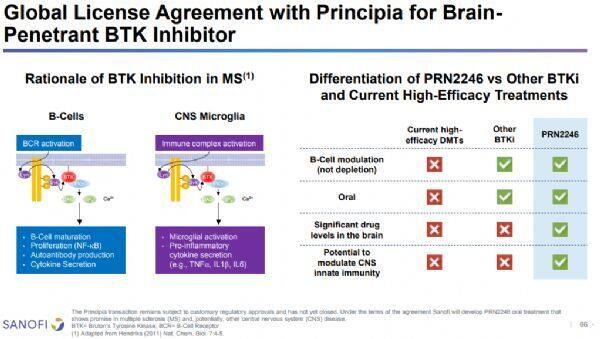
Differentiating Features of SAR442168 (Former Development Code: PRN2246)
Principal Academic Investigator of the Phase IIb Study, Senior Investigator at the National Institutes of Health, National Institute of Neurological Disorders andStrokeDr. Daniel Reich, Chief of the Section for Translational Neuroradiology at the National Institute of Neurological Disorders and Stroke (NINDS), stated, “The results of this study give us hope that SAR442168 has the potential to become an important treatment for relapsing multiple sclerosis (MS). In light of compelling, emerging data on the role of the brain’s innate immune system in smoldering MS lesions, there is also strong reason to believe that, due to its molecular mechanism of action and its ability to cross the blood-brain barrier, SAR442168 may have additional effects warranting further investigation. In my view, it is important to conduct broad and innovative testing of BTK inhibitors in Phase III clinical trials for MS.”
Dr. John Reed, Global Head of Research and Development at Sanofi, stated, “We believe that our brain-penetrant BTK inhibitor holds promise for reducing neuroinflammation and neurodegeneration in patients with multiple sclerosis, which are markers of disability progression. The effects on brain lesions observed in our Phase IIb study are encouraging. As we advance our research, we will explore whether this brain-penetrant BTK inhibitor provides robust efficacy and an excellent safety profile in patients with relapsing or progressive MS. Our Phase III program is rapidly launching four pivotalClinical Trial。”
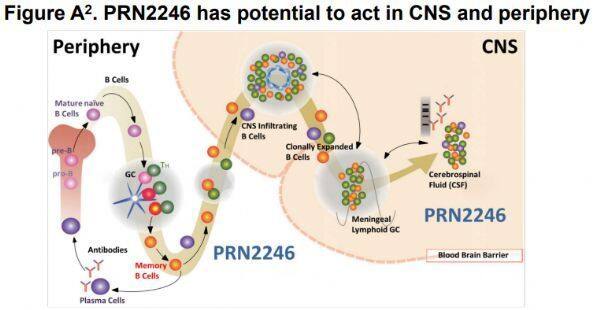
SAR442168 (PRN2246) acts on both the peripheral and central nervous systems
BTK inhibitors are believed to modulate adaptive (B-cell activation) and innate (CNS microglia) immune cells associated with neuroinflammation and neurodegenerative lesions in the brain and spinal cord, and their clinical significance is under investigation.
SAR442168 is an oral, brain-penetrant, selective, small-molecule Bruton’s tyrosine kinase (BTK) inhibitor that demonstrated BTK engagement and blood–brain barrier penetration in Phase I clinical trials.
SAR442168 (formerly known as PRN2246) was licensed from Principia Biopharma, with Sanofi holding global rights for its development and commercialization. The company plans to initiate four Phase IIIClinical Trial, to investigate the impact of SAR442168 on relapse rates, disability progression, and potential central nervous system damage in multiple sclerosis (MS). Phase III trials for treating relapsing and progressive forms of multiple sclerosis are scheduled to launch mid-year.
In the United States and Europe, approximately 1.2 million people areDiagnosisMultiple sclerosis (MS) is an unpredictable chronic disease that attacks the central nervous system. Despite current treatments, many patients with MS continue to experience disability accumulation, and one-quarter of MS patients suffer from progressive disease with limited or no treatment options. The global market for MS treatments exceeds €20 billion annually.
The Vast Majority of Patients with Multiple Sclerosis Experience Disability During the Course of the Disease.SAR442168This small molecule not only inhibits the peripheral immune system but also crosses the blood-brain barrier to suppress immune cells that have migrated into the brain, while simultaneously modulating microglia associated with the progression of multiple sclerosis.Has the potential to transform the treatment of MS.(Bioon.com)