


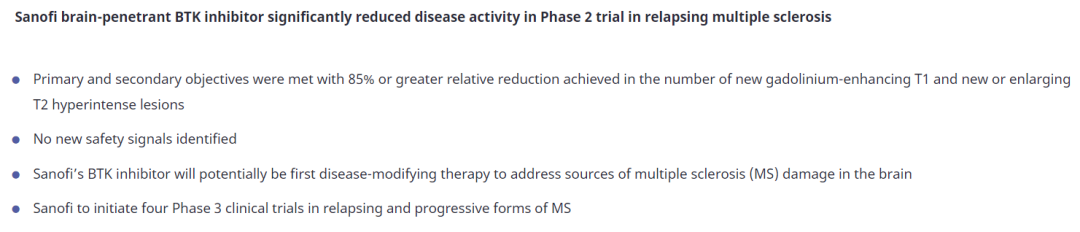
On April 23, Sanofi announced the Phase IIb study data of its oral BTK inhibitor SAR442168, which has strong brain penetrability, for the treatment of relapsing multiple sclerosis (MS).
This Phase IIb dose-ranging study employed a randomized, double-blind, placebo-controlled, crossover design. One cohort of patients (n=64) received SAR442168 at four different doses (5 mg to 60 mg) for 12 weeks, followed by a 4-week placebo period. The other cohort (n=66) received placebo for 4 weeks first, followed by SAR442168, to provide dose-response curves and simulate placebo exposure. The study used magnetic resonance imaging (MRI) to detect new brain lesions to assess the drug’s impact on MS disease activity.
Results from gadolinium-enhanced T1-weighted imaging at Week 12 demonstrated that SAR442168 reduced the number of brain lesions in a dose-dependent manner. The 60 mg treatment group achieved an 85% reduction in multiple sclerosis (MS) disease activity compared with the placebo group, thereby meeting the primary endpoint. Results from T2-weighted imaging showed that the 60 mg SAR442168 treatment group achieved an 89% reduction in MS disease activity compared with the placebo group, thereby meeting the secondary endpoint.
In terms of safety, the most common adverse events were headache (3%–13%), upper respiratory tract infection (3%–6%), and nasopharyngitis (3%–9%). Only one serious adverse event, a multiple sclerosis (MS) relapse, was reported within 12 weeks of SAR442168 treatment.
SAR442168 is a blood-brain barrier-penetrant BTK inhibitor with the potential to become the first therapy to improve brain injury in patients with this disease. Sanofi announced that it will soon initiate four Phase III clinical studies of SAR442168 in patients with relapsing multiple sclerosis (MS).
Multiple Sclerosis (MS) is an autoimmune disease that attacks the central nervous system. Despite the availability of numerous therapies, most patients still experience gradual disease progression, ultimately leading to disability. It is estimated that there are approximately 1.2 million MS patients in the United States and Europe, one-quarter of whom have relapsing MS. The global market for this disease exceeds €20 billion annually.