

Former VP of WeDoctor Launches PhilRivers Technology to Advance Computational Medicine with Supercomputing-Powered Life Information Engine

PHIL RIVERS
Medical Information Technology Service Provider
Zhao Yu posted on his WeChat Moments, marking his first public revelation of his “new battlefield” more than a year after leaving WeDoctor: PHIL RIVERS, an AI company incubated by the Institute of Computing Technology, Chinese Academy of Sciences, that builds a life data analytics platform.
Previously, Zhao Yu served as Vice President in charge of marketing and strategy at WeDoctor, with many years of deep engagement in the “Internet + Healthcare” sector. He believes that “healthcare is one of the largest application scenarios for artificial intelligence. With technological advancements, the volume of clinical data accumulated by humans is growing increasingly large; data generation, represented by genomics, is rising exponentially, data updates are accelerating, and the cost of data acquisition is decreasing. When faced with over 100 GB of data per individual, the cumulative data exceeds the petabyte (PB) level (1 PB = 106G), how we interpret this diverse, high-dimensional, massive, and heterogeneous information becomes critical." Ordinary small-scale computers can no longer meet the demands of such analysis and interpretation; PHIL RIVERS leverages models and supercomputing technologies to break through the bottlenecks in interpretation and cognition.
Based on this, PHIL RIVERS, in collaboration with the research team from the Institute of Computing Technology, Chinese Academy of Sciences, has taken the initiative as a national-level force to pioneer and advance computational medicine. Computational medicine is dedicated to developing quantitative methods that leverage mathematics, engineering, and computational science to intelligently elucidate the mechanisms of human diseases. It provides new insights for medical services by leveraging an industrialized framework encompassing data, algorithms, computing power, and biomedical technologies.
The concept of constructing digital human life to let data express the body's post-treatment responses is no longer a far-fetched idea but a tangible project being implemented by PHIL RIVERS. By using computers (supercomputers) to simulate information interactions within the human body, life becomes quantifiable into data, enabling the interpretation of human biological data. This data can then be applied to areas such as personal health management and new drug development by pharmaceutical companies.
Unlike evidence-based medicine and precision medicine, computational medicine is a novel concept that relies heavily on high-performance data analytics platforms and represents an emerging scientific discipline built upon supercomputing infrastructure. Computational medicine employs computational techniques as its primary methodology and medical issues as its guiding orientation to construct models of various life processes. It fully leverages accumulated biomedical knowledge to systematically elucidate the biological principles embedded within big biomedical data.
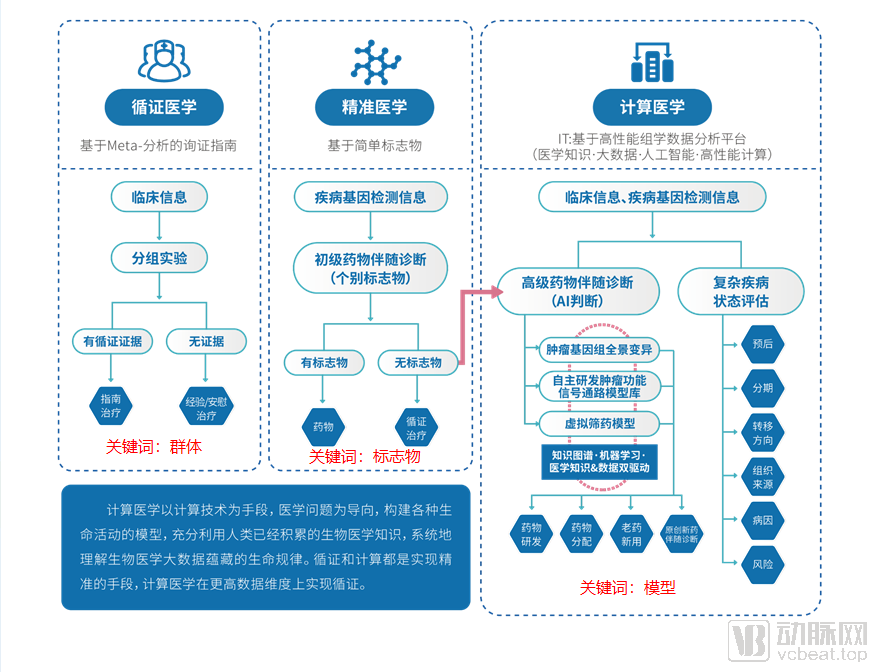
Comparison Diagram of Evidence-Based Medicine, Precision Medicine, and Computational Medicine (Image sourced from the official website)
Incubated by the Institute of Computing Technology, Chinese Academy of Sciences, with 20 years of experience: Computational Medicine Runs on Supercomputers
China’s achievements in supercomputing place the Institute of Computing Technology, Chinese Academy of Sciences (ICT, CAS) in the first tier. Professor Tan Guangming and Zhang Chunming are researchers at the institute with 20 years of experience in supercomputing. For many years, ICT, CAS has actively participated in national projects. To support the Human Genome Project, it developed genomics processing technologies and established computational and fusion models for genetic data. Building on this accumulated expertise, Professor Tan Guangming, a world-class scientist in the field of supercomputing and Director of the High-Performance Computer Research Center at ICT, CAS, led his team to propose the concept of computational medicine. ICT, CAS decided to commercialize its research outcomes by establishing a company, thus incubating Beijing PHIL RIVERS TECHNOLOGY Co., Ltd. (hereinafter referred to as “PHIL RIVERS”). The company aims to promote the social application of artificial intelligence in biomedical data processing, build a life information engine, and empower clinical practice.
In addition to Zhao Yu, a former executive at WeDoctor, who oversees the company’s commercialization efforts, PHIL RIVERS boasts formidable technical capabilities. Associate Researcher Zhang Chunming and Dr. Niu Gang form the core technical team at PHIL RIVERS. Dr. Niu currently serves as Director of the Turing-Darwin Laboratory and previously led the analysis of the world’s largest patient-derived cell (PDC) dataset for liver cancer.
Building a Life Information Engine to Become the “Intel Chip” of the Medical Industry, Empowering All Clinical Practices
“The most prominent feature of evidence-based medicine is that it reflects population-level characteristics, yet it can never determine the actual efficacy of a drug for any specific individual,” stated Zhao Yu, COO of PHIL RIVERS. “For instance, in determining oncology medication, approximately 25,000 genes are involved. In the classification and treatment selection for breast cancer, over 3,000 genes may be implicated. In current clinical practice, if a patient lacks identifiable biomarkers, even precision medicine offers limited solutions, ultimately reverting to evidence-based approaches.”Under the methodology of computational medicine, PHIL RIVERS no longer relies on a single gene as the key determinant of drug efficacy, nor is it confined to one-to-one causal relationships between targets and drugs. Instead, it adopts a systemic view of life. Ultimately, PHIL RIVERS can provide medication recommendations by leveraging high-performance computing to identify and prioritize novel drivers, while employing artificial intelligence for iterative algorithmic output. This approach explores the correlative relationships within the holistic biological system, thereby constructing a Life Information Engine.
According to Zhao Yu, the volume of data used to train this model has already exceeded the petabyte (PB) level (1 PB = 106G) The scale is such that each system iteration incurs electricity costs in the tens of millions. “The Life Information Engine is not a ‘mirage’; some of our achievements have already been clinically validated,” Zhao Yu told VCBeat.
Recently, PHIL RIVERS utilized TWIRLS, a subsystem of its Life Information Engine, to analyze over 14,000 coronavirus-related literature texts, comprising more than 3 million words. Without relying on any clinical resources, the system identified the potential mechanism by which the novel coronavirus triggers a "cytokine storm" within just four hours, thereby clearly pinpointing a new therapeutic target.
Coincidentally, one month later, the theoretical findings of this computational medicine approach were validated in a paper published on March 25 on the Research Square platform, with Professor Wang Chaofu from the Department of Pathology at Shanghai Ruijin Hospital and Academician Bian Xiuwu from the Chinese Academy of Sciences serving as corresponding authors. These results were further corroborated by subsequent retrospective studies conducted by Jiang Chengyu’s team at the Chinese Academy of Medical Sciences and Li Hongliang’s team at the School of Basic Medical Sciences, Wuhan University.
The Vital Information Engine can be vividly understood as the “Intel chip” of the medical community. In theory, it enables digital simulation and virtual drug testing for various specific diseases across the entire healthcare sector. Even when confronting challenging cancers, computational medicine demonstrates significant advantages.
The difficulty in curing tumors stems from the fact that cancer is not controlled by a single gene, but rather results from the combined effects of tens of thousands of genes. These genes undergo mutations and evolution within the body, and they do not act in isolation; instead, they form “populations” through signaling pathways to jointly accomplish specific tasks. Conquering cancer is akin to deciphering an extremely complex electronic circuit diagram, making it easy to imagine the immense challenge of achieving comprehensive cancer treatment through the regulation of individual genes.

A BBC documentary described cancer signaling pathways as "the most complex circuit diagram you have ever seen."
PHIL RIVERS leverages machine learning models to deeply interpret global genomic alterations in tumors, assess the activation status of tumor signaling pathways, and perform tasks such as tumor staging, identification of the primary tumor origin, and prediction of tumor progression. This technology assists physicians and patients in selecting targeted therapies, chemotherapy, and immunotherapies, while evaluating treatment efficacy. In particular, for challenging clinical scenarios—such as failure of first-line or multi-line therapies, lack of actionable drug targets from genetic testing, poor clinical response despite detected actionable mutations, and the development of drug resistance—PHIL RIVERS provides viable medication options and helps optimize subsequent clinical treatment plans, thereby enabling precise, end-to-end diagnosis and management of cancer.
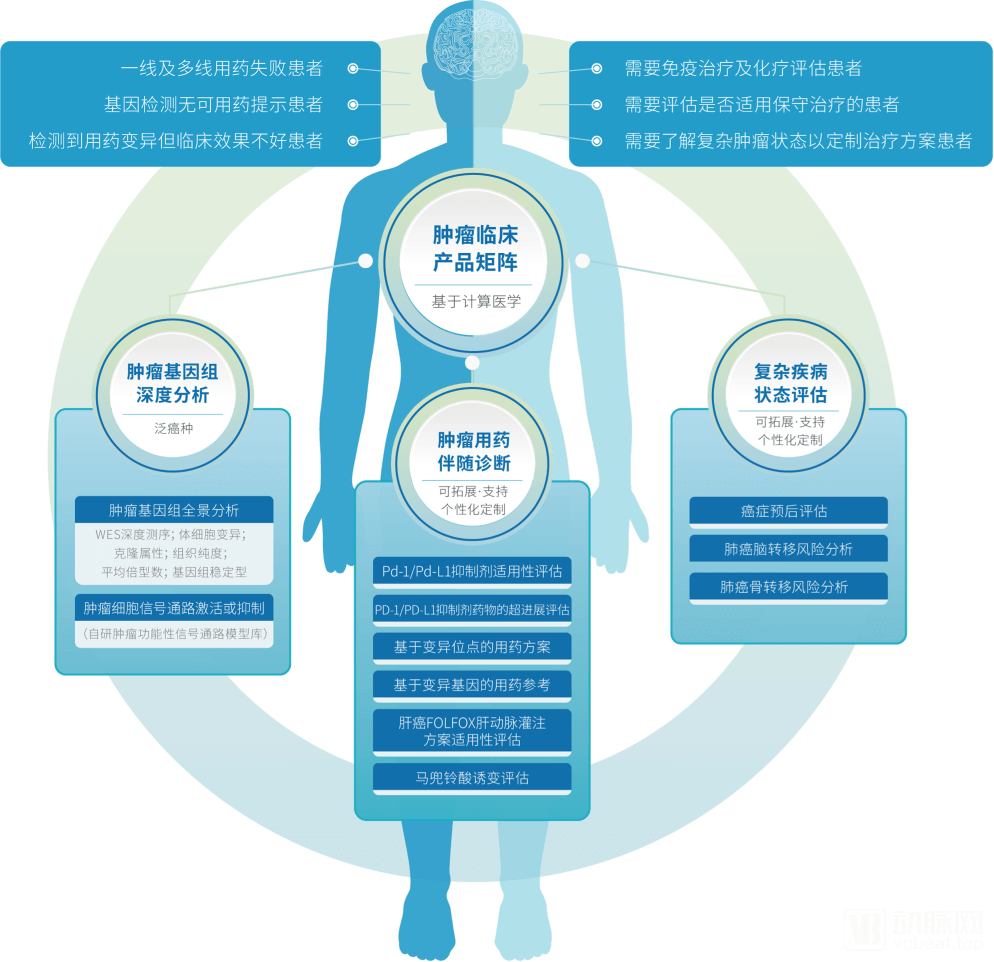
PHIL RIVERS' Oncology Clinical Products and Services
Currently, PHIL RIVERS has delivered multiple clinical products. In the field of clinical oncology, distinct from existing gene analysis approaches, PHIL RIVERS employs computational medicine methods to provide comprehensive medication recommendations for complex second- and third-line treatments of solid tumors, as well as for drug resistance and metastasis. This approach ensures no gaps in coverage and eliminates negative or inconclusive reports, achieving a clinical effective response rate of over 80%.
In Zhao Yu’s view, there is no such thing as a failed Phase III clinical drug trial. “Through computational medicine, we aim to match patients with suitable drugs in hospital settings. In collaborations with pharmaceutical companies, our goal is to match drugs with suitable patients—essentially giving drugs ‘eyes’ to identify the right patient population. PHIL RIVERS can help drugs that have failed in clinical trials find new indications, enabling pharmaceutical companies to recoup their substantial investment costs.”
“Under the computational medicine framework, we have proposed tumor treatment solutions for three healthcare scenarios: hospitals, internet-based healthcare, and third-party medical laboratories. However, we still hope that clinical medical scientists and pharmaceutical R&D teams will collaborate with us by bringing their specific challenges to our technology. We also aim to integrate our mature clinical oncology medication recommendation products into the product portfolios of various genetic testing companies,” appealed Zhao Yu. It is reported that the company has also launched a new round of financing, primarily intended to expand its scientific research team and advance multi-scenario product collaborations.