

Dynacure Secures €50 Million Series C Financing to Advance DYN101 for Centronuclear Myopathy
Andera Partners
Venture Capital Firms

Dynacure
Orphan Disease Treatment Technology R&D Developer

Pontifax
Israeli Venture Capital Firm
Perceptive Advisors
Private Hedge Fund Sponsor

Tekla Capital Management
Venture Capital Firm

Kurma Partners
Healthcare-Focused Venture Capital Firms
Large Venture
Venture Capital Fund
Recently, VCBeat learned thatFrench drug development company Dynacure has completed a €50 million Series C financing round. The round was led by Perceptive Advisors, with participation from new investors Bpifrance Large Venture and Tekla Capital Management, as well as existing investors Andera Partners, Kurma Partners, and Pontifax.
The proceeds from this financing round will be used to support its ongoing DYN101 program—the Phase 1/2 Unite-CNM study in patients with centronuclear myopathy.
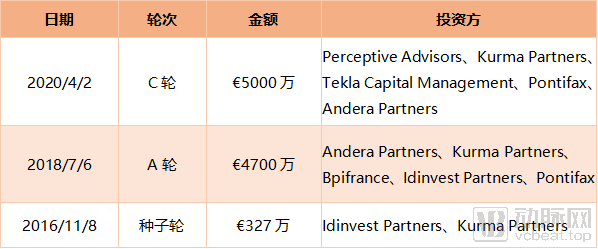
Dynacure's Previous Financing History
In recent years, as various countries have successively introduced new preferential policies for the research and development of orphan drugs to benefit patients with rare diseases, the promising prospects in this field have attracted a large number of established pharmaceutical companies and emerging drug development firms to engage in orphan drug research. Dynacure is one such emerging enterprise.
Dynacure, founded in 2016, is a spin-off from the French IGBMC (Institute of Genetics and of Molecular and Cellular Biology). Headquartered in Strasbourg, France, the company also maintains an office in Philadelphia, Pennsylvania, USA.Dynacure is a clinical-stage drug development company dedicated to improving the lives of patients with orphan diseases.
“Orphan diseases,” also known as rare diseases, are a category of conditions with extremely low incidence. Medications used to treat orphan diseases are referred to as orphan drugs. Although criteria for defining orphan diseases vary across countries based on national circumstances, there is a general consensus that they are diseases with a prevalence of less than 1 in 500,000 among adults or an incidence of less than 1 in 10,000 among newborns.Based on this definition, the estimated global number of patients with rare diseases has reached 300 million. In China, there are approximately 20 million patients with rare diseases, with over 200,000 new cases added each year.
Dynacure’s team leverages its expertise in orphan drug development to establish a new pipeline for drug discovery.In 2017, Dynacure partnered with Ionis Pharmaceuticals, a U.S. pharmaceutical company with years of focused research in the field of RNA-targeted therapeutics, to jointly develop the DYN101 program.
Stéphane van Rooijen is the Chief Executive Officer of Dynacure, with extensive experience in the life sciences sector across Europe and North America.Stéphane studied medicine at KU Leuven, where he earned his M.D., and later pursued business administration at Erasmus University Rotterdam and Georgetown University in Washington, D.C., obtaining an MBA.

Dynacure CEO:Stephane van Rooijen
Image source: Dynacure official website
Stéphane began his career as a strategic consultant at Arthur D. Little. After joining Genzyme Corporation to work in business development and finance, he became the Head of the European Cardiovascular Business Unit. In this role, he managed cross-functional business unit teams and early- and late-stage portfolios, launched new products, and oversaw profit and loss statements.
In 2012, Stephane joined Viropharma to lead the company’s flagship commercial initiative, Cinryze, an orphan drug for hereditary angioedema. In 2014, he founded Confo Therapeutics, a spin-off from VIB-VUB, serving as its Founder and CEO. He established the company, secured funding, recruited talent, and spearheaded business expansion to build a portfolio of drug development programs.
As a drug development company focused on orphan diseases, Dynacure has centered its flagship drug development project, DYN101, on centronuclear and myotubular myopathies (CNM).
Central Nemaline Myopathy (CNM) is named for the abnormal finding on muscle biopsy—nuclei located centrally within affected muscle fibers. The disease is driven by mutations in various genes, including MTM1, DNM2, and BIN1. Researchers at Dynacure have discovered that elevated levels of DNM2 are directly linked to the pathogenesis of this condition. CNM has multiple genetic forms, including X-linked recessive inheritance (XLCNM/myotubular myopathy), autosomal dominant inheritance (ADCNM), and autosomal recessive inheritance (ARCNM), all of which are associated with a poor prognosis.
Central Core Myopathy (CNM) is a rare, life-threatening genetic disorder that affects skeletal muscle growth from birth. The severity of its impact varies, with symptoms persisting from infancy through late adulthood. This condition significantly impairs patients' daily lives and work capabilities: weakness in the respiratory muscles necessitates ventilatory support; leg muscle weakness hinders ambulation, often requiring wheelchair use as the disease progresses; and esophageal muscle weakness causes dysphagia, necessitating reliance on gastric tubes to ensure adequate nutritional intake. These patients urgently require effective therapies to alleviate disease burden and improve quality of life.
DYN101 is an antisense oligonucleotide (ASO) therapy designed to modulate the expression of dynamin 2 (DNM2) for the treatment of CNM.This project is being co-developed in collaboration with the U.S. pharmaceutical company Ionis Pharmaceuticals, leveraging Ionis’ innovative antisense platform.
The lead compound developed by Dynacure utilizes antisense molecules to target the Dynamin-2 gene. When cells attempt to transmit RNA messages for protein synthesis, the antisense molecules bind to the RNA, blocking specific base pairs. This action partially inhibits the expression of the corresponding protein, ultimately altering the resulting protein or significantly reducing its yield.
Preclinical studies indicate that DYN101 has the potential to modify the disease course in centronuclear myopathy (CNM), demonstrating significant preclinical efficacy in animal models of X-linked centronuclear myopathy (XLCNM) and autosomal dominant centronuclear myopathy (ADCNM), with a clear dose-dependent improvement in systemic muscle strength and survival in mice.
Chief Executive Officer Stephane van Rooijen told Endpoints News in 2018, “Our animal data indicate that Dyn101 can halt disease progression and reverse the disease.”
The Dynacure team believes that antisense technology represents the optimal mechanism of action for treating CNM, given the ability of effective antisense drugs to modulate biological targets that are difficult to control in other rare diseases. Dynacure has demonstrated that DYN101 downregulates the expression of the dynamin 2 gene, leading to disease control and reversal in relevant mouse models. These mouse models indicate that a 50% reduction in dynamin protein levels is sufficient to effectively alleviate the disease.
Dynacure’s DYN101 development program is the only known initiative targeting the majority of patients with congenital neuromuscular disorders (CNM), including X-linked myotubular myopathy (XLMCM), autosomal dominant CNM (ADCNM), and autosomal recessive CNM (ARCNM). The project is also designed with a broad scope; in addition to investigating DYN101 for the treatment of CNM, Dynacure aims to expand the therapeutic indications for DYN101.
Leen Thielemans, Chief Development Officer at Dynacure, stated, “DYN101 holds the potential to make a significant impact on patients, and we believe it shows promise for the treatment of centronuclear myopathy. Furthermore, as we prepare to initiate the UNITE-CNM clinical study, we intend to expand the application of DYN101 to explore other indications where DNM2 overexpression serves as a disease driver.”
Currently, Dynacure’s DYN101 has been granted Orphan Drug Designation by the U.S. Food and Drug Administration (FDA) and the European Medicines Agency (EMA).
Decades ago, due to the extremely small number of patients with rare diseases and the exorbitant costs associated with developing treatments for these conditions, pharmaceutical companies and biotechnology firms were consistently unable to meet the needs of rare disease patients. Today, supported by relevant policies in various countries, this situation has improved significantly.
In the United States, prior to the implementation of the Orphan Drug Act (before 1983), only 38 drugs approved by the FDA were indicated for the treatment of rare diseases. Following the enactment of the Orphan Drug Act, from 1983 to 2018, the FDA approved 770 orphan drugs and granted approximately 4,860 orphan drug designations.Of the 49 innovative drugs approved by the FDA in 2019, 44% were indicated for orphan diseases; among the 11 innovative drugs approved from 2020 to date, five are orphan drugs.
The U.S. FDA Grants Orphan Drug Designation, Providing Significant Development Incentives for the Rare Disease Research Market, Such as Seven Years of Market Exclusivity Upon Drug Approval, Tax Credits for Clinical Trial Costs, Waiver of FDA User Fees, and Assistance from the FDA in Clinical Trial Design.
Products approved by the European Medicines Agency (EMA) with “orphan drug designation” will be eligible for up to ten years of market exclusivity in the European Union, qualify for protocol assistance, and have access to the EU’s centralized marketing authorization procedure.
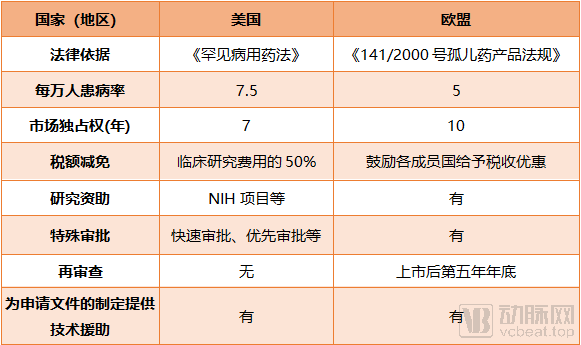
Preferential Measures for Orphan Drug Approval in the United States and the European Union
These government initiatives and enacted legislation have had a significant impact on the research and development of orphan drugs.In recent years, the research and development of drugs for rare diseases has become a primary battlefield in new drug development.
In 2018, the global market size for orphan drugs was $131 billion, growing rapidly at a compound annual growth rate (CAGR) of 12.3%. It is projected that by 2024, the market size for orphan drugs will reach $242 billion. The growth rate of the orphan drug market is twice that of the non-orphan drug market during the same period (6%). By 2024, the share of orphan drugs in the prescription drug market is expected to exceed 20% for the first time.
In April 2019, Dynacure received CTA approval to initiate the Phase 1/2 study “Unite-CNM” for DYN101.Unite-CNM (DYN101-C101) is a European, multicenter, dose-escalation study designed to evaluate the safety, tolerability, pharmacokinetics, and preliminary efficacy of DYN101 in patients aged approximately 16 years and older with X-linked centronuclear myopathy (XLCNM) or autosomal dominant centronuclear myopathy (ADCNM).
Although the primary focus of the Phase 1/2 study was to identify the optimal drug dose by assessing safety, tolerability, and other endpoints after 12 weeks of treatment, Dynacure is also exploring and analyzing multiple efficacy domains of DYN101.
Currently, in the Phase 1/2 “Unite-CNM” study, Dynacure announced that the first CNM patient has been treated with DYN101.One month after the first patient was dosed, on April 2, 2020, Dynacure announced that it had secured Series C financing to continue advancing the trial.
For a long time, China lacked statistical data and a catalog of rare disease types, as well as a clear definition of drugs for rare diseases, resulting in no rapid development in the registration and production of such medications. Since 2018, China has successively introduced relevant policies to support the research and development of drugs for rare diseases, accelerating the progress of related drug research.
In May 2018, five departments, including the National Health Commission, the Ministry of Science and Technology, and the Ministry of Industry and Information Technology, jointly issued the "First Batch of Rare Disease Catalog," which listed 121 diseases to strengthen national management of rare diseases; in February 2019, the state decided to implement tax reduction incentives for the first batch of 21 rare disease drugs and 4 active pharmaceutical ingredients.
Nowadays, the Chinese government has introduced policies in the field of rare disease drugs, including reducing import tariffs on rare disease medications, accelerating the review and approval process for these drugs, and incorporating them into the national medical insurance scheme. The implementation of these multiple policies has significantly alleviated the plight of rare disease patients who previously faced "no treatment available, no medication accessible, and no insurance coverage," boosted the confidence of domestic pharmaceutical companies, and encouraged more firms to increase their R&D investment in orphan drugs.
Currently, China has seen the emergence of rare disease drug R&D companies such as Canbridge Pharmaceuticals, InnoCare Pharma, and Beijing Kexin Bicheng.Among them, Canbridge Therapeutics has established an integrated platform for the research, development, and commercialization of rare disease drugs in China, facilitating the market launch of rare disease treatments in the country through strategies such as introducing foreign technologies and pursuing independent innovation.