

GSK's Niraparib Supplemental Application Approved by FDA, Expanding First-Line Maintenance Treatment to All Ovarian Cancer Patients Regardless of Biomarker Status

GSK
Pharmaceutical R&D Manufacturer

FDA
U.S. Food and Drug Administration
On April 29 local time, GSK announced that the U.S. Food and Drug Administration (FDA) had approved the supplemental New Drug Application (sNDA) for Zejula (niraparib), as a first-line monotherapy maintenance treatment for adult patients with advanced epithelial ovarian cancer, fallopian tube cancer, or primary peritoneal cancer who have achieved complete or partial response after first-line platinum-based chemotherapy.
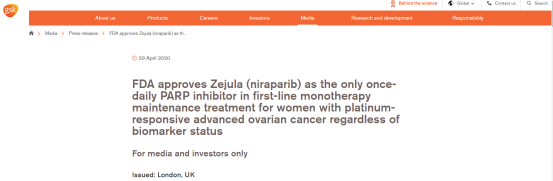
Zejula is an oral, once-daily poly(ADP-ribose) polymerase (PARP) inhibitor and the only oral monotherapy approved for first-line maintenance treatment regardless of patients’ BRCA mutation status.
Hal Barron, Chief Scientific Officer and President of R&D at GlaxoSmithKline PLC, stated, “The five-year survival rate for women with advanced ovarian cancer is less than 50%. Signs of an expanded indication for the drug mean that more women suffering from this devastating disease will be able to receive Zejula treatment earlier.”
The FDA approval was based on the results of the Phase III PRIMA study (ENGOT-OV26/GOG-3012), which were previously presented at the 2019 European Society for Medical Oncology (ESMO) Congress and published in The New England Journal of Medicine. The study enrolled patients with newly diagnosed advanced ovarian cancer who had achieved a complete or partial response to first-line platinum-based chemotherapy, regardless of their biomarker status. The PRIMA study included patients at high risk of disease progression, a population with significant unmet needs and limited current treatment options.
The primary endpoint of the PRIMA study was progression-free survival (PFS), with sequential testing in the homologous recombination deficiency (HRd) population and the overall population. Regardless of patients’ biomarker status, the PRIMA study demonstrated that first-line maintenance therapy with Zejula significantly improved PFS. Compared with placebo, Zejula reduced the risk of disease progression or death by 57% in the HRd population (HR 0.43; 95% CI, 0.31–0.59; p < 0.0001). In the overall population, Zejula reduced the risk of disease progression or death by 38% compared with placebo (HR 0.62; 95% CI, 0.50–0.76; p < 0.001). The PRIMA study results indicated that the safety profile of Zejula was consistent with previous clinical trials. The most common grade 3 or higher adverse events associated with Zejula included thrombocytopenia (39%), anemia (31%), and neutropenia (21%).
The prescribing information for Zejula in the United States has been updated. The individualized starting dose for first-line maintenance therapy is 200 mg or 300 mg once daily, based on the patient’s baseline body weight and/or platelet count during first-line maintenance therapy. The starting dose for recurrent ovarian cancer and subsequent lines of therapy is 300 mg once daily. Additionally, Zejula is not approved outside the United States for first-line maintenance therapy.
Reference Source: FDA Approves Zejula (niraparib) as the Only Once-Daily PARP Inhibitor in First-Line Monotherapy Maintenance Treatment for Women with Platinum-Responsive Advanced Ovarian Cancer Regardless of Biomarker Status

Responsible Editor: Squirtle
Disclaimer: The views expressed in this article are solely those of the author and do not represent the position of Yaozhi.com. Comments and supplementary information are welcome in the comment section. If reprinting, please be sure to cite the author and source.