

Big Pharma Q1 2020 Earnings Shake Up Rankings: Pfizer Dethroned, Merck Enters Top Three

MSD
Pharmaceutical R&D and Manufacturer
On the evening of April 28, Pfizer, Novartis, and Merck & Co. successively released their first-quarter 2020 financial reports. Under the shadow of the pandemic, this year is destined to be extraordinary.As for multinational pharmaceutical companies, their performance at the beginning of the year staged a drama of "throne succession."
01 Pfizer: Revenue Down 8% Amid Generic Drug Competition
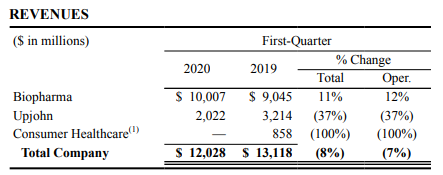
Pfizer's revenue in Q1 this year was $12.028 billion, a year-on-year decrease of 8%. Among them,Biopharmaceuticals revenue reached $10.007 billion, an 11% year-over-year increase; Upjohn business revenue was $2.022 billion, a 37% year-over-year decrease.; while the Consumer Health business has been excluded from total revenue starting this year.
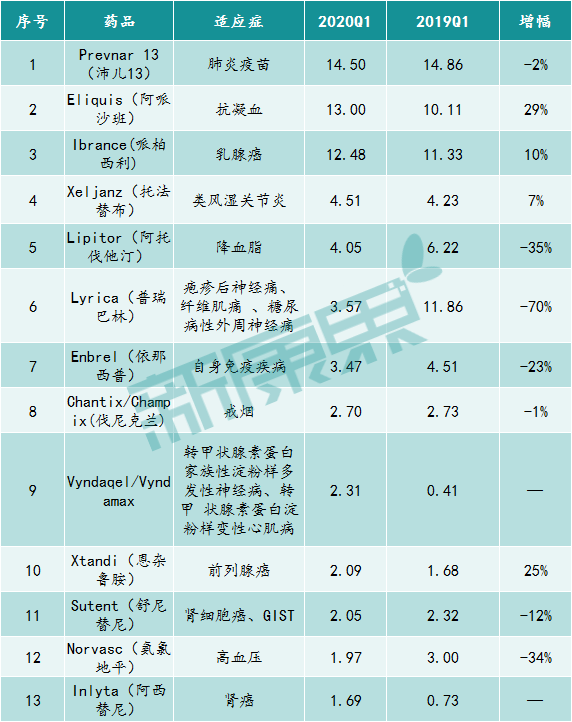
The biopharmaceutical segment was primarily driven by Eliquis, Vyndaqel/Vyndamax, Ibrance, and Inlyta.Eliquis generated sales of $1.3 billion, a 29% year-over-year increase, primarily driven by gains in market share for non-valvular atrial fibrillation (NVAF) treatment and oral anticoagulants. Notably, the drug demonstrated robust growth in emerging markets and the U.S. market, with respective increases of 44% and 34%. Sales of Vyndaqel/Vyndamax rose from $41 million in Q1 2019 to $231 million. This surge was attributable to two key factors: first, the drug’s rapid uptake following FDA approval in May last year for treating cardiomyopathy in adults with transthyretin-mediated amyloidosis (ATTR-CM); second, the expansion of its ATTR-CM indication in Japan in March last year, which fueled a 156% growth in international sales. Ibrance and Inlyta reported sales of $1.248 billion and $169 million, respectively, with both drugs achieving further market expansion through indication extensions.
In contrast to the growth of the biopharmaceutical business,Upjohn’s performance declined sharply, driven by generic competition for Lyrica in the United States and declining sales of Lipitor and Norvasc in the Chinese market (primarily due to the impact of centralized procurement).Among them, Lyrica's sales decreased from $1.186 billion to $357 million,Year-on-year decrease of up to 70%, was the drug with the greatest reduction.
In terms of clinical trials, due to the impact of the global pandemic, Pfizer suspended enrollment for certain ongoing global interventional clinical studies in late March and delayed the initiation of most new studies. In late April, Pfizer began resuming some clinical trial activities, restarting enrollment and launching new clinical studies where permitted by local governments or health authorities. However, the completion of some clinical trials may still be delayed.
02 Novartis: Revenue Up 11% Year-on-Year, Strong Performance in China
Novartis reported net sales of $12.283 billion in the first quarter of this year, representing an 11% year-over-year increase. Among these,Innovative medicines revenue reached $9.755 billion, a year-on-year increase of 11%; Sandoz revenue amounted to $2.528 billion, a year-on-year increase of 9%. Regionally, emerging markets saw a 14% revenue growth, with strong performance in China, which grew by 18% ($622 million). Additionally,Q1 net profit was $2.173 billion, a year-on-year increase of 22%.
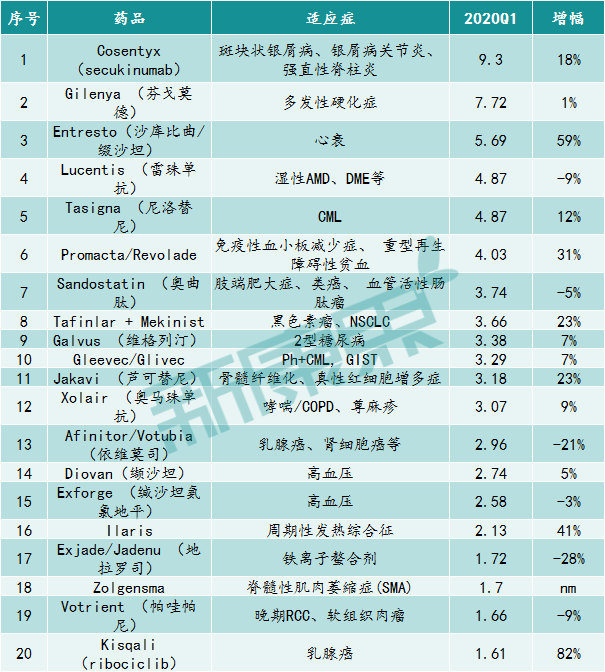
In the innovative drug sector, revenue from the pharmaceutical business division grew by 14%, primarily due toDriven by the sales growth of Entresto ($569 million, +59%) and Cosentyx ($930 million, +18%), as well as the increasing market acceptance of Zolgensma ($170 million),All three drugs have achieved substantial sales in the U.S. market. The Oncology business segment reported a 12% revenue growth, primarily driven by the continued strong performance of Promacta/Revolade ($403 million, +31%), Tafinlar + Mekinist ($366 million, +23%), and Kisqali ($161 million, +82%).
Sandoz’s business growth was primarily driven by long-term procurement of COVID-19-related medications. Net sales in markets outside the United States surged by 17%. Propelled by sustained double-digit growth in the European market, global biopharmaceutical sales rose to USD 450 million, representing a 31% year-over-year increase.
03 MSD: Keytruda Continues Strong Momentum, with a 45% Year-on-Year Growth
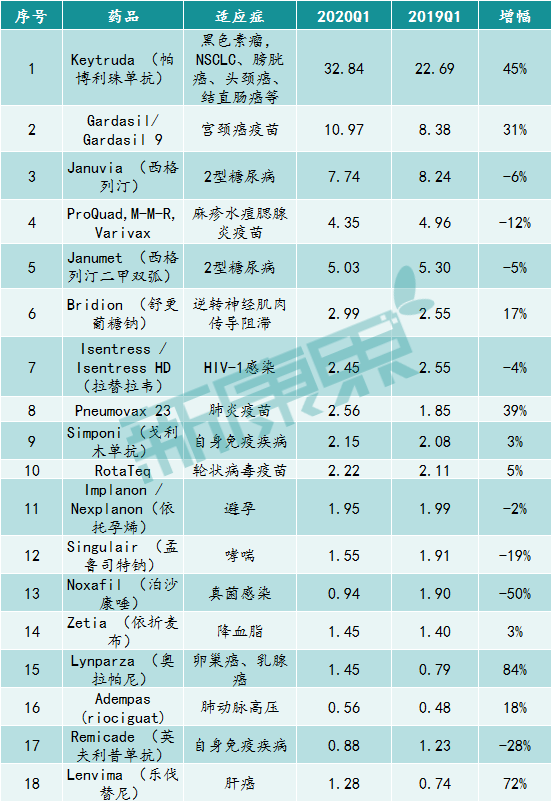
Merck & Co., Inc. reported first-quarter revenue of $12.057 billion this year, an 11% year-over-year increase. Of this, pharmaceutical sales amounted to $10.655 billion, up 11% year over year; animal health sales reached $1.214 billion, up 18% year over year. The most closely watchedKeytruda’s sales continued to surge, rising 45% to $3.284 billion, reflecting its strong market penetration in the non-small cell lung cancer (NSCLC) field.Of course, other indications such as renal cell carcinoma and melanoma also serve as a significant driver for its market expansion. Currently, Keytruda (K drug) has up to 1,200 clinical trials worldwide, exploring treatments for various types of cancer.
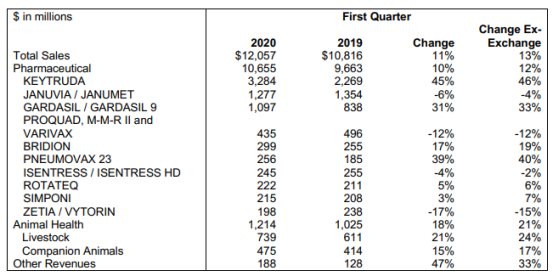
In addition to Keytruda, itsGardasil 9, the nine-valent HPV vaccine, also demonstrated strong growth momentum, with sales reaching $1.097 billion, a year-on-year increase of 31%.In addition, driven by the impact of the COVID-19 pandemic, demand for its 23-valent pneumococcal vaccine, Pneumovax 23, increased in the United States and Europe, with sales rising 39% to $256 million. In contrast, sales revenue from the measles, mumps, rubella, and varicella vaccine Varivax declined by 12%. Previously, MSD had projected that full-year 2020 sales of Varivax would be lower than the prior year, partly due to the timing of government tenders in Latin American markets and a reduction in measles outbreaks in the United States.
04 Revenue of Multinational Pharmaceutical CompaniesRankings Shift: The Pandemic’s Great Test Has Only Just Begun
Based on the Q1 reports released so far by multinational pharmaceutical companies, the ranking of MNCs by revenue in Q1 2020 has clearly changed. Johnson & Johnson and Roche have already announced their financial results for the first quarter of this year:Johnson & Johnson reported total revenue of $20.691 billion, with its pharmaceutical segment generating $11.134 billion, a year-on-year increase of 8.7%; Roche reported total revenue of CHF 15.143 billion, with its pharmaceutical segment amounting to CHF 12.262 billion ($12.6 billion, at an exchange rate of 1 Swiss franc = $1.0276), a year-on-year increase of 7%.. In addition to the above three companies, the top five enterprises by pharmaceutical business revenue are now largely confirmed.Rankings from highest to lowest are as follows:Roche, Novartis, Merck & Co., Pfizer, and Johnson & Johnson.
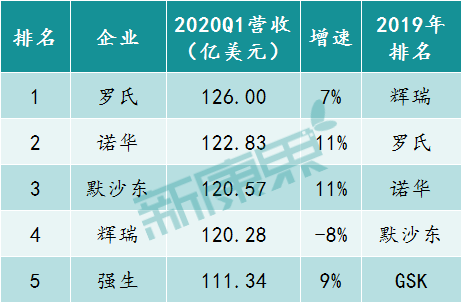
Pfizer has fallen from its throne, even dropping out of the top three, while Roche has risen to the top, with Novartis and Merck Sharp & Dohme (MSD) filling the vacancies. However, as GSK, which ranked fifth last year, has not yet released its performance results, there remains some uncertainty regarding the final lineup for the top five; GSK could emerge as a dark horse. In fact, Pfizer’s shift in ranking is hardly surprising, given that its revenue already showed signs of weakness in 2019, with a year-on-year decline of 4%. In contrast, companies like Roche and MSD achieved growth rates exceeding 10% during the same period, highlighting a stark divergence from Pfizer’s sluggish performance. In response, Pfizer is transforming into a smaller, more innovation-focused pharmaceutical enterprise. According to its financial reports, impacted by the COVID-19 pandemic, 2020 is expected to remain a transitional year for Pfizer.
The pandemic continues to spread globally. According to real-time statistics from Johns Hopkins University, as of 0:31 a.m. Beijing time on April 28, the global number of confirmed COVID-19 cases had surpassed 3 million, with deaths exceeding 200,000. For multinational pharmaceutical companies, the impact of the pandemic in the second quarter is likely to be greater than in the first quarter of this year; the true test has only just begun!
This article is published with authorization; the copyright belongs to the original author. The content represents the author’s independent views and does not reflect the position of EqualOcean. For reprint requests, please contact the original author.