

BMS and Acceleron's Reblozyl Receives Positive CHMP Opinion for Anemia in Beta Thalassemia and MDS
May 06, 2020 12:23
CST Updated
May 04, 12:23

Bristol-Myers Squibb
Biopharmaceutical and Nutritional Product R&D and Sales

Acceleron Pharma
Developer and Producer of Novel Biologic Therapeutics

European Medicines Agency
The European Medicines Agency (EMA) is a decentralized agency of the European Union (EU), located in London. It began operations in 1995. The agency is responsible for the scientific evaluation, supervision, and safety monitoring of medicines developed by pharmaceutical companies for use in the EU. By ensuring that all medicines available on the EU market are safe, effective, and of high quality, the EMA protects public and animal health in the 28 EU Member States and countries of the European Economic Area.

May 04, 2020 /BioonBIOON/ -- Bristol-Myers Squibb (BMS) and Acceleron Pharma recently announced jointly that the Committee for Medicinal Products for Human Use (CHMP) of the European Medicines Agency (EMA) has issued a positive opinion, recommending the approval of Reblozyl (luspatercept),For the treatment of beta-thalassemia in adult patientsAnemia(β-thalassemia) and anemia associated with myelodysplastic syndromes (MDS).Specifically: (1) for the treatment of transfusion-dependent anemia associated with β-thalassemia in adult patients; (2) for the treatment of transfusion-dependent anemia caused by myelodysplastic syndromes (MDS) in adult patients with very low-, low-, or intermediate-risk MDS who have ring sideroblasts (RS) on bone marrow smears and are unsuitable for or have an inadequate response to erythropoietin (EPO).
The CHMP opinion will now be submitted to the European Commission (EC) for review, which typically issues a final decision within two months. If approved, Reblozyl will become the first erythroid maturation agent authorized in the EU, representing a new therapeutic option for the treatment of anemia in eligible patients.
In the United States, Reblozyl was approved in November 2019 and April 2020, respectively: (1) for the treatment of anemia in adult patients with beta-thalassemia who require regular red blood cell transfusions; (2) for adult patients with very low- to intermediate-risk myelodysplastic syndromes with ring sideroblasts (MDS-RS) who have failed treatment with an erythropoiesis-stimulating agent, require ≥2 units of red blood cells (RBCs) within 8 weeks, and have ring sideroblasts (RS) present on bone marrow smears, or for patients with myelodysplastic/myeloproliferative neoplasms with ring sideroblasts and thrombocytosis.Tumor(MDS/MPN-RS-T) Adult patients, treatment of anemia.
Reblozyl is the first and onlyFDAApproved erythroid maturation agents represent a novel class of therapies that help reduce the burden of red blood cell transfusions in patients by modulating the late stages of erythroid maturation.
Notably, Reblozyl is the first drug approved by the FDA for the treatment of anemia associated with beta-thalassemia, and also the first in over a decade to receiveFDAApproved new treatment regimen for MDS patients who require red blood cell (RBC) transfusions and have failed treatment with one erythropoiesis-stimulating agent. It should be noted that Reblozyl is not indicated as a substitute for RBC transfusion in patients requiring immediate correction of anemia.
The efficacy and safety of Reblozyl in the treatment of β-thalassemia and MDS-associated anemia were confirmed in the pivotal Phase III BELIEVE and MEDALIST studies, respectively. The BELIEVE study was conducted in patients with transfusion-dependent β-thalassemia, and the MEDALIST study was conducted in patients with very low- to intermediate-risk MDS. Both studies met their primary endpoints and all key secondary endpoints. The results demonstrated that, compared with the placebo group, patients treated with luspatercept experienced a significant reduction in transfusion burden.
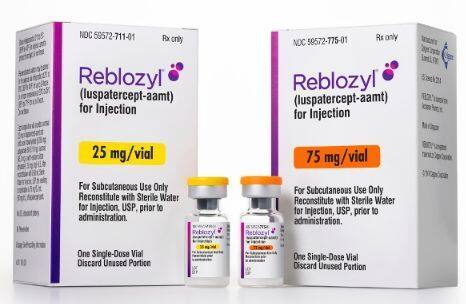
—BELIEVE is a randomized, double-blind, placebo-controlled, multicenter study conducted in adult patients with transfusion-dependent β-thalassemia who require regular red blood cell (RBC) transfusions (6–20 units of RBCs every 24 weeks, with no transfusion-free interval exceeding 35 days during this period). In the study, patients were randomly assigned to receive Reblozyl plus best supportive care (BSC) or placebo plus BSC. In this study, BSC included: RBC transfusions, iron chelation therapy, use ofAntibiotics, antiviral and antifungal therapy, and/or nutritional support as needed.
The results showed that the proportion of patients with a reduction in red blood cell (RBC) transfusion burden of >33% (a reduction of at least 2 units) from baseline during Weeks 13–24 was significantly higher in the Reblozyl treatment group than in the placebo group, thereby meeting the primary endpoint of the study. In addition, all key secondary endpoints were also met: the proportions of patients with a >33% reduction in RBC transfusion burden during Weeks 37–49, and those with a >50% reduction in RBC transfusion burden during Weeks 13–24 or Weeks 37–48, were all significantly higher in the Reblozyl treatment group than in the placebo group. In this study, the most common adverse events (any grade) with an incidence more than 5% higher in the Reblozyl treatment group than in the placebo group included: bone pain (19.7% vs 8.3%), dizziness (11.2% vs 4.6%),Hypertension(8.1% vs 2.8%), hyperuricemia (7.2% vs 0%).
——MEDALIST is a randomized, double-blind, placebo-controlled, multicenter Phase III study conducted in 229 patients with very low- to intermediate-risk myelodysplastic syndromes (MDS) to evaluate the efficacy and safety of luspatercept versus placebo for the treatment of anemia. These patients had ring sideroblasts (RS+), required red blood cell (RBC) transfusions, and had failed prior erythropoiesis-stimulating agent (ESA) therapy, were intolerant to ESAs, or were ineligible/unlikely to respond to ESA treatment. In the study, patients were randomized in a 2:1 ratio to receive either luspatercept (n=153; subcutaneous injection of 1.0–1.75 mg/kg body weight every 3 weeks) or placebo (n=76). The primary endpoint was achieving RBC transfusion independence (RBC-TI) for ≥8 consecutive weeks during Weeks 1–24 of the study. Key secondary endpoints included achieving RBC-TI for ≥12 consecutive weeks during Weeks 1–24 and during Weeks 1–48 of the study.
The results demonstrated that the study met its primary endpoint: a statistically significant higher proportion of patients in the luspatercept group achieved red blood cell transfusion independence (RBC-TI) for ≥8 weeks during the first 24 weeks of the study (Weeks 1–24) compared with the placebo group (38% vs. 18%, p<0.001). Furthermore, a greater proportion of patients in the luspatercept group achieved the key secondary endpoints compared with the placebo group (RBC-TI for ≥12 weeks during Weeks 1–24: 28% vs. 8%; RBC-TI for ≥12 weeks during Weeks 1–48: 33% vs. 12%; p<0.001 for both comparisons). The most common adverse events (any grade) associated with luspatercept in this study included fatigue, diarrhea, asthenia, nausea, and dizziness. The incidence of adverse events decreased over time.
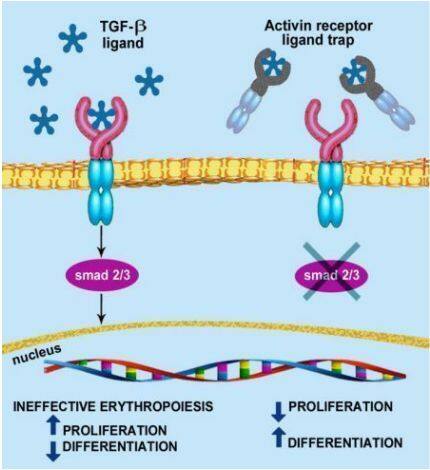
The active pharmaceutical ingredient of Reblozyl is luspatercept, a first-in-class erythroid maturation agent (EMA) that modulates late-stage erythrocyte maturation. This drug is a soluble fusion protein composed of the Fc domain of human IgG1 fused to the extracellular domain of the activin receptor type IIB (ActRIIB). Acting as a ligand trap, it selectively binds specific ligands of the transforming growth factor (TGF)-β superfamily involved in late-stage red blood cell (RBC) maturation, thereby reducing Smad2/3 signaling pathway activation, ameliorating ineffective erythropoiesis, promoting late-stage erythrocyte maturation, and increasing hemoglobin levels.
Luspatercept is being developed globally through a collaboration between Celgene (acquired by BMS) and Acceleron Pharma. Currently, both parties are also evaluating the potential of luspatercept for the treatment of erythropoiesis-stimulating agent (ESA)-naïve patients with lower-risk myelodysplastic syndromes (MDS) (Phase III COMMANDS study), non-transfusion-dependent β-thalassemia (Phase II BEYOND study), and myelofibrosis. The industry holds strong optimism regarding the commercial prospects of luspatercept. Late last year, EvaluatePharma released the report “Vantage 2019 Preview,” which highlighted the top 20 most valuable R&D projects worldwide, with luspatercept ranking 18th with a net present value (NPV) of $3.1 billion.
Previously, analysts at the prominent Wall Street investment bank Jefferies predicted that the annual peak sales of Reblozyl would reach $2 billion. (Bioon.com)
Original Source: Reblozyl (luspatercept) Receives Positive CHMP Opinion for the Treatment of Adults with Anemia in Beta Thalassemia and Myelodysplastic Syndromes