




On May 1, Janssen, a subsidiary of Johnson & Johnson, announced that the FDA had approved the new subcutaneous formulation of its CD38 monoclonal antibody drug daratumumab, Darzalex Faspro (daratumumab/hyaluronidase-fihj), for the following indications: 1) in combination with bortezomib, melphalan, and prednisone (D-VMP) for the treatment of newly diagnosed multiple myeloma (MM) patients who are ineligible for stem cell transplantation; 2) in combination with lenalidomide and dexamethasone (D-Rd) as first-line therapy for newly diagnosed MM patients ineligible for stem cell transplantation, and as second-line therapy for relapsed or refractory MM patients; 3) in combination with bortezomib and dexamethasone as second-line therapy for MM patients; and 4) as monotherapy for relapsed or refractory MM patients who have received at least three prior therapies, including a proteasome inhibitor and an immunomodulatory agent, or who are double-refractory to both a proteasome inhibitor and an immunomodulatory agent.
Darzalex Faspro is a fixed-dose combination comprising daratumumab and recombinant human hyaluronidase PH20 (rHuPH20), developed by Halozyme Therapeutics based on its Enhanze drug delivery technology. Compared with intravenous Darzalex, it reduces administration time from several hours to just 3–5 minutes. rHuPH20 decreases hyaluronic acid activity in the body, thereby facilitating the penetration and absorption of subcutaneously injected drugs. Previously, Roche collaborated with Halozyme Therapeutics to launch subcutaneous formulations of Herceptin SC and MabThera SC, and on February 25, submitted a marketing application for a fixed-dose combination subcutaneous injection of Perjeta/Herceptin.
This FDA approval was primarily based on data from the Phase III COLUMBA (MMY3012) study and the Phase II PLEIADES (MMY2040) study. In the Phase III COLUMBA study, 263 patients with relapsed or refractory multiple myeloma (MM) received monotherapy with Darzalex Faspro 1800 mg via subcutaneous injection. The dosing regimen consisted of once-weekly administration during Cycles 1–2 (with each cycle lasting 28 days), once every two weeks during Cycles 3–6, and once every four weeks from Cycle 7 onwards, continuing until disease progression. The median administration time was 5 minutes. Meanwhile, 259 patients with relapsed or refractory MM received monotherapy with Darzalex 16 mg/kg via intravenous infusion, following the same dosing schedule and frequency as the subcutaneous formulation. The median administration times for the different dosing frequency phases were 7.0 hours, 4.3 hours, and 3.4 hours, respectively.
The results showed that the overall response rate (ORR) in the Darzalex Faspro group was non-inferior to that of Darzalex (41% vs 37%), with similar pharmacokinetic and overall safety profiles, and a nearly two-thirds reduction in injection-related adverse events (13% vs 34%).
Darzalex Faspro will be officially commercially launched in the United States on May 11. To improve the accessibility of Darzalex Faspro, Janssen has introduced the “CarePath Program,” under which eligible patients pay no more than $5 per dose, regardless of their individual income level. Darzalex Faspro is the first subcutaneous CD38 monoclonal antibody approved globally, and a marketing application has also been submitted in Japan. The clinical trial application for this subcutaneous formulation was approved in China in August 2018.
The tumor cells in multiple myeloma (MM) originate from plasma cells in the bone marrow (the final functional stage of B lymphocyte development). MM is the second most common hematologic malignancy worldwide, with approximately 138,000 new cases diagnosed annually. In 2019, there were 32,000 new cases and 13,000 deaths from MM in the United States. The disease progresses relatively slowly, and numerous treatment options are available clinically; however, it remains difficult to cure. Clinically, MM is characterized by repeated relapses and remissions. After multiple lines of therapy, patients often exhaust all available treatment options, creating an urgent need for novel therapeutic agents.
The multiple myeloma (MM) drug market offers substantial growth potential, having fostered the emergence of several blockbuster agents, including bortezomib, lenalidomide, and pomalidomide. CD38 is consistently and highly expressed on the surface of myeloma cells across various developmental stages, while exhibiting relatively low expression levels in normal lymphocytes, myeloid cells, and certain non-hematopoietic tissues. This differential expression profile establishes CD38 as an effective therapeutic target for the treatment of myeloma.
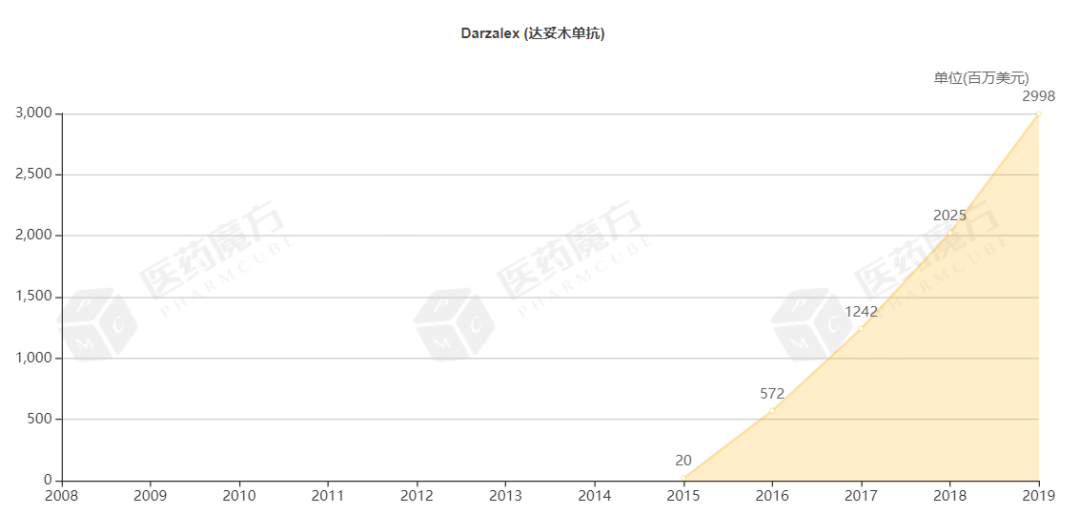
Johnson & Johnson’s daratumumab is the first CD38 monoclonal antibody approved globally. Initially authorized as a fourth-line therapy, it has progressively advanced to become a first-line clinical treatment and is now regarded as a cornerstone drug in the clinical management of multiple myeloma (MM). Darzalex has not only enabled Johnson & Johnson to maintain its leadership position in the MM market but also, together with ibrutinib, has driven the growth of the company’s oncology business. In 2019, global sales of Darzalex reached $2.998 billion, with first-quarter 2020 revenue amounting to $937 million, representing a 49% year-over-year increase.
The approval of the subcutaneous formulation of Darzalex Faspro provides Johnson & Johnson with an additional market tool to counter the competitive impact of Sanofi’s new CD38 antibody, isatuximab. On March 2 this year, Sanofi’s Sarclisa (isatuximab) received FDA approval, in combination with pomalidomide and dexamethasone, for the treatment of adult patients with multiple myeloma, becoming the second CD38 monoclonal antibody marketed globally.