

Top Chinese Executive at GE Departs Amid Broader Wave of Layoffs and Leadership Changes in Multinational Pharma

GE Healthcare
Digital Solution Provider
“The COVID-19” pandemic has gradually receded, yet the challenges facing multinational pharmaceutical companies in China remain unresolved. Amidst the wave of resignations and layoffs, executives and employees of foreign pharmaceutical firms are confronting a new market landscape in China, where they are subject to selection and must also make their own choices.
Duan Xiaoying, who served at GE for 24 years, has stepped down; Guo Anfeng, Vice President of the Oncology Business Unit at BMS, has also left his position less than three months after an internal transfer...
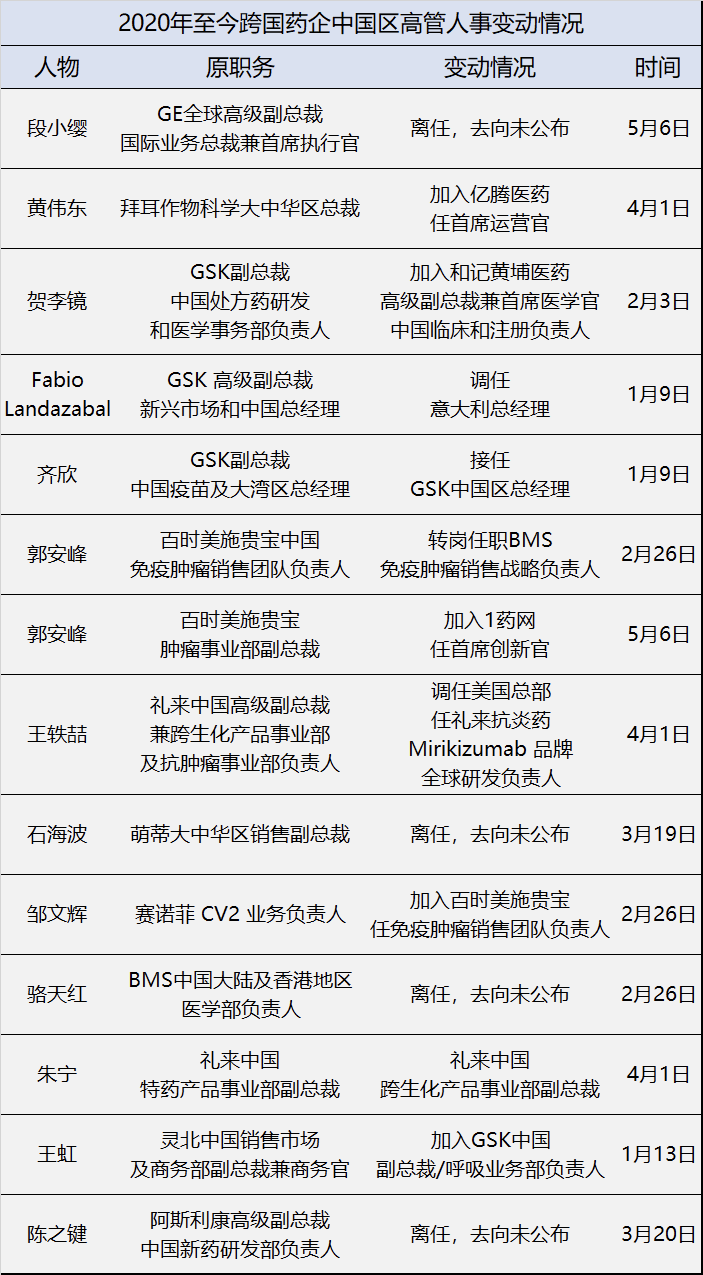
Recently, multiple pieces of information involving senior executives of foreign pharmaceutical companiesPersonnel ChangesNews has emerged successively, along with layoff compensation plans from several multinational pharmaceutical companies. According to incomplete statistics by E-Pharma Manager, since the beginning of 2020, there have been more than 10 cases of executive personnel changes involving multinational pharmaceutical companies. At least three multinational pharmaceutical companies have announced structural adjustments and even layoff arrangements.
Clearly, foreign pharmaceutical companies did not have an easy time in 2020.
The External Environment Facing Foreign Pharmaceutical Companies Is Undergoing Intensified ChangesForeign pharmaceutical companies are facing mounting pressure across both mature and innovative drug portfolios. Amid the dual pressures of national medical insurance negotiations and volume-based procurement, companies have begun implementing layoffs to enhance efficiency; recently, multiple foreign firms, including AbbVie and Merck & Co., announced severance packages. The path for innovative drugs has also been far from smooth: most of the executives who spearheaded the commercialization of Keytruda and Opdivo have departed, while other senior executives who joined local pharmaceutical companies struggled to adapt and have recently announced their resignations. According to public announcements by listed companies, Hequn Yin, Senior Vice President of Fosun Pharma, resigned for personal reasons, just over a year after assuming the role in February 2019 from his previous position as Vice President of R&D at Pfizer.
These personnel changes are not isolated incidents. What are managers and employees at foreign pharmaceutical companies in China currently experiencing, and what will they face in the future? Valuable insights can be gleaned from these staffing shifts.
Escaping the GE Crisis, Returning to Pharmaceuticals
On May 6, GE announced that Duan Xiaoying, current Senior Vice President of GE globally, President and CEO of International Operations, who has served at GE for 24 years, will soon depart.
Notably, in February 2019, Duan Xiaoying was promoted to President and Chief Executive Officer of GE International. In this role, her responsibilities extended beyond the China market and were not limited to the healthcare business.
Following this departure, the role of President and CEO of GE International will be assumed on an interim basis by Nabil Habayeb, President and CEO of GE Middle East. Xiang Weiming, current President of GE Aviation Greater China, will succeed Duan Xiaoying as the new President of GE China, reporting to Nabil Habayeb. These appointments became effective on June 1.
This means that the international influence within GE’s global system, which Chinese professional managers had gained through promotions, will be withdrawn along with Duan Xiaoying’s departure.
Since 2018, GE’s overall performance has remained sluggish, with healthcare being a relatively robust growth segment.
Annual report data shows that GE Group’s net profit was negative in both 2018 and 2019, amounting to -$22.802 billion and -$5.439 billion, respectively. Meanwhile, its operating revenue declined year-on-year by 0.39% in 2018 and by 21.71% in 2019. In contrast, GE Healthcare achieved a net profit of $3.7 billion in 2018, with its operating revenue increasing by 4% year-on-year during the same period.
Duan Xiaoying’s previous promotion within GE’s global system carried strong overtones of a “firefighting” move. During her nine-year tenure leading GE Healthcare China, the company’s order volume in China grew from $900 million to $2.9 billion, suggesting that her elevation aimed to replicate the success of GE Healthcare in other markets.
However, after her promotion, GE adopted a simpler and more direct approach to managing its healthcare business. In 2018, there were reports that GE Healthcare would be spun off and listed separately, but the plan ultimately did not materialize. On March 31, 2020, GE Healthcare directly sold its life sciences business, which was part of the healthcare segment, to Danaher for a pre-tax price of $12.3 billion.
Xiaoying Duan’s next move after leaving GE has not yet been announced, but she is likely to return to the pharmaceutical business, with which she is most familiar. Shortly before the announcement of her departure, Duan was just approved for appointment as a new independent director at Sanofi’s annual general meeting held on April 28.
The pressure stemming from global business architecture restructuring is not a challenge faced solely by professional managers at GE. Recently, Pfizer has completed the spin-off of its established pharmaceuticals and innovative medicines businesses; Merck & Co. and GSK have both announced spin-off decisions; Bristol Myers Squibb’s acquisition of Celgene has been completed; and AbbVie’s acquisition of Allergan is currently underway.
Following these spin-offs or acquisitions, business architecture restructuring and workforce reductions to enhance efficiency are inevitable. For Chinese professional managers at multinational pharmaceutical companies, these changes mean at least unchanged performance targets alongside reduced human, financial, and material resources. For frontline Chinese employees at these multinational pharmaceutical firms, they may become targets for layoffs. These shifts in the external environment warrant serious attention.
Keytruda and Opdivo “First-Generation” Drugs Have All Departed
Yesterday, another piece of news about personnel changes also circulated within the pharmaceutical industry.
On May 6, 111 Inc., a NASDAQ-listed internet healthcare company, announced the appointment of Guo Anfeng, former Vice President of the Oncology Business Unit at Bristol Myers Squibb, as Chief Innovation Officer. He will be fully responsible for the operation and innovation of the company’s internet healthcare platform.
Just a few months ago, on February 26, Bristol Myers Squibb announced a change in the leadership of its China Immuno-Oncology Sales Team. Zou Wenhui, formerly the head of Sanofi’s CV2 business, succeeded Guo Anfeng as the Head of the China Immuno-Oncology Sales Team, while Guo Anfeng transitioned to the role of Head of Immuno-Oncology Sales Strategy.
The announcement of 1 Drug Network’s latest appointment signifies that Guo Anfeng has completely bid farewell to the “O Drug” sales team and entered the new realm of internet-based pharmaceuticals.
PD-1 Inhibitors See Booming Performance in China: Keytruda’s First-Year Sales Surpass RMB 2 Billion, Yet Keytruda and Opdivo Face Challenges of Commercial Talent Attrition Amid Competition from Domestic Innovative Pharmaceutical Companies
Guo Anfeng’s decision to leave Bristol Myers Squibb to join 1 Drug Network is not an isolated case. On February 26, Bristol Myers Squibb announced not only a change in the head of its immuno-oncology sales team but also the departure of Luo Tianhong, head of the Medical Affairs Department for Mainland China and Hong Kong.
Notably, as early as December 6, 2019, Zhao Ping, who had previously served as General Manager for Mainland China and Hong Kong at Bristol-Myers Squibb (BMS) and spearheaded the launch of Opdivo in China, announced her joining of CStone Pharmaceuticals, a domestic innovative biopharmaceutical company, as General Manager for Greater China and Head of Commercialization. Prior to this, on December 2, Chen Siyuan, former Vice President and Head of the Respiratory and HIV Business Unit at GSK, joined Bristol-Myers Squibb as General Manager for Mainland China and Hong Kong.
With this, the commercialization team for Opdivo in China has been completely reshuffled. Not only Opdivo, but Keytruda’s commercial operations and team are also facing a major restructuring. On March 16, 2020, MSD China announced that Yanping Mu, head of its Oncology Business Unit, had decided to leave the company. During her three-year tenure as head of MSD China’s Oncology Business Unit, Ms. Mu built and managed the Keytruda sales team, helping MSD China achieve oncology sales exceeding USD 500 million in 2019.
Shortly after her departure, on March 26, Shanghai Ailis Pharmaceutical announced the appointment of Mou Yanping as Chief Executive Officer, with full responsibility for the company’s business operations. On April 17, Shanghai Ailis Pharmaceutical submitted its initial public offering application to the STAR Market.
Changes in the commercialization teams for Keytruda and Opdivo are typical examples. Although both drugs have promising commercial prospects, they face intense competition from domestic pharmaceutical companies. Due to the constraints of multinational corporations’ compensation structures, the professional managers responsible for Keytruda and Opdivo cannot receive further incentives. Consequently, moving to pharmaceutical companies listed on the STAR Market or the Hong Kong Stock Exchange undoubtedly offers more direct performance-based incentives.
In fact, not only PD-1-related pharmaceutical companies, but also many domestic innovative drug enterprises such as CStone Pharmaceuticals, Hutchmed, Henlius, and Zelixir Pharmaceuticals have announced plans to establish their own commercialization teams and have already entered the recruitment process. This will undoubtedly create competitive pressure on talent for foreign pharmaceutical companies that are just launching innovative drugs in China.
Foreign Executive"Acclimatization Issues"
Also on May 6, Fosun Pharma announced the resignation of senior executive Yin Hequn from his positions as Senior Vice President and Dean of the Central Research Institute. Mr. Yin had served as Senior Vice President of Fosun Pharma since February 11, 2019, and prior to that, he was Vice President of R&D at Pfizer for two years. In the ten years before joining Pfizer, Mr. Yin held various roles at Novartis, including R&D Scientist, Director, Senior Director, and Executive Director.
Previously, when assuming his new role at Fosun Pharma and discussing his career in an interview, Yin Hequn stated, “I believe I can continue working for at least another 20 years.” Ultimately, however, Yin Hequn chose to leave Fosun Pharma just over a year after joining.
Although it is no longer uncommon for executives from foreign companies to join domestic pharmaceutical firms, cases of cultural and operational misfit still persist. On July 6, 2019, after a brief tenure at Ascletis Pharma, Li Zhengqing returned to Merck & Co. to serve as Vice President of Merck Research Laboratories China.
Kerry Blanchard, who previously served as the head of R&D at Eli Lilly China, left Innovent Biologics after a brief stint and became the CEO of Everest Medicines, a company established by CMB Capital.
How to Retain Executive Talent? It poses a significant challenge for both multinational and domestic pharmaceutical companies. For executives from multinational corporations, the primary hurdle lies in overcoming "cultural maladaptation" and adapting to environments outside the multinational corporate system.
Announcing their resignations on the same day, the three individuals share a significant commonality: all possess extensive professional backgrounds and experience in multinational pharmaceutical companies. However, the circumstances they face and the choices they make differ considerably.
Duan Xiaoying’s previous promotion within GE’s global system carried strong overtones of a “firefighting” move, while her departure followed the restructuring of multinational pharmaceutical companies’ global architectures, marking a return to the core pharmaceutical business. Guo Anfeng’s choice reflects that of many current...Multinational Pharmaceutical CompaniesExecutives have chosen career paths that involve joining domestic pharmaceutical companies. Yin Hequn, however, somewhat represents the “counter-current” of this trend, as there are many cases of executives from foreign pharmaceutical companies who joined local firms only to leave due to poor adaptation.
The resignations of these three individuals are not isolated incidents. Recently, foreign pharmaceutical companies have faced significant personnel changes, affecting both senior executives and frontline employees, with multiple firms announcing layoff plans. For instance, recent reports indicate that AbbVie is laying off its hepatitis C drug representatives due to a substantial loss in competitive advantage, as competing products were included in the National Reimbursement Drug List (NRDL) while AbbVie’s products were not. Details of the severance package have also been leaked.
As the epidemic gradually winds down in China, the crisis for foreign pharmaceutical companies has not yet abated. Both executives and frontline employees are being selected by the environment and must also make choices in this challenging context.
Appendix: Table of Personnel Changes at Foreign Pharmaceutical Companies Since 2020 (Compiled by E-Drug Manager Based on Publicly Available Information):
This article is published with authorization; the copyright belongs to the original author. The content represents the author’s independent views and does not reflect the position of YiOu. For reprint requests, please contact the original author.