


On May 15, the National Medical Products Administration officially accepted the marketing authorization application for satralizumab, a therapeutic drug for neuromyelitis optica spectrum disorder (NMOSD), a rare disease.
Satralizumab is a humanized IgG2 monoclonal antibody utilizing SMART™ recycling technology, targeting the interleukin-6 (IL-6) receptor. By blocking IL-6 signal transduction, it modulates multiple pathways involved in the pathogenesis of neuromyelitis optica spectrum disorder (NMOSD), such as inhibiting the production of NMOSD-specific aquaporin-4 immunoglobulin G (AQP4-IgG) antibodies and suppressing inflammatory responses both within and outside the central nervous system [1-7]. At acidic pH, satralizumab dissociates from its receptor and is released back into the plasma, where it can bind to additional antigens, thereby prolonging the drug’s plasma half-life [1-2].
Innovative Drugs Seek Market Approval in Multiple Regions
Neuromyelitis Optica Spectrum Disorder (NMOSD) is an autoimmune disease of the central nervous system characterized by high relapse rates and significant disability. In May 2018, it was included in the National List of 121 Rare Diseases, with a prevalence of approximately (1–5)/100,000 person-years [8-9]. Approximately 60% of patients experience a relapse within one year, and 90% relapse within three years [8]. The degree of disability in NMOSD patients worsens with an increasing number of relapses [10]. Five years after disease onset, approximately 50% of patients require a wheelchair, and 62% become blind [11].
Roche has submitted marketing authorization applications for satralizumab in 13 countries and regions worldwide, including China. Notably, satralizumab received Breakthrough Therapy Designation (BTD) from the U.S. Food and Drug Administration (FDA) in December 2018, and its marketing application was submitted in August 2019 [12]. In addition, satralizumab was granted orphan drug designation by the European Medicines Agency (EMA) in June 2016, with the marketing application submitted in August 2019 [13]. The marketing application for satralizumab in Japan was submitted in November 2019, where it received orphan drug designation and priority review status [14].
Positive and Effective Clinical Study Data
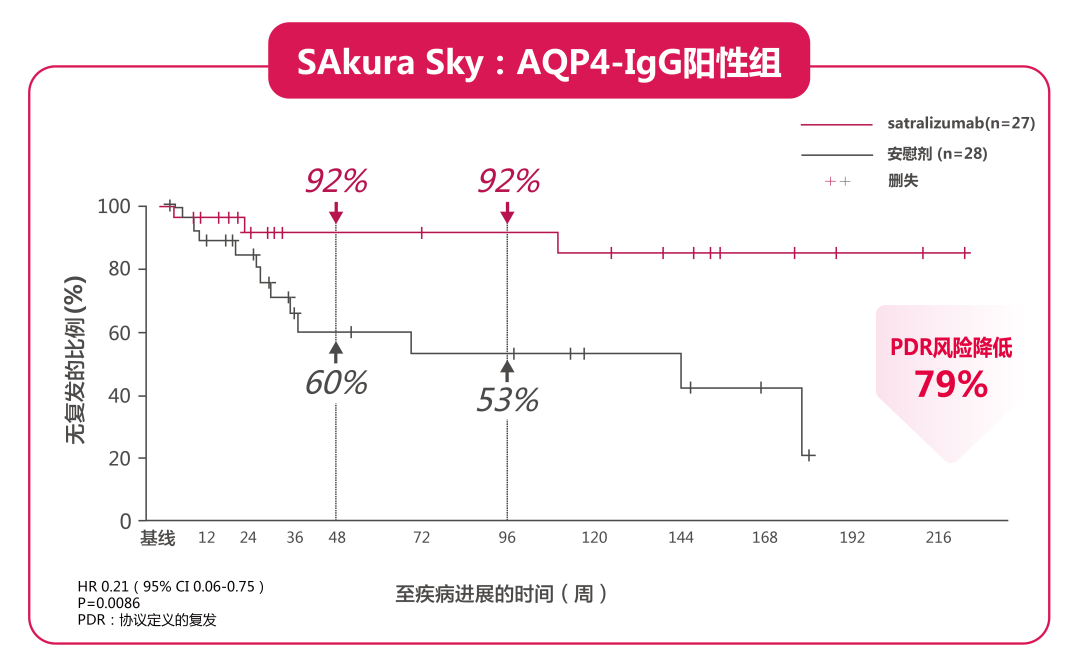
Two global, multicenter, Phase III clinical trials of satralizumab in patients with neuromyelitis optica spectrum disorder (NMOSD) have been conducted, evaluating its use in combination with immunosuppressants and as monotherapy, respectively. The SAkuraSky study[15] (satralizumab combined with immunosuppressants), published in The New England Journal of Medicine in 2019, aimed to assess the efficacy and safety of satralizumab plus immunosuppressants for NMOSD. Data showed that among AQP4 antibody-positive patients (n=55), the proportions of relapse-free patients in the satralizumab group were 92%, 92%, and 85% at 48, 96, and 144 weeks, respectively. The recently published SAkuraStar study[2] (satralizumab monotherapy) in The Lancet Neurology also yielded positive results: during the double-blind period, satralizumab reduced the risk of relapse by 74% compared with placebo in AQP4 antibody-positive patients (HR=0.26 [95% CI: 0.11–0.63]). Both studies confirmed the safety profile of satralizumab, with no significant difference in the risk of serious infections compared to placebo, and no cases of severe allergic reactions or deaths reported.
References:
[1] Kaplon H, Reichert JM. MAbs. 2019 FebMar;11(2)219-238.
[2] Traboulsee A, et al. Lancet Neurol. 2020;19(5):402-412.
[3] Uzawa A, et al. Mult Scler. 2010 Dec;16(12):1443-52.
[4] Ringelstein M, et al. JAMA Neurol. 2015 Jul;72(7):756-63.
[5] Içöz S, et al. Int J Neurosci. 2010 Jan;120(1):71-5.
[6] Kong BS, et al. J Neuroinflammation. 2017 Sep 25;14(1):191.
[7] Tanaka T, et al. Cold Spring Harb Perspect Biol. 2018 Aug 1;10(8). pii: a028456.
[8] Neuroimmunology Branch of the Chinese Society of Immunology. Chinese Journal of Neuroimmunology and Neurology, 2016, 23(3):155-166.
[9] National Health Commission of the People's Republic of China. Guidelines for Diagnosis and Treatment of Rare Diseases (2019 Edition).
[10] Wingerchuk DM, et al. Lancet Neurol. 2007 Sep;6(9):805-15.
[11] Kessler RA, et al. Neurol Neuroimmunol Neuroinflamm 2016;3:e269.
[12] Chugai’s Satralizumab Receives FDA Breakthrough Therapy Designation for Neuromyelitis Optica and Neuromyelitis Optica Spectrum Disorders.
[13] Roche’s marketing applications for satralizumab in neuromyelitis optica spectrum disorder accepted for review by EMA and FDA. roche. 30 October 2019.
[14] Chugai Files a New Drug Application for Satralizumab for NMOSD in Japan, Following the United States and Europe. chugai-pharm. Nov 08, 2019.
[15] Yamamura T, et al. N Engl J Med. 2019;381(22):2114-2124.