

BMS’s Opdivo + Yervoy Receives FDA Approval as First-Line Immune Therapy for NSCLC, Marking Fifth Indication with Significant Survival Benefit
May 17, 2020 15:45
CST Updated
15:45
Bristol-Myers Squibb
Biopharmaceutical and Nutritional Product R&D and Sales
FDA
U.S. Food and Drug Administration

May 17, 2020 /Bio ValleyBIOON/ -- Bristol-Myers Squibb (BMS) recently announced that the U.S. Food and Drug Administration (FDA) has approved the combination therapy of the anti-PD-1 agent Opdivo (Opdivo, generic name: nivolumab) at 3 mg/kg and the anti-CTLA-4 agent Yervoy (ipilimumab) at 1 mg/kg for first-line treatment of patients without EGFR or ALK genomic tumor aberrations,TumorPatients with metastatic non-small cell lung cancer (NSCLC) expressing PD-L1 (≥1%).
Opdivo + Yervoy (the OY combination) is the first and only dual immunotherapy approved by the U.S. FDA. This approval also marks the fifth indication for the OY combination to receive regulatory approval in the United States. The two therapies in the Opdivo + Yervoy combination have potential synergistic mechanisms of action, targeting two distinct immune checkpoints (PD-1 and CTLA-4) and functioning in a complementary manner. To date, the Opdivo + Yervoy combination has been approvedFDAApproved for the treatment of five types of cancer (Melanoma, renal cell carcinoma, colorectal cancer, hepatocellular carcinoma, non-small cell lung cancer).
This approval is based on the results from Part 1a of the Phase III CheckMate-227 trial. This was a global, multi-part, open-label, randomized trial conducted in patients with Stage IV or recurrent NSCLC who had not previously received chemotherapy (chemotherapy-naïve). The study comprised two parts: (1) Part 1: Part 1a compared Opdivo (3 mg/kg) plus Yervoy (1 mg/kg), Opdivo monotherapy, and chemotherapy in patients whose tumors expressed PD-L1; Part 1b compared Opdivo plus Yervoy, Opdivo plus chemotherapy, and chemotherapyTumorPatients not expressing PD-L1; (2) Part 2: Comparison of Opdivo in combination with chemotherapy versus chemotherapy, regardless of PD-L1 expression.
Results from Part 1a showed that in patients with NSCLC whose tumors expressed PD-L1 ≥1% receiving first-line treatment (regardless ofTumorHistology), with a minimum follow-up of 29.3 months, the Opdivo + Yervoy group (n=396) demonstrated superiority in overall survival (OS) compared to the chemotherapy group (n=397) (median OS: 17.1 months vs. 14.9 months; HR=0.79, 95% CI: 0.67-0.94, p=0.0066). In this trial, the 1-year survival rates for the Opdivo + Yervoy group and the chemotherapy group were 63% and 56%, respectively; the 2-year survival rates were 40% and 33%, respectively; and the 3-year survival rates (at a median follow-up of 43.1 months) were 33% and 22%, respectively.
Based on the assessment by blinded independent central review (BICR) with a minimum follow-up of 28.3 months, the confirmed overall response rate (ORR) in the Opdivo + Yervoy group was 36% (complete response [CR] = 5.8%, partial response [PR] = 30.1%), and the confirmed ORR in the chemotherapy group was 30% (CR = 1.8%, PR = 28.2%). Among patients who achieved a response, the median duration of response (DOR) was 23.2 months (95% CI: 15.2–32.2) in the Opdivo + Yervoy group and 6.2 months (95% CI: 5.6–7.4) in the chemotherapy group. Both ORR and DOR were prespecified descriptive analyses.
These results represent the first instance of dual immunotherapyTumorImmuno-oncology (I-O) therapy as first-line treatment for NSCLC demonstrated superior efficacy over chemotherapy in terms of overall survival (OS). The safety profile of the Opdivo plus Yervoy combination regimen was consistent with previous NSCLC studies, with no new safety signals observed.
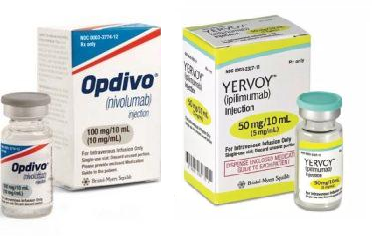
Opdivo and Yervoy are both immuno-oncology (I-O) therapies that leverage the body’s own immune system to fight cancer by targeting distinct regulatory components of the immune system.Tumor, in which Opdivo targets and blocks the PD-1/PD-L1 pathway, while Yervoy targets and blocks CTLA-4.
As of now, the Opdivo + Yervoy immunotherapy combination has been approved for five indications: (1) first-line treatment of tumors expressing PD-L1 (≥1%) without EGFR or ALK genomicTumoradult patients with metastatic NSCLC harboring alterations; (2) treatment of unresectable or metastaticMelanoma; (3) patients with intermediate- or high-risk advanced renal cell carcinoma (RCC) in the first-line setting; (4) pediatric (≥12 years) and adult patients with microsatellite instability-high (MSI-H) or mismatch repair-deficient (dMMR) metastatic colorectal cancer (mCRC); (5) patients with hepatocellular carcinoma (HCC) who have previously received sorafenib.
Opdivo was first approved in Japan in July 2014, becoming the world’s first approved PD-1 immunotherapy. By harnessing the body’sAutoimmunitySystemic Cancer Therapy: Opdivo Has Become a Key Treatment Option for Various Cancers.
In China, Opdivo (Opdivo) was approved for marketing in June 2018, becoming the first immunotherapyTumor(I-O) therapeutic drugs. To date, Opdivo has been approved for three indications in China, including: non-small cell lung cancer (NSCLC), squamous cell carcinoma of the head and neck (SCCHN), and gastric/gastroesophageal junction adenocarcinoma. (Bioon.com)
Original Source: U.S. Food and Drug Administrationapproves Opdivo® (nivolumab) + Yervoy® (ipilimumab) as First-Line Treatment of Patients with Metastatic Non-Small Cell Lung Cancer Whose Tumors Express PD-L1≥1%