

Merck’s Novel HIF-2α Inhibitor MK-6482 Demonstrates 27.9% Objective Response Rate in VHL-Associated Clear Cell Renal Cell Carcinoma
May 18, 2020 09:56
CST Updated
May 17, 15:44

MSD
Pharmaceutical R&D and Manufacturer

May 17, 2020 /BIOON/ -- Merck & Co. recently announced for the first time the results from its Phase II trial (NCT03401788) of MK-6482, a hypoxia-inducible factor-2α (HIF-2α) inhibitor. MK-6482 is a novel investigational agent in the company’s oncology pipeline for the treatment of von Hippel-Lindau (VHL) disease-associated clear cell renal cell carcinoma (ccRCC). Clinical data showed that MK-6482 demonstrated durable responses, with a confirmed objective response rate (ORR) of 27.9% (17/61; 95% CI: 17.1–40.8) and a median duration of response (DOR) not yet reached (range: 9.1–39.0 weeks).
Dr. Scot Ebbinghaus, Vice President of Clinical Research at MSD Research Laboratories, stated, “The Nobel laureates’ research identified HIF-2α and its role in cancer. MK-6482 was developed based on this science, and these data demonstrate the potential of targeting HIF-2α in patients who are in need of new options. These findings validate Merck’s long-standing strategy to build its oncology pipeline, including through the acquisition and accelerated development of novel therapeutic candidates such as MK-6482.”
Dr. Eric Jonasch, Professor of Genitourinary Medical Oncology in the Department of Cancer Medicine at The University of Texas MD Anderson Cancer Center, stated, “Von Hippel-Lindau syndrome is a rare, multi-organ hereditary disorder that predisposes patients to various cancers, including renal cell carcinoma. Cancer remains one of the leading causes of death among patients with Von Hippel-Lindau syndrome, and there is an urgent need for new therapeutic options. The results of this study provide evidence of the potential benefits of MK-6482 and support further investigation into how this HIF-2α inhibitor can play a meaningful role in treating these patients, as there are currently no approved systemic treatment regimens.”

The currently announced study is an open-label, single-arm Phase II trial evaluating MK-6482 for the treatment of VHL-associated clear cell renal cell carcinoma (ccRCC). The study enrolled adult patients with pathogenic germline VHL mutations, measurable local or non-metastatic ccRCC, no prior systemic anticancer therapy, and an Eastern Cooperative Oncology Group (ECOG) performance status (PS) of 0 or 1. In the study, patients received oral MK-6482 at a dose of 120 mg once daily until disease progression, unacceptable toxicity, or withdrawal by the investigator or patient. The primary endpoint was the overall response rate (ORR) for VHL-associated ccRCC tumors, assessed by independent radiologic review according to RECIST v1.1. Secondary endpoints included duration of response (DOR), time to response, progression-free survival (PFS), and safety and tolerability.
As of the data cutoff date (December 6, 2019), a total of 61 patients were enrolled in the study. The median treatment duration was 36.1 weeks (range: 0–73 weeks), with 95.1% of patients still receiving treatment. Results showed a confirmed objective response rate (ORR) of 27.9% (n=17; 95% CI: 17.1–40.8). All responses were partial responses (PR), and 43% of patients achieved stable disease. The median time to response was 23.7 weeks (range: 11.6–61.0 weeks), and the median duration of response (DOR) had not been reached (range: 9.1–39.0 weeks). Additionally, 86.9% (n=53) of patients experienced a reduction in the sum of diameters of target lesions.
Regarding safety, the incidence of treatment-related adverse events (TRAEs) was 96.7%, with 9.8% being Grade 3. No Grade 4 or 5 TRAEs occurred. The most common all-cause adverse events (≥20%) were anemia (86.9%), fatigue (57.4%), headache (36.1%), dizziness (31.1%), and nausea (24.6%). Grade 3 all-cause adverse events included fatigue (4.9%), anemia (3.3%), dyspnea (1.6%), and weight gain (1.6%).。
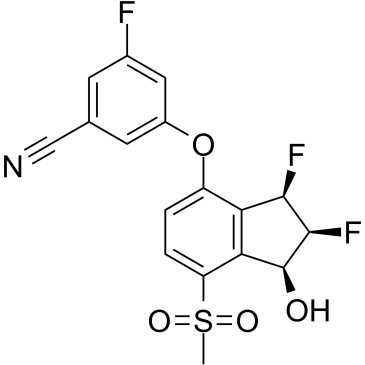
MK-6482 (Image source: medchemexpress.com)
Von Hippel-Lindau Syndrome (VHL syndrome) is a rare genetic disorder, affecting one in every 36,000 individuals (with 200,000 cases worldwide, including 10,000 in the United States alone). Patients with VHL syndrome are at risk of developing benign vascular tumors and various cancers, including renal cell carcinoma (RCC). Up to 60% of patients with VHL syndrome develop RCC, which is the leading cause of death among these patients.
Renal cell carcinoma (RCC) is currently the most common type of kidney cancer, accounting for approximately 9 out of 10 kidney cancer cases, with clear cell renal cell carcinoma (ccRCC) comprising about 7 out of 10 RCC cases. It is estimated that in 2018, there were approximately 403,000 new diagnoses of kidney cancer worldwide, with about 175,000 deaths attributed to the disease. In the United States alone, it is projected that by 2020, there will be nearly 74,000 new cases of kidney cancer and nearly 15,000 deaths from the disease.
The VHL gene is a critical tumor suppressor gene, and its mutations were first identified in patients with von Hippel-Lindau (VHL) syndrome. The VHL protein functions as a tumor suppressor; its inactivation leads to the aberrant activation of hypoxia-inducible factor-2α (HIF-2α) in cancer patients. This loss of VHL tumor suppressor activity is observed in more than 90% of clear cell renal cell carcinoma (ccRCC) tumors, resulting in the accumulation and activation of hypoxia-inducible factor (HIF) proteins within cancer cells. This process erroneously signals a hypoxic state, thereby promoting angiogenesis and stimulating tumor growth.
MK-6482 (formerly PT2977) is an investigational, novel, potent, and selective oral HIF-2α inhibitor that targets and inhibits HIF-2α, thereby blocking cell growth and proliferation and preventing abnormal angiogenesis. MK-6482 was developed by Peloton Therapeutics, which was acquired by Merck & Co., Inc. (MSD) in May 2019 for an upfront payment of $1.05 billion and milestone payments totaling $1.15 billion.
Currently, MK-6482 is being evaluated in multiple clinical studies. In addition to the Phase II trial for the treatment of VHL-associated clear cell renal cell carcinoma (ccRCC) (NCT03401788), the clinical development program for MK-6482 also includes a Phase III trial for the treatment of advanced RCC (MK-6482-005; NCT04195750), a Phase II trial evaluating its combination with cabozantinib (a VEGFR-targeted agent) for the treatment of advanced ccRCC (NCT036334540), and a Phase I/II dose-escalation and dose-expansion trial for the treatment of advanced solid tumors, including advanced renal cancer (NCT02974738). (Bioon.com))
Original Source: Merck’s Novel HIF-2α Inhibitor Showed an Objective Response Rate of Nearly 30% in Patients with von Hippel-Lindau (VHL) Disease-Associated Clear Cell Renal Cell Carcinoma