

Lynparza Demonstrates 42.1% Five-Year Survival Rate, Setting New Standard in BRCAm Platinum-Sensitive Relapsed Ovarian Cancer
May 19, 2020 09:54
CST Updated
01:54

AstraZeneca
Biopharmaceutical Manufacturer

May 19, 2020 /BioValleyBIOON/ --AstraZenecaAstraZeneca recently announced the final overall survival (OS) results from the Phase III SOLO 2 trial (ENGOT Ov-21; NCT01874353) evaluating Lynparza (Chinese brand name: Lipuzhuo; generic name: olaparib, olaparib tablets), a targeted anticancer drug, for the treatment of ovarian cancer. The trial was conducted in patients with BRCA-mutated (BRCAm) platinum-sensitive recurrent ovarian cancer (PSROC).Long-term (5-year) follow-up data, first showing: Compared with placebo,Lynparza Monotherapy Maintenance Treatment Demonstrates Overall Survival (OS) Benefit: Median OSProlonged by 12.9 months(51.7 months vs. 38.8 months),26% Reduction in Mortality Risk. Detailed data will be presented at the virtual meeting of the 2020 ASCO Annual Meeting.
Lynparza is a first-in-class, oral poly(ADP-ribose) polymerase (PARP) inhibitor co-developed by AstraZeneca and Merck & Co. The drug has been approved for six therapeutic indications, four of which are for ovarian cancer, including two for first-line maintenance treatment of ovarian cancer. Specifically: (1) first-line maintenance treatment of adult patients with BRCA-mutated (BRCAm) advanced ovarian cancer; (2) in combination with bevacizumab for first-line maintenance treatment of adult patients with homologous recombination deficiency (HRD)-positive advanced ovarian cancer; (3) maintenance treatment of adult patients with recurrent ovarian cancer; (4) adult patients with advanced germline BRCA-mutated (gBRCAm) ovarian cancer; (5) gBRCAm, HER2-negative (HER2-) metastaticBreast CancerAdult patients; (6) adult patients with germline BRCA-mutated (gBRCAm) metastatic pancreatic cancer receiving first-line maintenance therapy.
US ClinicalTumorDr. Richard L. Schilsky, Chief Medical Officer of the American Society of Clinical Oncology (ASCO), commented, “This study confirmsPARP inhibitor Lynparza should be the standard maintenance therapy for patients with BRCA-mutated, platinum-sensitive recurrent ovarian cancer, patients with this type of cancer have historically had a poor prognosis. The long-term OS data released this time represents a significant advancement for female patients with this type of cancer.”
The lead author of the study, Quironsalud Hospital in Valencia, SpainTumorDr. Andres Poveda of Initia Oncology stated, “Long-term follow-up shows that maintenance therapy with Lynparza significantly prolonged overall survival compared with placebo. This study will help usher in a new era of personalized medicine for women with this difficult-to-treat cancer.”

SOLO-2 is a randomized, double-blind, multicenter Phase III trial designed to evaluate the efficacy and safety of Lynparza as monotherapy maintenance treatment versus placebo in patients with platinum-sensitive recurrent ovarian cancer harboring germline BRCA mutations (gBRCAm). The trial enrolled a total of 295 patients with platinum-sensitive recurrent ovarian cancer carrying germline BRCA1/2 mutations, who had achieved complete or partial response following ≥2 lines of platinum-based chemotherapy prior to study enrollment. Patients were randomized in a 2:1 ratio to receive either Lynparza tablets (n=196; 300 mg twice daily) or placebo tablets (n=99; twice daily).
Previously published data demonstrated that, compared with placebo, Lynparza maintenance therapy significantly prolonged median progression-free survival (PFS) by 13.6 months (median PFS: 19.1 months vs. 5.5 months) and significantly reduced the risk of disease progression or death by 70% (HR=0.30; 95% CI: 0.22–0.41; p<0.0001). Furthermore, compared with placebo, Lynparza maintenance therapy significantly delayed the time to second disease progression or death (Pujade-Lauraine et al., Lancet Oncol, 2017) and demonstrated quality-adjusted PFS benefit (Friedlander et al., Lancet Oncol, 2018).
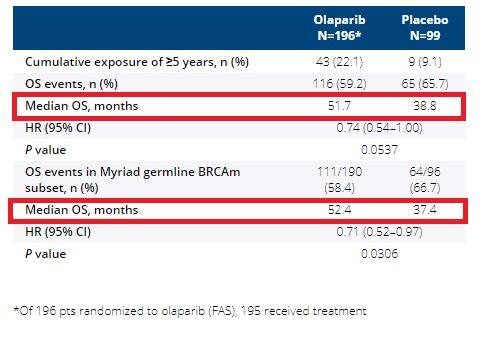
The final overall survival (OS) analysis data are presented herein. At the final data cutoff date (February 3, 2020), the median follow-up time was 65 months in both the Lynparza group and the placebo group. InFull Analysis Set (FAS,No adjustment was made for crossover; 38.4% of patients in the placebo group crossed over to Lynparza treatment),Compared with the placebo group, the Lynparza group demonstrated long-term treatment benefits, with a median OS extension of 12.9 months (51.7 months vs. 38.8 months) and a 26% reduction in the risk of death (HR=0.74; 95% CI: 0.54-1.00; p=0.0537).In the Myriad gBRCAm subset identified by the Myriad BRAC Analysis test kit, the median OS was prolonged by 15.0 months in the Lynparza group compared with the placebo group (52.4 months vs. 37.4 months), with a 29% reduction in the risk of death (HR=0.71; 95% CI: 0.52–0.97; p=0.0306).
InAt the 5-year follow-up, 42.1% of patients in the Lynparza group and 33.2% of patients in the placebo group were alive.In the Lynparza group, 28.3% of patients remained alive without receiving subsequent treatment, compared with 12.8% in the placebo group. The long-term tolerability profile of Lynparza was largely consistent with previously reported data.
Conclusion:In the final analysis of SOLO-2, Lynparza maintenance therapy extended median OS by 12.9 months compared with placebo, a result that is unprecedented.Notably, this study is the first to provide long-term follow-up and final overall survival (OS) data in the evaluation of Lynparza for the treatment of patients with BRCA-mutated (BRCAm), platinum-sensitive recurrent ovarian cancer.
Lynparza is a first-in-class, oral poly(ADP-ribose) polymerase (PARP) inhibitor that selectively kills cancer cells by exploiting defects in the tumor DNA damage repair (DDR) pathway. This mechanism of action enables Lynparza to treat a broad range of cancers with DNA damage repair deficiencies.Tumorpotential.
Lynparza is the first PARP inhibitor launched globally, first approved in the United States in December 2014FDAApproved. AstraZeneca and Merck & Co., Inc. (known as MSD outside the United States and Canada) entered into a global strategic collaboration in oncology in July 2017 to jointly develop and commercialize Lynparza and another MEK inhibitor, selumetinib, for the treatment of various types of cancer. Within the class of PARP inhibitors, Lynparza has the broadest and most advancedClinical TrialsDevelopment Project. Currently, both parties are collaborating to investigate Lynparza as a monotherapy and in combination regimens for a broad range ofTumortherapeutic potential.
In the Chinese market, Lynparza (Lynparza) was approved in August 2018 for maintenance treatment of platinum-sensitive recurrent ovarian cancer. Lynparza is the first targeted therapy approved for the treatment of ovarian cancer in China, marking the entry of PARP inhibitors into the era of ovarian cancer treatment in China.
In early December 2019, Lynparza (Olaparib) was again approved for first-line maintenance treatment of patients with advanced ovarian cancer harboring BRCA mutations. Benefiting from China’s strong support for pharmaceutical innovation and the accelerated approval of new drugs urgently needed in clinical practice, Lynparza (Olaparib) became the first PARP inhibitor approved in China for first-line maintenance therapy in ovarian cancer. On November 28, 2019, Lynparza (Olaparib) was included in the National Reimbursement Drug List. (Bioon.com)
Original Source: AZ/Merck & Co’s Lynparza Sets ‘New Standards’ in Ovarian Cancer