

Janssen Reports First Clinical Data of BCMAxCD3 Bispecific Antibody Teclistamab in Relapsed/Refractory Multiple Myeloma with 67% ORR
May 19, 2020 09:37
CST Updated
01:57

Johnson & Johnson
Healthcare Product Manufacturers, Health Service Providers

Janssen Pharmaceuticals
Pharmaceutical R&D Developer

May 19, 2020 News /BioonBIOON/ -- Janssen Pharmaceuticals, a subsidiary of Johnson & Johnson (JNJ), recently reported for the first time the results from its Phase I human dose-escalation study (NCT03145181) of teclistamab (JNJ-64007957, JNJ-7957). Teclistamab is a bispecific antibody targeting B-cell maturation antigen (BCMA) and the T-cell CD3 receptor. The study evaluated teclistamab in heavily pretreated patients with relapsed or refractory multiple myeloma (RRMM).
Preliminary results showed that teclistamab had a manageable safety profile across all evaluated dose ranges. Pharmacokinetic (PK) results indicated that the half-life of teclistamab supports once-weekly dosing. Researchers reported that patients achieved durable and deep responses, including complete response (CR) with minimal residual disease negativity (MRD-) at a level of 10E-6, with one patient maintaining MRD-CR for more than 12 months. These data will be presented on May 30 at the 2020 American Society of Clinical Oncology (ASCO) Annual Meeting.TumorVirtual Annual Meeting of the American Society of Clinical Oncology (ASCO)Meetingpublished above.
This study enrolled patients with multiple myeloma who had relapsed after or were refractory to existing therapies, and who had previously been treated with proteasome inhibitors (PIs) and immunomodulatory drugs (IMiDs). Prior to study initiation, the median number of previous therapy lines was 6 (range, 2–14); 92% of patients had received three classes of therapy, 86% were refractory to their last line of therapy, 80% were triple-class refractory, and 41% were penta-drug refractory, meaning that their cancer did not respond to treatment with ≥2 immunomodulatory agents, ≥2 PIs, and one anti-CD38 therapy, or relapsed within 60 days of such treatment. Patients with triple-class refractory and penta-drug refractory multiple myeloma have a poor survival prognosis due to limited treatment options.
The principal investigator of the study, Levine Cancer Institute/Carolina HealthCare System HematologyTumorSaad Usmani, MD, of the Department of Hematologic Malignancies, stated: “Despite significant advances in the treatment of multiple myeloma in recent years, it remains critical to identify additional therapeutic options for patients with relapsed disease who have developed resistance to existing therapies. In this heavily pretreated population, preliminary findings with teclistamab support further investigation of this dual-targeting immunotherapy.”
Vice President, Janssen R&D, Hematologic MalignanciesTumorYusri Elsayed, M.D., Global Head, stated, “We are committed to adopting a multi-platform approach in our scientific strategy to meet patient needs and provide treatment options for all patients with multiple myeloma. Teclistamab is an example of one of our bispecific antibodies, and we aim to leverage our immunotherapy expertise to offer potential new options for patients with severely progressed disease.”。”
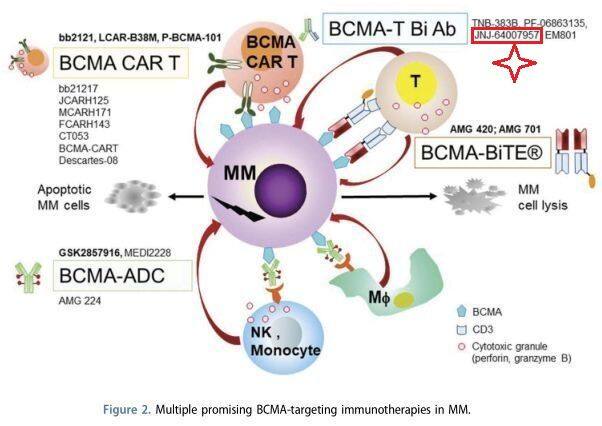
Investigational MM Immunotherapies Targeting BCMA (Source: PMID: 31277554)
This Phase I study was conducted in two parts: dose escalation (Part 1) and dose expansion (Part 2). Results from the Phase I portion demonstrated deep responses among patients (n=78) treated with teclistamab across the 0.3 μg/kg to 720 μg/kg dose groups.At a dose of 270 μg/kg (n=12), the overall response rate (ORR) was 67% (8/12); 50% (6/12) of patients achieved a very good partial response or better (≥VGPR), and 3 patients achieved a complete response (CR).
Patients demonstrated deep and durable responses. At the data cutoff, 76% (16/21) of patients who had achieved a response across all dose cohorts maintained their response; among patients evaluable for minimal residual disease (MRD), 80% (4/5) were MRD-negative, and two patients achieved MRD-negative complete response (CR), both of whom were confirmed to maintain MRD negativity. Additional dose-escalation and expansion cohorts of the study are ongoing.
In the Phase I study, the most common adverse events (AEs) (all grades) wereAnemia(58%), cytokine release syndrome (CRS, 56%), neutropenia (45%), thrombocytopenia (40%), and fever (31%). Among patients who experienced grade ≥3 adverse events, the most common (≥20%) were neutropenia (38%), anemia (36%), and thrombocytopenia (24%). One case of a grade 5 adverse event occurred, which was respiratory failure caused by pneumonia; however, the investigator considered it unrelated to the treatment. All CRS events were mild or moderate (grades 1–2) and typically limited to the initial dose.
Teclistamab (JNJ-7957) is a bispecific antibody that simultaneously targets BCMA and CD3. CD3 is involved in activating the immune system’s response to infection, while BCMA expression is significantly elevated on multiple myeloma cells. Teclistamab redirects CD3+ T cells to BCMA-expressing myeloma cells to induce cytotoxicity against the target cells. Preclinical study results have demonstrated that teclistamab can kill myeloma cell lines and myeloma bone marrow cells derived from heavily pretreated patients.
Currently,Teclistamab is being evaluated for its efficacy in treating relapsed or refractory multiple myeloma (RRMM) in Phase I clinical studies and is also being explored in combination therapy research. The production and development of teclistamab adhere to the licensing agreement between Janssen Biotech, Inc. and Genmab for the use of the DuoBody® technology platform. (Bioon.com)
Original Source: Janssen Presents First Data from Phase 1 Study of BCMAxCD3 Bispecific Teclistamab in Patients with Heavily Pretreated Relapsed or Refractory Multiple Myeloma