

End "Armchair Strategy": Enho Technology Releases SAION AI, Allowing AI4Science to Evolve Through Real Experiments
Recently, the open-source AI agent OpenClaw (commonly known as "Lobster") has gone viral across the web. During the Two Sessions in China, Academician Gao Wen remarked, "Everyone is in such a rush now, fearing they haven’t raised their own ‘lobster.’ Even Ma Huateng didn’t expect it to become this popular." In fact, OpenClaw’s rise to fame is no accident — unlike ChatGPT’s question-and-answer interaction, OpenClaw can directly control local devices, performing real tasks like file management and code writing, acting as a 24/7 "digital employee." This signifies that while artificial intelligence is reshaping the digital world, another more groundbreaking force has stepped into the physical world — Physical Artificial Intelligence (Physical AI), an intelligent system capable of perceiving, understanding, and entering real physical environments, directly participating in task execution, and making rational decisions.
In the more hardcore scientific research field, a similar transformation is taking place. Driven by the collaborative efforts of policy, capital, and industry, biomanufacturing is now approaching the industrial inflection point of "physical intelligence." On the policy front, national departments have successively issued policies such as the "Typical Application Cases of Artificial Intelligence in the Biomanufacturing Field (First Batch)" and the "Implementation Opinions of the Special Action Plan for ‘Artificial Intelligence + Manufacturing’," upgrading "AI + biomanufacturing" from scientific exploration to a national-level, systematic industrial strategy. In terms of capital, the National Venture Capital Guidance Fund has been officially launched, with 100 billion yuan of fiscal funding, primarily directed toward strategic emerging industries and future industries like biomanufacturing. Regarding the industry, the Ministry of Industry and Information Technology disclosed that during the "14th Five-Year Plan" period, the total scale of China’s biomanufacturing industry reached 1.1 trillion yuan, with bio-fermentation product output accounting for over 70% of the global share.
But beneath the热潮, deep-seated contradictions in the industry are becoming increasingly prominent: In the classic DBTL (Design-Build-Test-Learn) cycle, "Design" and "Learn" have been profoundly transformed by AI, while "Build" and "Test" still heavily rely on manual operations and discrete equipment. In the field of biomanufacturing, challenges such as lengthy research and production chains, numerous complex processes, fragmented data, and a high dependency on artisanal experience and repetitive trial-and-error persist. The emergence of Physical AI offers the industry a new approach to solving these problems.Unlike traditional AI's deduction in the digital world, Physical AI emphasizes real-time interaction, closed-loop feedback, and autonomous evolution between intelligent agents and the physical environment. In the field of biomanufacturing, this means that AI can not only design strains but also directly command automated equipment to conduct experiments, acquire data, and iteratively optimize, forming a true dry-wet closed loop.
The evolutionary trajectory of Bota perfectly aligns with this trend. On March 9, the company completed its brand upgrade, changing its name from "Bota Bio" to "Bota." This is not merely a name change but signifies its leap from "bio" to "technology"—from serendipitous biological discoveries to systematic engineering intelligence. On March 10, Bota officially launched SAION AI, the world’s first Physical AI platform for the biomanufacturing field.
SAION AIIt is not an AI agent that stays at the virtual design level or a single-execution experimental automation tool, but a Physical AI platform with cognitive, control, and closed-loop execution capabilities. It can autonomously design, directly participate in, and optimize biological discovery and production processes. The platform generates executable experimental protocols based on research intentions, which are then sent directly to biofoundries through BPL (Biology Protocol Language), a self-developed biological standard protocol language by Enhe Technology. It completes real experiments in a standardized manner and continuously evolves through data feedback loops, addressing industry challenges in biomanufacturing such as lengthy R&D and production chains, complex procedures, fragmented data, and heavy reliance on manual expertise and trial-and-error. This is not just a product launch; it marks the transition of the biomanufacturing industry from "experience-driven repeated exploration" to "digitally and hardware-integrated intelligent engineering with iterative advancements."
Biomanufacturing Enters "Autopilot" Mode
In the architecture design, SAION AI takes Physical AI as the core concept, and buildsCognition Layer – Orchestration Layer – Close-loop Execution LayerThe Co-evolution Architecture (COE Model).
This architecture can be analogous to the widely recognized autonomous driving VLA model in the current Physical AI field.(Vision–Language–Action Model).The VLA model constructs a unified architecture and cognitive reasoning capability under the native multimodal large model, breaking the traditional modular and rule-driven paradigm, and giving rise to the emergence of efficient data evolution and intelligent application scenarios. Through SAION AI's self-developed three-layer architecture by Enhe Technology, it achieves intrinsic unified scheduling and collaboration, enabling it to rely on the digital dimension for multi-scale deep cognition of life systems, intelligent task orchestration, and tool scheduling in complex and long-chain biomanufacturing industrial scenarios. It directly reaches task execution and data feedback in the physical dimension, forming a self-optimizing intelligent closed loop within the platform.
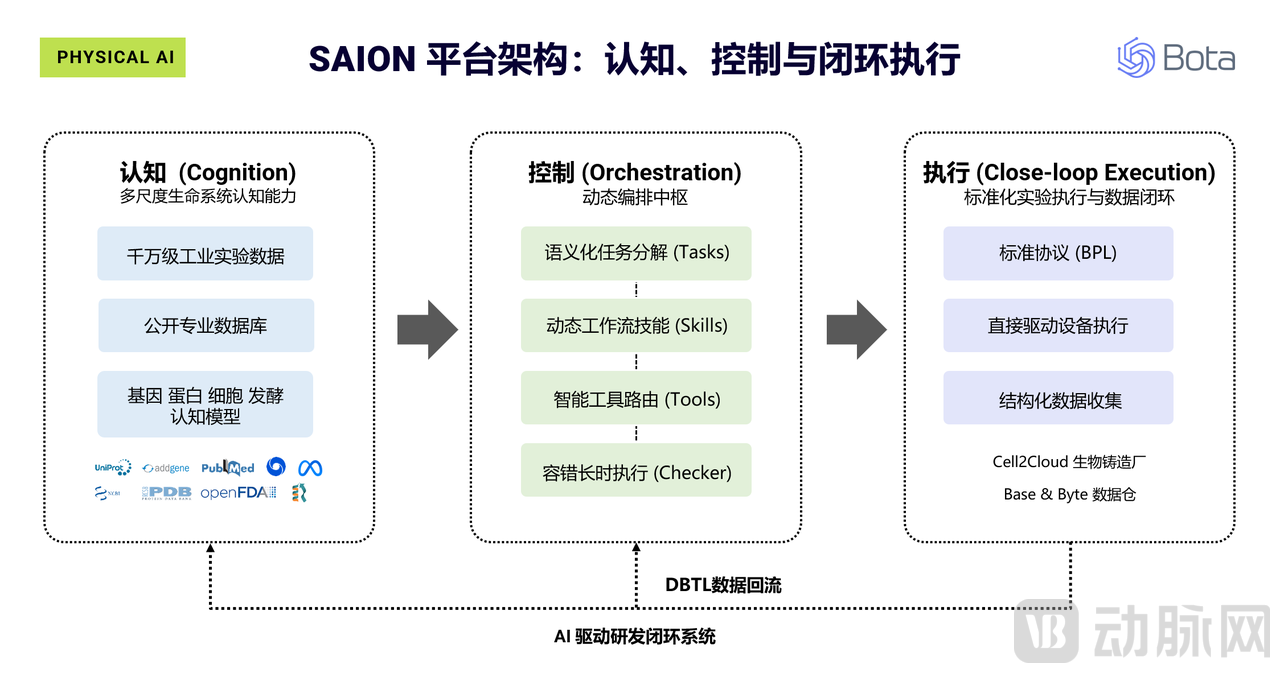
The cognitive layer is built on Enhe Technology's self-research.Cell2Cloud BiomanufacturingBased on the long-term accumulated data, integrationTens of millions of real project closed-loop experimental data,Millions of documents and patents, integrating NCBI, UniProt, PubMed, etc.Biological professional database.The system integrates multiple AI4Science models such as AlphaFold, ProteinMPNN, RFDiffusion, and ESMFold, covering capabilities like protein structure prediction, sequence generation, metabolic pathway analysis, enzyme engineering, and fermentation data modeling, enabling SAION AI to achieve end-to-end functionality.Gene-Protein-Metabolism-Cell-FermentationSystematic cognition at multiple scales, identifying the optimal R&D direction within a vast design space, and providing cross-scale contextual data foundation for subsequent scientific research decisions.
The core of the control layer isAgent Harness Intelligent Agent Orchestration Engine,With large language model reasoning at its core, it unifies the scheduling of multi-agent collaboration, tool invocation, and task execution. The system can parse complex scientific research objectives into structured task graphs and build based on the enterprise's accumulated experience in strain development and biomanufacturing.Workflow Skills,Form a stable scientific research execution model. At the same time, the platform has been integrated.316 professional research tools,Dynamic combination of model and algorithm capabilities through intelligent tool routing, and throughCheckpoint and Fault Tolerance MechanismSupports the stable operation of long-term complex scientific research processes, forming the core of SAION AI's scientific research decision-making and task scheduling.
The execution layer is implemented through Enhe's self-developed technology.Biological Standard Protocol Language - BPL,Convert the SAION AI-generated experimental protocol into standardized experimental instructions andDirectly drive device execution,Achieve automated flow from R&D planning to experimental operations. The system intelligently schedules pipetting workstations, incubation and testing equipment by interfacing with the Biofoundry API, while monitoring experiment progress and equipment status in real time. Meanwhile, experimental data is automatically parsed and structured for feedback to the platform through...Reinforcement learning drives continuous model optimization,FormationDesign–Build–Test–Learn (DBTL) Closed-loop,Continuously strengthen the research capability enhancement and knowledge asset accumulation of SAION AI.
Through this architecture, SAION AI willScientific Research Cognition, Intelligent Decision-Making, and Physical Experiment ExecutionDeep integration, comprehensive construction for biomanufacturingAI-Driven Closed-Loop System.
SAION AI Ranks First in Multiple International Benchmark Evaluations
Specifically, in each process of biological research,SAION AI has achieved industry-leading (SOTA) performance in multiple international life science AI benchmark tests, systematically verifying its core scientific research capabilities as an AI Scientist.In key scientific research tasks such as literature comprehension, biological sequence reasoning, genetic engineering design, and scientific discovery, SAION AI significantly outperforms general large models and several professional models.
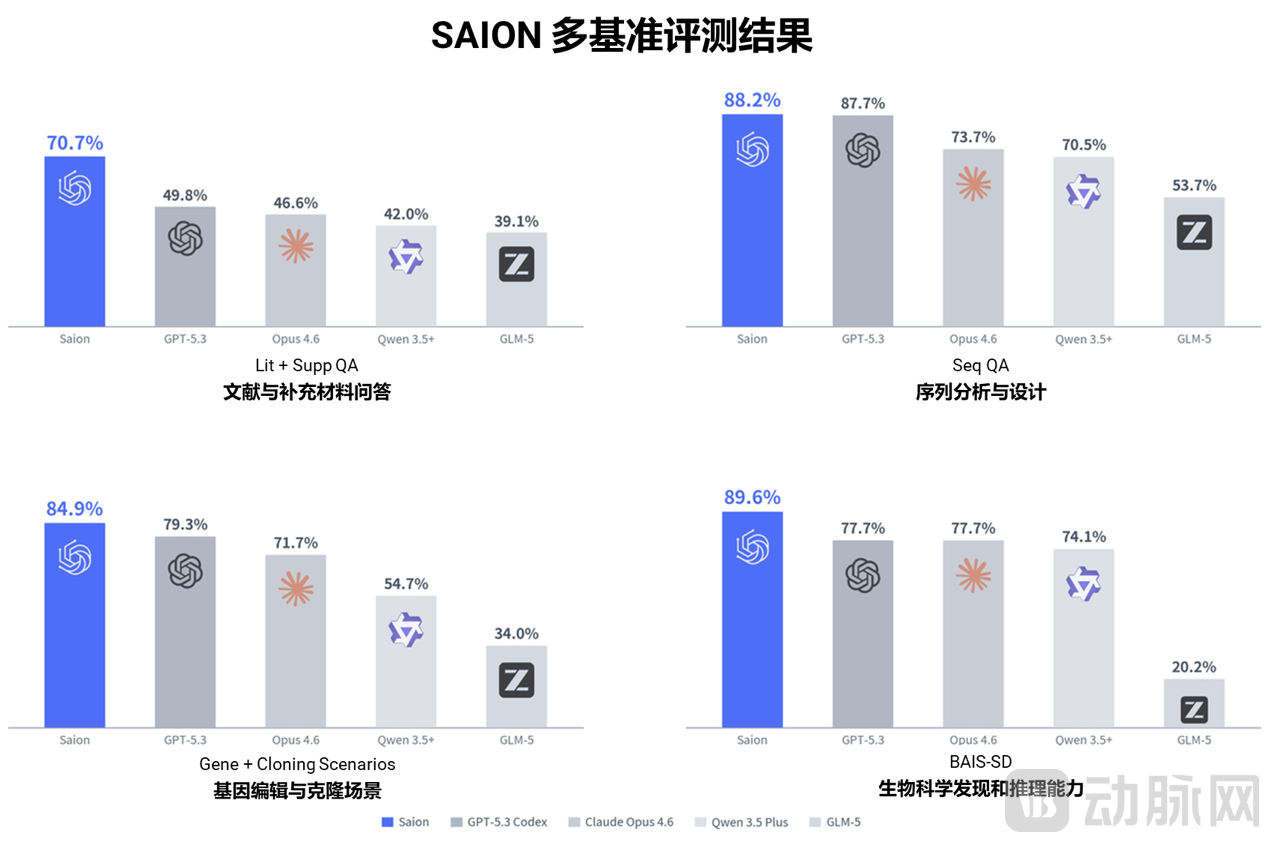
Achieved an average accuracy of 70.7% in the LitQA (Lab-Bench) and SuppQA (Lab-Bench) benchmarks,Significantly leading the current mainstream base models (GPT-5.3, Opus 4.6) by nearly 20 percentage points,And the public evaluation results of the Stella model optimized for scientific research (LitQA 65.0%).
In the SeqQA (Lab-Bench) benchmark, the accuracy rate reaches 88.2%, surpassing the current mainstream base models.Exceeding public evaluation results — the Biomni platform (81.9%) published in Stanford University literature,Demonstrates leading capabilities in DNA/RNA/protein sequence inference and design.
Achieved an average accuracy of 84.9% in the Gene Editing (Lab-Bench) and Cloning Scenarios (SDE) benchmarks,Reach the SOTA level in the current model,Validated its reasoning ability in real molecular biology experimental design.
Achieved 89.6% accuracy in the BAIS-SD benchmark (which evaluates an agent's ability to generate new discoveries and reasoning in the biological sciences).An increase of approximately 12 percentage points compared to mainstream benchmark models,Demonstrates its leading capabilities in understanding research hypotheses, scientific reasoning, and research discovery tasks.
Due to the currentThere is no benchmark test available yet that can comprehensively evaluate the capability of AI models in executing closed-loop biological experiments.We have verified the physical-level scientific research performance of SAION AI through full-process real experiments. SAION AI has independently completed tasks from literature reading to plasmid design and wet-lab assembly.Achieve 90%+ accuracy,Proving that it excels not only in scientific research understanding and reasoning benchmarks, but alsoCapable of independently driving biological R&D in real experiments.
Based on four core benchmark tests and real experimental validation, SAION AI ranks first in multiple tasks.These results indicate that SAION AI has developed a systematic capability that runs through the entire bioresearch process—fromFrom scientific knowledge understanding, sequence analysis to experimental design and scientific discovery,Upgrading AI from a knowledge tool to one that can drive real scientific research workAI Scientist Model,Significantly improve the R&D efficiency of biomanufacturing andAccelerate the process from scientific discovery to the physical world.
Five Core Advantages Make SAION AI an "AI Scientist That Can Conduct Experiments on Its Own"
Based on the aforementioned architecture and technical achievements, SAION AI boasts five core advantages and features:
SAION AI builds a cognitive model barrier with tens of millions of private experimental data from real projects within the enterprise, combined with millions of publicly available literature and patents. The platform integrates the advantages of multiple SOTA models, can independently combine and chain-call several cutting-edge specialized models, forming an adaptive goal-oriented workflow that translates research intentions into executable technical routes, task planning, and experimental protocols.
The experimental protocols output by SAION AI can be accurately converted into standardized experimental work orders for researchers and machine-executable instructions for equipment through Enhe Technology's self-developed Biological Protocol Language (BPL). Meanwhile, as a standard protocol, BPL ensures the reproducibility and traceability of experimental protocols across different individuals, timeframes, and equipment, guaranteeing the compliance of experimental data results.
Strains and biological components are the core assets of bio-manufacturing. SAION AI can automatically identify existing, reusable DNA fragments, standard plasmids, and strains from internal inventory during the experimental design phase, and proactively recommend or automatically incorporate them into the experimental plan. Meanwhile, during the execution of experiments, results such as DNA design, strain construction, transformation, and genetic information transmission are automatically entered into the database, forming a traceable strain construction pathway and a complete physical state of the strain.
Through the BPL standardization protocol, SAION AI translates experimental protocols into machine-readable instructions and directly delivers them to Enhe Technology's self-developed Cell2Cloud biofoundry for execution. This eliminates information transmission loss in traditional biological experiments, enhances the accuracy and reproducibility of experiment execution, and enables real-time monitoring of experimental progress. Moreover, all experimental queues, equipment statuses, and consumables inventory within the Cell2Cloud biofoundry are optimally and intelligently scheduled under the control of SAION AI.
During task execution, SAION AI can autonomously acquire, track, and analyze result data in real time, supporting rational decision-making and enabling full-chain physical AI intervention in biomanufacturing processes. Meanwhile, the accumulated proprietary data is transformed into structured, queryable, and callable organizational data assets, empowering internal talent development, achieving precise design of experimental protocols and process development, and driving the continuous evolution of the SAION AI platform at all levels.
Pysical AI Enables the R&D Closed Loop to Evolve into a Smart Manufacturing Closed Loop
The deep real-scenario application of Physical AI has expanded the ability to understand life and fundamentally transformed the experimental paradigm and production logic of traditional biomanufacturing. As AI's "hand" truly reaches into the laboratory, the traditional linear "hypothesis-validation" R&D model is broken. Instead, a self-evolving and continuously enhancing intelligent system takes its place — every data feedback loop from each experiment strengthens the platform’s cognitive abilities, forming a positive flywheel that becomes smarter with use. This continuously self-reinforcing modality is the core feature distinguishing Physical AI from traditional automation tools and the key force in bridging the gap between the laboratory and industrialization — the so-called "valley of death."
The release of SAION AI marks a new era: biomanufacturing is entering a continuously self-enhancing paradigm driven by digital cognition, intelligent orchestration, and closed-loop execution. In this new phase of development, AI is no longer just an auxiliary tool for researchers but has become an "intelligent agent" capable of independently driving scientific research processes. Experiments no longer rely on individual experience but are based on standardized engineering derived from tens of millions of data points. Knowledge is no longer confined to papers and patents but accumulates in a structured form and can be accessed instantly. From the perspective of industrial evolution, this is not only a technological breakthrough but also a reconstruction of infrastructure. When digital cognition truly merges with physical execution, the biomanufacturing industry transitions from experience-driven trial and error to intelligent engineering characterized by digital-hardware interaction, perception, and iterative advancement.The official release of SAION AI has completely redefined the efficiency frontier of bio-manufacturing.
Contact information for Enhe Technology: bota.pr@bota.bio
SAION AI: Physical AI Platform for the Biomanufacturing Field