

Bayer Submits NDA in Japan for Vitrakvi (Larotrectinib), a Tumor-Agnostic TRK Inhibitor for NTRK Fusion Cancers
May 26, 2020 11:07
CST Updated
May 25, 19:20
Bayer
Pharmaceutical Product R&D Developer
May 25, 2020 /BioValleyBIOON/ --Bayer(Bayer) recently announced that it has submitted a New Drug Application (NDA) to the Japanese Ministry of Health, Labour and Welfare (MHLW) for its precision oncology drug Vitrakvi (larotrectinib). Vitrakvi is an oral TRK inhibitor specifically indicated for the treatment ofTumorpediatric and adult patients with advanced or metastatic solid tumors harboring neurotrophic tyrosine receptor kinase (NTRK) gene fusions. Currently, Vitrakvi has been approved in multiple countries and regions worldwide, including the United States, Brazil, Canada, and European Union member states, with applications in other regions either underway or planned.
Scott Z. Fields, M.D., Senior Vice President and Head of Oncology Development at Bayer Pharmaceuticals, stated, “With this submission, we are one step closer to providing Japanese patients and physicians with a highly selective therapy specifically designed for adult and pediatric TRK fusion cancers, which has the potential to significantly improve treatment outcomes regardless of tumor type or patient age. Previously, anticancer drugs were primarily used for cancers in specific parts of the body, whereas Vitrakvi was developed specifically to treat patients with TRK fusion cancers, regardless”Tumorwhere it originates in the body. Vitrakvi represents a significant advancement in combating this rare cancer, as it will replace costly treatments that are not specifically targeted at this type of cancer and have not demonstrated efficacy and safety in this patient population.”
In Japan, the submission of the Vitrakvi NDA was based on pooled data from a total of 102 patients enrolled in the Phase I trial in adult patients, the Phase II NAVIGATE trial in adult and adolescent patients, and the Phase I/II SCOUT trial in pediatric patients. In these trials, Vitrakvi was investigated for the treatment of more than 20 types of solid tumors with diverse histologies.Tumor, including lung cancer and thyroid cancer,Melanoma, gastrointestinal stromal tumors, colorectal cancer, cholangiocarcinoma, soft tissue sarcoma, salivary gland carcinoma, and infantile fibrosarcoma.
Of the 102 patients, 93 were from the primary analysis population, and the remaining 9 had primary central nervous system (CNS)TumorPatients. The results showed that Vitrakvi treatment demonstrated high response rates, with durable and rapid responses. Specific data were as follows: In the primary analysis set, the overall response rate (ORR) was 72% (95% CI: 62, 81), including a complete response (CR) rate of 16% and a partial response (PR) rate of 55%. In an additional analysis that included patients with primary CNS tumors, the ORR was 67% (95% CI: 57, 76), with a CR rate of 15% and a PR rate of 51%.
In the primary analysis, the median time to first response for patients treated with Viktarvy was 1.81 months. At the time of analysis, the median duration of response had not been reached (range: 1.6+ to 38.7+ months), and 75% of patients had a duration of response ≥12 months. Among treated patients, 88% (95% CI: 81, 95) remained alive one year after treatment initiation. At the time of analysis, the median progression-free survival (PFS) had not been reached. Safety was evaluated in 125 patients with NTRK gene fusions. Most adverse events (AEs) were Grade 1 or 2, and only 3% of patients permanently discontinued treatment due to treatment-emergent AEs. Dose reductions were reported in 19 (15%) patients, 10 (8%) of whom reduced doses due to AEs. Most AEs leading to dose reduction occurred within the first three months of treatment.
Viktarvy demonstrates clinically meaningful improvements in quality of life (QoL) for adult and pediatric patients with TRK fusion-driven cancer. In two global, multicenterClinical TrialAmong them, 60% of adult patients reported an improvement in the EORTC QLQ-C30 global health status score. For pediatric patients, 76% reported an improvement in the PedsQL total score.
TRK fusion cancers are generally rare, can affect both children and adults, and occur with varying frequencies across different tumor types. TRK fusion cancers arise when an NTRK gene fuses with another unrelated gene, resulting in an altered TRK protein. This altered protein, or TRK fusion protein, becomes constitutively active or overexpressed, triggering the activation of intracellular signaling cascades. These TRK fusion proteins act as oncogenic drivers, promoting tumor growth regardless of the tissue of origin.Tumorof diffusion and growth.
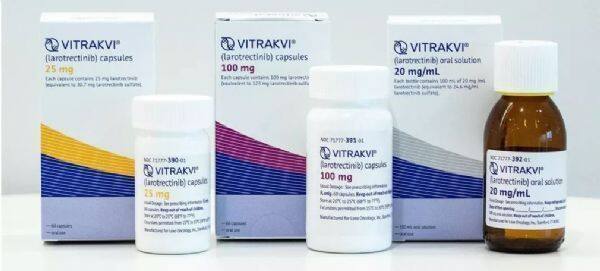
Vitrakvi is a first-in-class oral TRK inhibitor. Its active pharmaceutical ingredient, larotrectinib, is a potent, oral, selective tropomyosin receptor kinase (TRK) inhibitor designed to directly target TRKs (including TRKA, TRKB, and TRKC), thereby shutting down the signaling pathways that drive the growth of TRK fusion tumors. TRK fusion-drivenTumorIt can occur in various parts of the body, and conventional treatment regimens (such as surgery, chemotherapy, and radiotherapy) usually fail to achieve satisfactory therapeutic outcomes.
Vitrakvi is a histology-independent therapy specifically developed for the treatment of tumors harboring NTRK gene fusions, regardless of the tumor’s site of origin. In pediatric and adult patients with TRK fusion-positive tumors, Vitrakvi has demonstrated robust efficacy, including in primary central nervous system (CNS) tumors and brain metastases, providing high response rates and durable responses, irrespective of patient age andTumorHow is the histology?
In late November 2018, Vitrakvi received the world’s first approval in the United States, becoming the first orally administered TRK inhibitor ever approved, as well as the firstTumorTumor-agnostic, “broad-spectrum” targeted anticancer drugs. Currently, Vitrakvi has been approved in many countries and regions around the world, including the European Union. (Bioon.com)
Original Source: Bayer Submits Larotrectinib for Marketing Authorization in Japan for the Treatment of TRK Fusion Cancer