

Hepatocellular Carcinoma Breakthrough: Roche’s Tecentriq plus Avastin Significantly Improves Overall Survival in First-Line Treatment
May 27, 2020 14:35
CST Updated
May 26, 19:33

Roche
Oncology Drug Research, Development, and Manufacturing
May 26, 2020 /Bio ValleyBIOON/ -- Recently, the results of the Phase III IMbrave150 study (NCT03434379), which evaluated Roche’s anti-PD-L1 therapy Tecentriq (atezolizumab) in combination with Avastin (bevacizumab) as first-line treatment for unresectable hepatocellular carcinoma (HCC), were published in the prestigious international medical journal The New England Journal of Medicine (NEJM). The articleTitle:Atezolizumab plus Bevacizumab in Unresectable Hepatocellular Carcinoma. Data shows that,The efficacy of the Tecentriq plus Avastin combination regimen is significantly superior to that of the standard-of-care drug sorafenib.
IMbrave150 is an open-label, multicenter, randomized Phase III study conducted in patients with unresectable, locally advanced or metastatic hepatocellular carcinoma (HCC) who had not previously received systemic therapy. The study evaluated the efficacy and safety of the combination regimen of Tecentriq plus Avastin compared to the standard-of-care drug, the multikinase inhibitor sorafenib. In the study, patients were randomized in a 2:1 ratio to receive either Tecentriq plus Avastin (n=336) or sorafenib (n=165) until unacceptable toxicity occurred or clinical benefit was lost. The co-primary endpoints of the study were overall survival (OS) and progression-free survival (PFS), as determined by an independent review facility according to the Response Evaluation Criteria in Solid Tumors version 1.1 (RECIST 1.1).
The results showed that the study met its co-primary endpoints: compared with the sorafenib group, the Tecentriq plus Avastin combination therapy group demonstrated statistically and clinically significant improvements in both OS and PFS.
The specific data are as follows: At the primary analysis time point (August 29, 2019), compared with the sorafenib group, the Tecentriq + Avastin combination therapy group demonstrated a significantly prolonged overall survival (median OS: NE vs. 13.2 months), a 42% reduction in the risk of death (HR=0.58, 95% CI: 0.42–0.79, p<0.001), and an improved 12-month survival rate (67.2% vs. 54.6%). Furthermore, compared with the sorafenib group, the Tecentriq + Avastin combination therapy group showed a significantly prolonged progression-free survival (median PFS: 6.8 months vs. 4.3 months) and a 41% reduction in the risk of disease progression or death (HR=0.59, 95% CI: 0.47–0.76, p<0.001).
In this study, the safety profile of the Tecentriq and Avastin combination therapy was consistent with the known safety profiles of each individual drug, and no new safety signals were identified. The incidence of Grade 3 or 4 adverse events was 56.5% in the Tecentriq plus Avastin combination therapy group and 55.1% in the sorafenib group; 15.2% of patients in the Tecentriq plus Avastin combination therapy group experienced Grade 3 or 4Hypertension; however, other advanced toxic effects are not common.

Liver cancer is a leading cause of death worldwide, particularly in Asia, with hepatocellular carcinoma being the most common type. Based on the aforementioned results, IMbrave150 is in the most commonLiver CancerThe first Phase III cancer immunotherapy study to demonstrate improved OS and PFS with treatment.The combination of Tecentriq and Avastin is also the first treatment regimen to improve overall survival in patients with unresectable hepatocellular carcinoma who have not previously received systemic therapy, in over a decade.
Regulatory aspects, the United StatesFDACurrently being conducted in real-timeTumorThe pilot project for academic review is reviewing the supplemental application for the Tecentriq + Avastin combination regimen. Previously, this regimen had beenFDAGranted Breakthrough Therapy Designation. In China, the application was accepted by the National Medical Products Administration (NMPA) in January this year.
Roche has developed an extensive development plan for Tecentriq, including multiple ongoing and planned Phase III studies involving various types of lung cancer, urogenital cancers, skin cancer,Breast Cancer, gastrointestinal cancer, gynecologic cancer, and head and neck cancer. This includes studies of Tecentriq used as monotherapy or in combination with other medications.
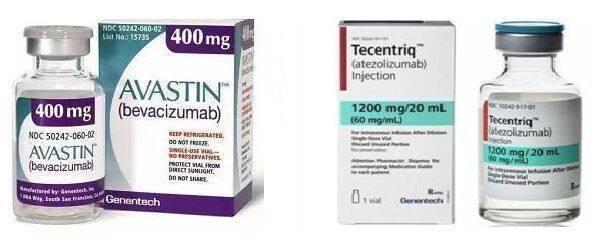
Tecentriq is a PD-(L)1 tumor immunotherapy designed to target tumor cells andTumorBinds to a protein called PD-L1 expressed on infiltrating immune cells, blocking its interaction with the PD-1 and B7.1 receptors. By inhibiting PD-1, Tecentriq can activate T cells, and the drug has the potential to serve as a foundational combination therapy for cancer immunotherapy, targeted drugs, and various cancer chemotherapies.
Avastin is an angiogenesis inhibitor that targets and binds to vascular endothelial growth factor (VEGF). VEGF plays a critical role in angiogenesis and its maintenance throughout the tumor life cycle. Avastin disrupts the tumor’s blood supply by directly binding to VEGF, thereby preventing it from interacting with receptors on endothelial cells. The tumor’s blood supply is consideredTumorKey to in vivo growth and metastatic capacity.
There is a strong scientific rationale for the combination of Tecentriq and Avastin, as the Tecentriq + Avastin regimen has the potential to enhance the immune system’s ability to combat tumors. In addition to its established anti-angiogenic effects, Avastin can also inhibit VEGF-mediated immunosuppression, promote T-cell infiltration into tumors, and prime T cells againstTumorantigen response, further enhancing Tecentriq's ability to restore the body's anti-cancer immunity.
December 2018, United StatesFDAApproval of Tecentriq + Avastin + Chemotherapy (Carboplatin and Paclitaxel) as First-Line Treatment for Patients Without EGFR or ALK Genomic AlterationsTumorAdult patients with metastatic non-squamous non-small cell lung cancer (NSq NSCLC) harboring alterations. This approval is based on data from Cohort B of the IMpower150 study: in intention-to-treat wild-type (ITT-WT) patients, Tecentriq plus Avastin and chemotherapy significantly prolonged overall survival compared with Avastin plus chemotherapy (median OS: 19.2 months vs. 14.7 months; HR=0.78; p=0.016). (Bioon.com)
Original Source: Atezolizumab plus Bevacizumab in Unresectable Hepatocellular Carcinoma
https://www.nejm.org/doi/full/10.1056/NEJMoa1915745?query=featured_home