

AstraZeneca’s Imfinzi Demonstrates Sustained Overall Survival Benefit in First-Line Extensive-Stage Small Cell Lung Cancer in Phase III CASPIAN Trial
May 31, 2020 20:54
CST Updated
20:54

AstraZeneca
Biopharmaceutical Manufacturer
May 31, 2020 News /BioValleyBIOON/ ---AstraZeneca(AstraZeneca) recently announced detailed results from the latest analysis of the Phase III CASPIAN trial in lung cancer. The data demonstrated that Imfinzi (brand name: Imfinzi; generic name: durvalumab), an anti-PD-L1 therapy, in combination with standard-of-care (SoC) platinum-based chemotherapy (etoposide plus cisplatin or carboplatin) as first-line treatment for adult patients with extensive-stage small cell lung cancer (ES-SCLC), provides a sustained and clinically meaningful overall survival (OS) benefit.
CASPIAN is a randomized, open-label, multicenter, global Phase III study comparing the efficacy and safety of Imfinzi plus standard-of-care (SoC) platinum-based chemotherapy (etoposide plus cisplatin or carboplatin), Imfinzi plus tremelimumab plus SoC platinum-based chemotherapy, and SoC platinum-based chemotherapy alone as first-line treatment for patients with extensive-stage small cell lung cancer (ES-SCLC). The Imfinzi plus tremelimumab plus SoC platinum-based chemotherapy regimen is a dual immune checkpoint blockade combined with chemotherapy, consisting of the CTLA-4 checkpoint inhibitor tremelimumab (an anti-CTLA-4 monoclonal antibody), the PD-L1 checkpoint inhibitor Imfinzi (an anti-PD-L1 monoclonal antibody), and SoC chemotherapy. In the study, Imfinzi was administered at a fixed dose of 1500 mg every three weeks for four cycles. Patients in the experimental arms received up to four cycles of SoC chemotherapy, whereas those in the control arm were allowed up to six cycles of SoC chemotherapy and prophylactic cranial irradiation (PCI). The study was conducted across more than 200 clinical centers in 22 countries, including the United States, Europe, South America, Asia, and the Middle East. The primary endpoint was overall survival (OS).
In June 2019, the CASPIAN trial met its primary endpoint of overall survival (OS): compared with the standard-of-care (SoC) chemotherapy group, the Imfinzi plus SoC chemotherapy group demonstrated a 27% reduction in the risk of death (HR=0.73, 95% CI: 0.591–0.909, p=0.0047), a significant prolongation of median OS (13.0 months [11.5, 14.8] vs. 10.3 months [9.3, 11.2]), and a substantially higher 18-month survival rate (33.9% vs. 24.7%). Furthermore, across all efficacy endpoints, the Imfinzi plus SoC chemotherapy group showed therapeutic benefits compared with the SoC chemotherapy group, including: a significantly higher progression-free survival (PFS) rate at 12 months (17.5% vs. 4.7%), an improved confirmed objective response rate (ORR) at 12 months (67.9% vs. 57.6%), and a higher proportion of patients with sustained duration of response (DOR) at 12 months (22.7% vs. 6.3%).
These data constitute the United StatesFDAThis approval, granted in March 2020, was based on the use of Imfinzi in combination with standard-of-care (SoC) platinum-based chemotherapy (etoposide plus cisplatin or carboplatin) as first-line treatment for adult patients with extensive-stage small cell lung cancer (ES-SCLC). SCLC is an aggressive, fast-growing cancer that, despite an initial response to platinum-based chemotherapy, often relapses and progresses rapidly. This approval provides an important first-line treatment option for patients with ES-SCLC. Currently, the use of Imfinzi plus SoC chemotherapy as first-line treatment for adult patients with ES-SCLC is also under regulatory review in the European Union and Japan.

The latest analysis released herein uses data with a cutoff date of January 27, 2020. The data show that after a median follow-up of more than 2 years, Imfinzi plus standard-of-care (SoC) chemotherapy demonstrated sustained efficacy, reducing the risk of death by 25% compared with SoC chemotherapy alone (HR=0.75; 95% CI: 0.62–0.91; nominal p=0.0032). The updated median overall survival (OS) was 12.9 months in the Imfinzi plus SoC chemotherapy group versus 10.5 months in the SoC chemotherapy group. In a post hoc analysis, the estimated 24-month survival rate was 22.2% in the Imfinzi plus SoC chemotherapy group and 14.4% in the SoC chemotherapy group. The post hoc analysis also showed that the 24-month progression-free survival rate was 11% in the Imfinzi plus SoC chemotherapy group and 2.9% in the SoC chemotherapy group.
Furthermore, the Imfinzi plus standard-of-care (SoC) chemotherapy group maintained a higher objective response rate (ORR: 68% vs. 58%). In a post hoc analysis, the proportion of patients with a duration of response of 24 months was 13.5% in the Imfinzi plus SoC chemotherapy group versus 3.9% in the SoC chemotherapy group. At 24 months, 12% of patients in the Imfinzi plus SoC chemotherapy group continued to receive Imfinzi treatment.
The second cohort of the CASPIAN trial evaluated the addition of the anti-CTLA-4 monoclonal antibody tremelimumab to Imfinzi plus standard-of-care (SoC) chemotherapy, demonstrating a trend in overall survival (OS) that did not reach statistical significance compared with SoC chemotherapy alone. In this trial,The safety and tolerability of Imfinzi in combination with chemotherapy were consistent with the known safety profiles of these agents.
Principal Investigator of the CASPIAN Trial, University Hospital October 12th, Madrid, SpainTumorDr. Luis Paz-Ares, Chief of Medical Oncology, stated: “The latest results from the CASPIAN trial show that 22% of patients were still alive at 24 months, supporting the sustained benefit of Imfinzi plus chemotherapy as an effective first-line treatment for extensive-stage small cell lung cancer (ES-SCLC). Improving outcomes for patients with ES-SCLC has long been a challenge, and few patients survive five years.”
AstraZenecaTumorJosé Baselga, Executive Vice President of Research and Development, stated, “With a median follow-up of 2 years, Imfinzi continues to demonstrate sustained and meaningful improvements in survival and durable treatment responses in patients with this devastating and aggressive disease. These data reinforce Imfinzi plus chemotherapy as an important new standard of care for patients with extensive-stage small cell lung cancer (ES-SCLC), offering the convenience of once-every-4-week dosing during the maintenance phase. We look forward to bringing the benefits of Imfinzi to patients worldwide.”
Lung cancer is the leading cause of cancer-related deaths in both men and women, accounting for approximately one-fifth of all cancer deaths. Lung cancer is broadly classified into non-small cell lung cancer (NSCLC) and small cell lung cancer (SCLC), with SCLC comprising about 15%. Approximately two-thirds of patients with SCLC areDiagnosisExtensive-stage disease, meaning the cancer has spread widely throughout the lungs or to other parts of the body. SCLC is an aggressive, fast-growing cancer that, despite an initial response to platinum-based chemotherapy, rapidly recurs and progresses, resulting in a particularly poor prognosis, with only 6% of SCLC patients surviving five years after diagnosis.
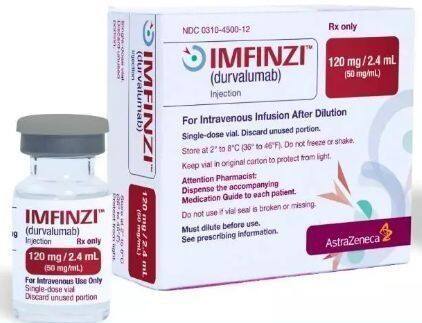
Imfinzi (英飞凡, durvalumab) is a humanized PD-L1 monoclonal antibody that blocks the binding of PD-L1 to PD-1 and CD80, thereby inhibitingTumorOvercome immune evasion and release suppressed immune responses. To date, Imfinzi has been approved in more than 60 countries (including the United States, Japan, China, and the entire European Union) for the curative treatment of patients with unresectable Stage III non-small cell lung cancer (NSCLC) whose disease has not progressed following concurrent chemoradiotherapy with platinum-based chemotherapy. Additionally, Imfinzi has been approved in more than 10 countries, including the United States, for the treatment of patients with advanced bladder cancer who have previously received platinum-containing chemotherapy.
As part of the extensive development program for lung cancer, Imfinzi is also being evaluated in another Phase III clinical trial, ADRIATIC, which assesses the use of Imfinzi following concurrent chemoradiotherapy (CCRT) in patients with limited-stage small cell lung cancer (SCLC). Data from this study are expected in 2021.
Tremelimumab is a human monoclonal antibody that targets cytotoxic T-lymphocyte-associated protein 4 (CTLA-4), blocking CTLA-4 activity, promoting T-cell activation, and initiatingTumorImmune response, promoting cancer cell death. Tremelimumab and Bristol Myers Squibb’s marketed antibody drug Yervoy (ipilimumab) target the same checkpoint, CTLA-4.
Currently, AstraZeneca is conducting a large-scale clinical program to evaluate Imfinzi as monotherapy and in combination with tremelimumab and other agents for NSCLC, SCLC, bladder cancer, head and neck cancer,Liver Cancer, cervical cancer, biliary tract cancer, and other solid tumors. (Bioon.com)
Original Source: Imfinzi showed a sustained overall survival benefit in 1st-line extensive-stage small cell lung cancer in the Phase III CASPIAN trial