

Heartech Medical Advances Heart Failure Treatment with China's First Clinical-Stage Transcatheter Left Ventricular Partitioning Device
Cardiovascular disease is currently the leading cause of death among the Chinese population, accounting for more than 40% of all disease-related mortality. The number of prevalent cases in China has reached as high as 290 million. The overall prevalence of heart failure in China is approximately 1.3%, with the current number of patients reaching 13.7 million. Heart failure refers to a condition in which impaired systolic or diastolic function of the heart prevents adequate expulsion of venous return blood from the heart, leading to venous congestion and insufficient arterial perfusion. Heart failure is not an independent disease; nearly all cardiovascular and cerebrovascular diseases may ultimately lead to its development.
Heart failure has numerous clinical etiologies. Common diseases leading to heart failure, such as hypertension, coronary artery disease, and myocardial infarction, are often accompanied by ventricular remodeling. However, myocardial infarction involves an additional process of mechanical remodeling. For patients with heart failure with reduced ejection fraction (HFrEF), the five-year long-term survival rate is comparable to that of malignant tumors. Currently, clinical treatment options for heart failure are very limited, primarily relying on pharmacological therapy, which offers limited symptomatic improvement for patients with mid-to-late stage heart failure and results in a poor prognosis.
As the population ages, the number of patients will continue to rise, and there is an urgent need for new treatment options for heart failure patients.
“China sees approximately 500,000 new heart failure cases annually. The emergence of interventional devices for heart failure will become a new highlight in its treatment, with the market size conservatively estimated to reach tens of billions of yuan,” pointed out Mei Qifeng, founder of Shanghai Xinrui Medical Technology Co., Ltd. (hereinafter referred to as “Xinrui Medical”).
In February 2014, Xinrui Medical was established in the Shanghai International Medical Zone. The company positions itself as an innovative enterprise focused on the development of heart failure devices and providing comprehensive systemic solutions for heart failure device-based therapies and service platforms. Xinrui Medical holds a leading position in China in the research and development of its heart failure device product series. Its core product, the transcatheter left ventricular isolation device, is the first domestically developed product to enter clinical trials in China and possesses independent intellectual property rights.
“At present, both domestically and internationally, the field of heart failure medical devices is in a relatively early stage, with a largely untapped market and significant opportunities.” This is how Mei Qifeng described the starting point for his entrepreneurial venture.
He introduced that the current categories of heart failure therapies, along with their advantages and disadvantages, are mainly as follows:
Pharmacological Treatment:Heart failure medications, such as diuretics, digitalis preparations, and some novel positive inotropic agents, have been proven ineffective in improving left ventricular remodeling and prognosis in patients with heart failure. These drugs are primarily used in the early stages and offer some benefit for chronic heart failure (e.g., in patients with asymptomatic left ventricular systolic dysfunction); however, they have minimal efficacy in ischemic heart failure (characterized by left ventricular involvement, ventricular aneurysm, apoptosis, and dilated cardiomyopathy), particularly in the mid-to-late stages (up to NYHA class IIIa). Although pharmacological therapy provides numerous benefits to patients, it cannot completely halt the progression of heart failure.
Surgical Treatment:Partial Left Ventriculectomy (PLV)—The objective is to reduce the left ventricular diameter through resection of left ventricular muscle and suture closure of the incision, thereby re-establishing the physiological relationship among left ventricular volume, wall tension, and diameter. Currently, PLV remains associated with numerous unresolved issues, including indications, timing of surgery, long-term efficacy, and surgical risks. Furthermore, it is often performed concomitantly with valve reconstruction and coronary artery bypass grafting. In China, there have been few successful cases of isolated partial left ventriculectomy.
Device Therapy:An increasing number of clinical trials have confirmed the importance of device-based therapy for patients with heart failure. Cardiac resynchronization therapy (CRT), implantable cardioverter-defibrillators (ICDs), cardiac contractility modulation (CCM) devices, left ventricular partitioning devices (LVPDs), and intracardiac shunt devices are now gradually becoming standard therapeutic options to improve symptoms, enhance quality of life, and prolong survival in heart failure patients. Left ventricular partitioning devices and intracardiac shunt devices represent novel device-based therapies introduced in recent years, indicated respectively for heart failure with reduced ejection fraction (HFrEF) and heart failure with preserved ejection fraction (HFpEF).
“With technological advancements, device-based therapies offer greater potential for improving symptoms in heart failure patients, thereby enhancing their prognosis to a certain extent,” said Mei Qifeng.
Prior to founding Xinrui Medical, Mei Qifeng engaged in research and development (R&D) in the cardiovascular device sector for over 18 years. This included working on the R&D, manufacturing, and clinical aspects of Class III interventional medical devices at domestic medical device companies such as Shanghai MicroPort Medical and Beijing Medtronic Peak Medical.
Leveraging extensive experience in the R&D, production, and management of medical devices, Mei Qifeng has been continuously exploring the cardiovascular field.
“Identify a precise entry point and pursue it to perfection.” Since the company’s establishment, Mei Qifeng has led the technical team in deeply engaging in the research and development of heart failure medical devices. After several years of R&D, the first productLeft Ventricular Isolation Device (Parachute)Granted special approval for innovative medical devices by the NMPA, the First-in-Human (FIH) clinical trial has been completed, and the product has entered the registration clinical trial phase. Market approval is expected in two to three years.
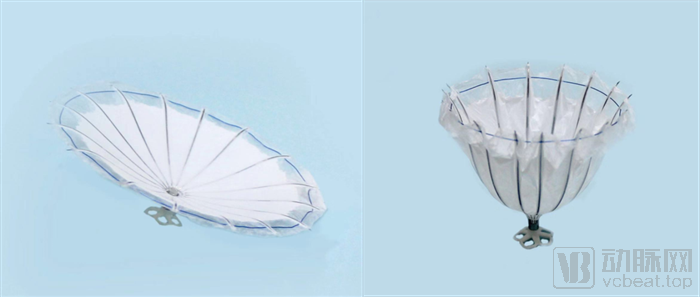
(Figure: Left Ventricular Isolation Device))
What Kind of Product Is a Transcatheter Left Ventricular Isolation Device?
Typically, the likelihood of developing a ventricular aneurysm after an acute myocardial infarction, particularly following an anterior wall infarction, is very high. Localized or extensive myocardial necrosis occurs, with the necrotic myocardium gradually being replaced by fibrous scar tissue. Once fibrous scar tissue associated with a ventricular aneurysm forms, pharmacological therapy is rarely effective.
The formation of a ventricular aneurysm leads to increased pressure on the ventricular wall. Ventricular aneurysms severely impair cardiac function; without active treatment, patients will ultimately die from causes such as heart failure. Therefore, further remodeling is of significant clinical importance.
The transcatheter left ventricular isolation device is a minimally invasive interventional implant placed within the left ventricle,Isolating the dilated ventricular aneurysm can effectively reduce left ventricular volume, decrease left ventricular wall stress, improve clinical symptoms and cardiac function in patients with heart failure, and significantly prolong their survival.
“Left ventricular isolation devices are currently used less frequently in China, whereas their application is relatively more common abroad. These devices have demonstrated significant efficacy in patients with mid-to-late stage heart failure, as confirmed by clinical trials. The device has shown remarkable therapeutic effects in improving cardiac function indicators, including left ventricular ejection fraction (LVEF), New York Heart Association (NYHA) functional classification, and the 6-minute walk test, making its market prospects promising. Notably, the follow-up results of Xinrui Medical’s Heartech FIM study were officially published in November 2019 in Catheterization and Cardiovascular Interventions (CCI) journal as a cover article,” said Mei Qifeng.
Heart failure is the terminal stage of various cardiac diseases, which means there is significant potential in the field of heart failure medical devices.
Mei Qifeng introduced that, currently, in addition to the transcatheter left ventricular isolation device,The company is developing a range of heart failure implantable and tool-based products, such as intracardiac shunt devices, to provide comprehensive solutions for heart failure device therapy and service platforms.
“These two types of implantable devices for heart failure treatment include: interatrial shunt devices, which are primarily indicated for device-based therapy in patients with heart failure with preserved ejection fraction (HFpEF), implanted between the left and right atria to reduce left atrial load; and the second-generation left ventricular isolation device (transapical approach), which represents an alternative access route for transcatheter left ventricular isolation. This device is designed for patients who cannot undergo transfemoral intervention due to femoral artery calcification, thereby providing heart failure patients with multiple therapeutic options,” said Mei Qifeng.
He pointed out that high-value surgical instruments currently account for a significant proportion of imports, and their technologies are becoming increasingly mature. However, in China, the rate of systematic compatibility between high-value surgical instruments and implantable devices remains low. Half of the products in his company’s portfolio are surgical instruments, reflecting its aim to achieve import substitution for high-value surgical instruments through independent research and development.
“Overall, we aim to become a leader in the field of device-based therapy for heart failure, providing the market with one-stop solutions and a comprehensive service system,” said Mei Qifeng.