

MedArt Medical Technology Files IPO Prospectus: Focused on Clinical Collaboration and Commercialization of Class III Neurosurgical Implants

MEDART
Biomedical Materials Application Developer
The majority of China’s medical consumables market is monopolized by foreign enterprises, with multinational corporations such as Johnson & Johnson and Medtronic dominating the core high-end segment of the high-value consumables market. The Chinese government has consistently provided strong support for the research, development, and production of domestically manufactured high-value medical consumables. However, achieving “domestic substitution” is not an overnight endeavor; it requires sustained efforts and accumulated experience from domestic medical consumables manufacturers.
Seventeen years ago, Zhang Xiaojin, who specialized in polymer materials science, joined a medical device manufacturer developing China’s first absorbable screws for internal fracture fixation immediately after obtaining his master’s degree. He participated in and organized the design and development of multiple absorbable medical device products. Subsequently, he earned his Ph.D. at the Chinese Academy of Sciences and completed postdoctoral research at Brigham and Women’s Hospital in the United States and at the Department of Neurosurgery of Xiangya Hospital, Central South University. Throughout his academic and professional career, Dr. Zhang has remained dedicated to the clinical application of biomedical materials.
“The longer one stays in this field, the deeper the insights become. Leveraging their mature product concepts and brand advantages, foreign companies have captured the majority of the high-quality market for implantable medical devices in China, particularly in neurosurgery, where the localization rate of high-end medical devices is less than 5%. Many surgical procedures rely heavily on medical devices provided by foreign manufacturers,” described Zhang Xiaojin, characterizing this as the current reality faced by the rapidly developing domestic neurosurgery sector over the past decade. In contrast, clinical demand continues to rise. Currently, Beijing Tiantan Hospital, Capital Medical University, alone performs nearly 15,000 craniotomies annually in its neurosurgery department.
“Persisting in doing something valuable is perhaps what people often refer to as ‘passion.’” This was a remark made by Zhang Xiaojin during an interview. The “value” he referred to reflects his steadfast commitment to domestic innovation, emphasizing that Chinese enterprises are capable not only of “benchmarking” but also of developing high-value medical consumables with independent innovation. Zhang named his company “MedArt,” upholding the philosophy that medicine is an art, and applying this principle to the design and development of biomedical material-based medical products.
Chengdu Medart Medical Scientific Co., Ltd. (hereinafter referred to as "MEDART") was registered and established in January 2013, located in the Western Park of Chengdu High-Tech Zone. The founding team includes not only Dr. Zhang Xiaojin, but also Mr. Wang Jun, the Technical and R&D Director with 18 years of experience in the biopharmaceutical field, and Ms. Chen Haiying, the Comprehensive Management Director with 12 years of experience in the medical device industry. The team members possess profound backgrounds in the biopharmaceutical industry.
From the inception of MEDART, the team established the company’s development trajectory. As Dr. Zhang Xiaojin stated, “MEDART must undergo a process of corporatization and cannot simply evolve into a pure R&D institution. We need to develop our own self-sustaining capabilities to ensure sufficient competitiveness and room for survival.”
The “self-sustaining capability” referred to by Dr. Zhang Xiaojin denotes MEDART’s strategy of progressively expanding its portfolio from Class I to Class III medical devices over the seven-plus years since its establishment. In 2013, shortly after its founding, MEDART defined its goals and plans for developing Class III medical devices, but decided to start with Class I products. The company launched multiple Class I devices, which were subsequently commercialized one by one. Between 2015 and 2016, leveraging its expertise in polymer materials technology, MEDART developed two Class II medical device products, marking its transition to systematic corporate management. The revenue generated from these marketed medical devices provided MEDART with a certain level of cash flow, helped cultivate mature and professional teams in R&D, manufacturing, quality control, and marketing, and laid a solid foundation for the company’s eventual launch of Class III medical devices.
“In fact, as early as 2013, at the inception of MEDART, we had already commenced the foundational development of our absorbable cranial fixation system (a Class III medical device),” Dr. Zhang Xiaojin told VCBeat. “We essentially completed the preclinical studies for the absorbable cranial fixation system by the end of 2016.”
As one of MEDART’s core R&D products, the absorbable cranial lock system underwent a multicenter clinical study led by Professor Li Xuejun of Xiangya Hospital, Central South University, starting in June 2017. The study was jointly conducted by West China Hospital of Sichuan University, Renmin Hospital of Wuhan University, and the First Affiliated Hospital of Hunan University of Chinese Medicine. Enrollment and follow-up for all cases were completed in December 2019.
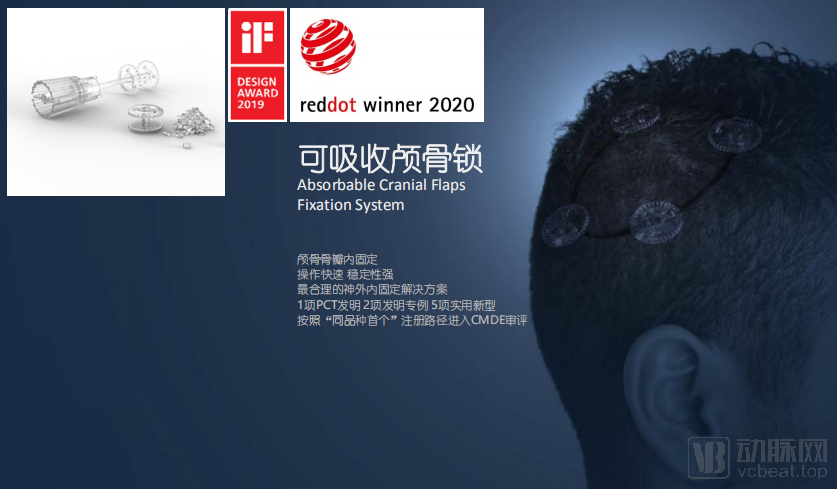
Schematic Diagram of Absorbable Cranial Lock
MEDART Absorbable Cranial Lock is fabricated from proprietary absorbable polyester material, featuring patented material technology and an innovatively optimized structural design. It enables rapid, stable, and safe internal fixation of cranial bone flaps. The product is safely absorbed and metabolized in the body into CO₂ and H₂O, effectively avoiding the long-term risks associated with permanent neurosurgical implants. Furthermore, it poses no risk of displacement or heating during MRI scans, making it one of the most ideal internal fixation solutions for neurosurgery. The product holds 1 PCT patent, 2 invention patents, and 5 utility model patents.
Notably, MEDART’s absorbable cranial lock successfully entered the CMDE review process via the “first-of-its-kind” registration pathway, with product registration expected to be completed within 2020.
Driven by the acceleration of "import substitution," the increasing number of high-tier hospitals, and enhanced capabilities in performing complex surgeries, the demand for implantable medical devices in China continues to grow. According to Double Medical's prospectus, the sales revenue of the neurosurgical implantable consumables market increased from RMB 1.3 billion to RMB 2.6 billion between 2010 and 2015, representing a compound annual growth rate (CAGR) of 14.01%. Major neurosurgical implantable consumables include cranial internal fixation devices (such as cranial locks and connection plates), dural patches, cerebral aneurysm clips, drainage tubes, and consumables for intracranial pressure monitoring sensors, with cranial internal fixation devices accounting for the largest share. By 2019, the sales scale of the neurosurgical implantable consumables market had approached RMB 5 billion. With the development of neurosurgery as a discipline in China, the overall market for neurosurgical implantable consumables has maintained a steady growth trajectory. Currently, domestic brands remain absent or hold a weak position in many niche segments. As the process of "import substitution" accelerates, China's neurosurgical medical consumables sector is poised for robust growth.
MEDART is rooted in the field of neurosurgery, specializing in the design and development of biomedical material-based medical devices. Currently, all products in its R&D pipeline are high-quality consumables for neurosurgical applications. To this end, the company has maintained close integration with clinical practice, establishing clinical collaborations with leading medical institutions such as West China Hospital of Sichuan University, Xiangya Hospital of Central South University, Renmin Hospital of Wuhan University, and the First Affiliated Hospital of Hunan University of Chinese Medicine. Guided by clinical needs in its product development, MEDART has built a strong foundation of trust and collaboration with numerous hospitals.
It is reported that MEDART completed its pre-A and Series A financing rounds in 2015 and 2018, respectively. The company has now initiated a new Series A+ financing round, aiming to raise approximately RMB 20 million. The funds will be primarily used for post-launch business expansion and academic promotion of its absorbable cranial bone products, as well as for advancing clinical research on its pipeline of high-value neurosurgical medical device consumables.