


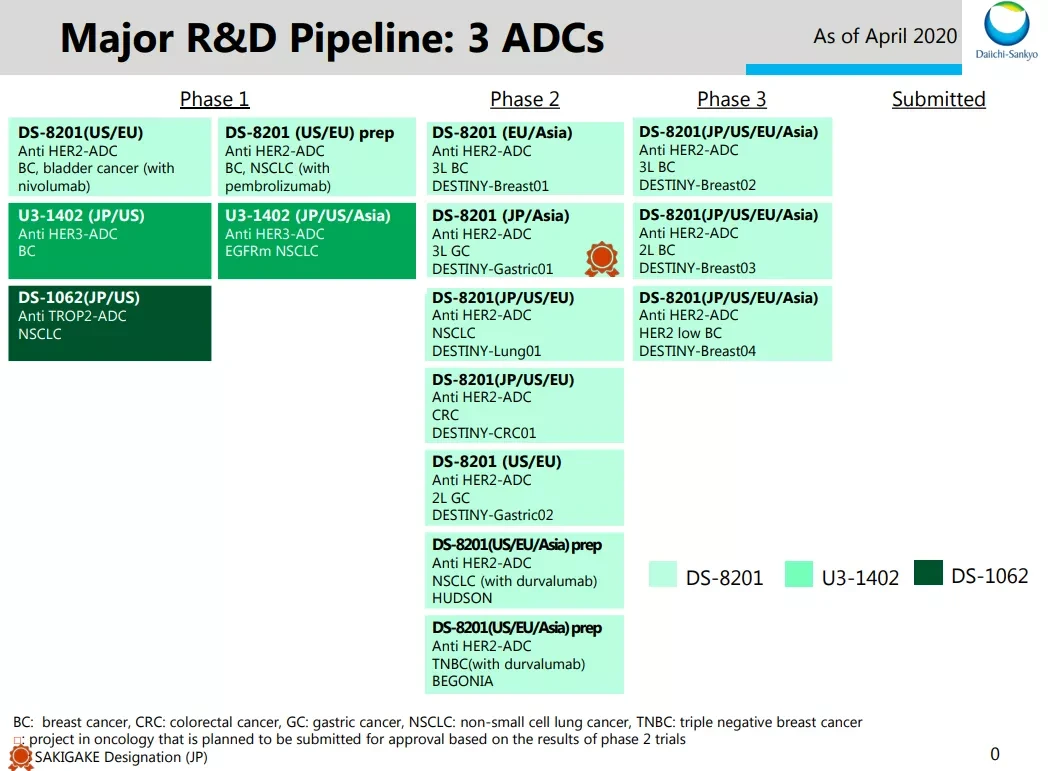
On July 27, Daiichi Sankyo announced a global collaboration and development agreement with AstraZeneca for the antibody-drug conjugate DS-1062. DS-1062 is a TROP2-targeting antibody-drug conjugate currently in Phase I clinical trials, being developed for the treatment of non-small cell lung cancer (NSCLC) and triple-negative breast cancer (TNBC).
Under the agreement, both parties will jointly be responsible for the development and commercialization of DS-1062 in global markets outside Japan, sharing profits equally. Daiichi-Sankyo retains exclusive marketing rights for DS-1062 in Japan and assumes full responsibility for global manufacturing and supply. AstraZeneca will pay Daiichi-Sankyo an upfront payment of $1 billion (paid in three installments: $350 million upon effectiveness of the agreement, $325 million 12 months after effectiveness, and $325 million 24 months after effectiveness), with future milestone payments totaling $5 billion ($1 billion in regulatory milestones and $4 billion in sales milestones), bringing the total transaction value to $6 billion.
This transaction also marks the second global collaboration between Daiichi Sankyo and AstraZeneca in the field of antibody-drug conjugates (ADCs). On March 29, 2019, AstraZeneca and Daiichi Sankyo entered into a global development and commercialization agreement for DS-8201 (trastuzumab deruxtecan), a HER2-targeting antibody-drug conjugate. The deal structure was nearly identical to that of the current DS-1062 agreement. The key difference was that DS-8201 was in Phase III clinical trials at the time, prompting AstraZeneca to make an upfront payment of $1.35 billion to Daiichi Sankyo. With subsequent milestone payments included, the total value of the transaction reached $6.9 billion. DS-8201 was approved by the U.S. Food and Drug Administration (FDA) in December 2019 under the brand name Enhertu.
Trophoblast cell-surface antigen 2 (Trop-2) is a transmembrane protein highly expressed on the surface of various tumor cells, including those in breast cancer, cervical cancer, colorectal cancer, renal cancer, liver cancer, lung cancer, pancreatic cancer, and prostate cancer. The positive expression rate of Trop-2 exceeds 80% in patients with triple-negative breast cancer (TNBC), and it is also highly expressed in non-small cell lung cancer (NSCLC); however, its expression in normal tissues is limited. Studies have further revealed that Trop-2 is associated with cancer cell proliferation and poor patient survival prognosis, making it an ideal therapeutic target for cancer.
DS-1062 is one of the three core antibody-drug conjugate (ADC) assets in Daiichi Sankyo’s oncology pipeline (DS-8201, DS-1062, and U3-1402). Developed using its DXd ADC technology platform, DS-1062 comprises a humanized monoclonal antibody targeting Trop-2 conjugated to the novel cytotoxic payload DXd via a tetrapeptide linker. Preclinical studies have demonstrated that DS-1062 can highly selectively recognize the Trop-2 receptor on the surface of tumor cells, followed by internalization into the tumor cells. Within the lysosomes, the tetrapeptide linker is cleaved, releasing the toxin to exert its cytotoxic effect and kill the tumor cells.
The anticancer activity of DXd is 10 times that of SN-38, the active metabolite of irinotecan. Moreover, DXd exhibits lower toxicity, thereby minimizing damage to normal cells. In addition, the payload possesses favorable membrane permeability, enabling it to penetrate adjacent cancer cells—even those not directly targeted—after killing the primary target cell, a phenomenon known as the "bystander effect." The cleavable tetrapeptide linker (GGFG) used in DS-1062 features a fixed aminomethylene spacer, which reduces hydrophobicity and ensures stability in systemic circulation compared to traditional p-aminobenzyl spacers. This ADC design strategy not only significantly enhances efficacy but also helps reduce adverse effects.
An open-label, Phase I clinical trial evaluated the safety and tolerability of DS-1062 in patients with previously treated non-small cell lung cancer (NSCLC). Results showed that among 46 evaluable patients (receiving DS-1062 at doses ranging from 0.27 mg/kg to 10.0 mg/kg), 12 achieved partial response. Of the 7 patients who received the recommended dose of 8.0 mg/kg, 5 achieved partial response, while the other 2 currently have stable disease. As of August 20, 2019, 35 patients were still ongoing in the trial. Furthermore, DS-1062 was well tolerated, with the most common adverse reactions being fatigue and nausea.
On April 22, the FDA approved the marketing of Immunomedics’ antibody-drug conjugate Trodelvy (sacituzumab govitecan-hziy) for the treatment of adult patients with metastatic triple-negative breast cancer who have previously received at least two therapies. Trodelvy is the first antibody-drug conjugate approved by the FDA for the treatment of triple-negative breast cancer, as well as the first approved antibody-drug conjugate targeting Trop-2.

Daiichi Sankyo CEO Sunao Manabe
Sunao Manabe, President and Chief Executive Officer of Daiichi Sankyo, stated: “DS-1062 is an antibody-drug conjugate (ADC) developed based on our leading DXd ADC technology platform. It is a Trop-2-targeting ADC with best-in-class potential for the treatment of various tumors, including lung cancer and breast cancer. This collaboration with AstraZeneca will enable us to deliver DS-1062 to more patients worldwide at the fastest possible pace. As with our previous collaborative development of Enhertu, we will jointly design and implement clinical development strategies to maximize the clinical value of DS-1062.”