

Skynor Medical: Five Years in the Making, Building a Complete Neurointerventional Portfolio and Poised for Domestic Market Breakthrough

Skynor Medical
Vascular Minimally Invasive Intervention Product Developer
As the founder of Skynor Medical, Zhao Zhenxin boasts an impressive background. He previously served as Co-Founder and Vice President of Technology at Peijia Medical (HK09996), where he spearheaded the research and development of multiple innovative interventional devices. This includes the TaurusOne transcatheter aortic heart valve, which received special approval for innovative medical devices from the National Medical Products Administration (NMPA) and successfully completed multi-center clinical trials in China, demonstrating outstanding follow-up efficacy.
Prior to joining Peijia Medical, he joined MicroPort Scientific Corporation (HK00853) in 2003, where he served as one of the company’s first senior engineers and as Senior R&D Manager for peripheral products, overseeing the development of multiple peripheral and neurovascular products.
Compared to the “domestication” progress of coronary interventions, neurovascular and peripheral interventions have lagged behind, with foreign brands currently holding 95% of the market share. Leveraging nearly 20 years of experience in the medical device industry and holding over 60 patents for interventional devices, Zhao Zhenxin founded Skynor Medical in 2014 with the determination to change the import-dominated landscape of China’s neurovascular and peripheral intervention markets.
Skynor Medical (full name: Skynor Medical (Shanghai) Co., Ltd.) is located in the Shanghai Pudong International Medical Zone,The company focuses onDeveloping high-end minimally invasive vascular interventional products to provide comprehensive treatment solutions for patients with stroke and peripheral vascular diseases. After more than five years of low-profile research and development, Skynor Medical has rarely appeared in the media, but it has quickly risen to the first tier of domestic neuro-interventional and peripheral interventional device manufacturers thanks to its outstanding product pipeline.
China is one of the countries with the highest incidence of stroke (commonly known as “wind stroke”) in the world. The “Report on Cardiovascular Diseases in China 2016” pointed out that there are currently 13 million stroke patients in China, with 2.5 million new cases and 1.9 million deaths from stroke each year. Stroke has become the leading cause of death among Chinese citizens. The “Outline of the ‘Healthy China 2030’ Plan” has elevated the prevention and control of stroke to a national strategy.
Stroke is primarily categorized into ischemic stroke and hemorrhagic stroke. Ischemic stroke, also known as "cerebral infarction," accounts for 85% of all stroke cases. Based on the origin of the thrombus, the etiologies are mainly classified as cerebral arterial embolism (20%), extracranial carotid artery embolism (22%), cardioembolism (33%), and other unknown causes. Currently, vascular recanalization and reperfusion represent the optimal treatment strategy.
Driven by the rising demand for cerebrovascular and cardiovascular treatments due to population aging, significant government attention and policy support, as well as internal and external factors such as the continuous innovation and iteration of neurointerventional products, the neurointerventional device market has experienced rapid growth. According to data from the China Medical Device Blue Book, Frost & Sullivan, and the 5th Academic Annual Meeting of the Neurointervention Branch of the Chinese Stroke Association (CINS 2020), the market size for neurointerventional devices reached RMB 6.3 billion in 2019, with 40,000 thrombectomy procedures performed. The compound annual growth rate (CAGR) from 2015 to 2019 was as high as 30%, indicating that the neurointerventional field is entering a period of robust development.
Due to the high precision requirements for interventional products used during surgery, domestic brands hold a generally low market share in the neurointerventional device sector, with 95% of the market monopolized by foreign medical giants such as Medtronic, Terumo, and Stryker. Industry insiders note that the current volume of neurointerventional procedures is comparable to that of cardiac interventions in 2004. With favorable policies and technological advancements, China’s neurointerventional field is poised to enter a “golden decade.”
Looking at the peripheral intervention market, in 2017, the volume of peripheral arterial interventional procedures in China was 99,000. It is expected to reach 171,000 cases by 2022, with an annual compound growth rate of 11.4% during this period, driven by improved living standards and heightened health awareness. Among these, lower extremity arterial interventions accounted for approximately 72.8% of the total volume and exhibited the fastest growth, with a projected compound annual growth rate of 13.4% from 2017 to 2022.
In 2017, the market size of peripheral vascular interventional devices in China was approximately RMB 3.01 billion, with peripheral arterial interventions accounting for RMB 2.12 billion and venous interventions for RMB 890 million. The market is projected to reach RMB 7.12 billion by 2022, representing a compound annual growth rate (CAGR) of approximately 18.8%.
Both neurointerventional and peripheral interventional procedures have demonstrated strong market potential, which is why Zhao Zhenxin decided to establish Skynor Medical to focus on product development in these two major sectors.
Zhao Zhenxin emphasized that Skynor Medical is a technology-oriented medical device company.
“We believe that only products that gain physicians’ endorsement and can effectively and reliably treat patients’ diseases and alleviate their suffering can be deemed ‘good products.’ This is the principle that Skynor Medical has consistently upheld in its product development,” said Zhao Zhenxin.
At Skynor Medical, R&D personnel account for 80% of the company’s total workforce, with the team boasting over 15 years of experience in the field of neuro and peripheral interventions.
Zhao Zhenxin introduced,In the field of neurointervention, the company has three product pipelines and has initially formed a relatively complete neurointerventional product solution. Among them, neuroischemic products include thrombectomy stents (for treating cerebral infarction thrombus), intracranial balloon catheters (for treating stenotic lesions), distal protection devices (to prevent plaque or thrombus detachment during surgery), etc. The thrombectomy stent products are benchmarked against Medtronic's and Stryker's thrombectomy products, with certification expected in the second quarter of 2021.
Neurovascular hemorrhagic products include intracranial flow diverter stents and intracranial aneurysm stents; neurovascular access products include distal access catheters, microcatheters, and balloon guide catheters. All access products are currently under registration application, with certification expected in the second quarter of 2021.
In the field of peripheral interventions, the next-generation peripherally inserted stent, independently developed, is currently undergoing clinical trials. Additionally, several other interventional products, including peripheral balloon dilation catheters and PTA balloon dilation catheters, are expected to receive certification by the end of 2020.
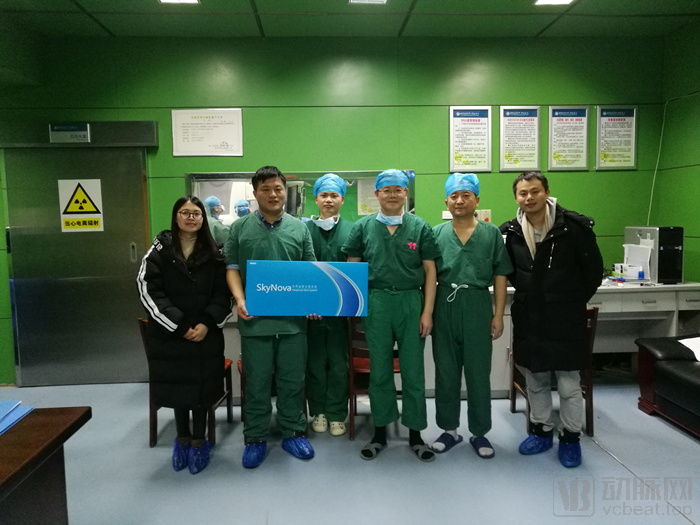
(SkyNova Peripheral Vascular Stent: First Clinical Enrollment at the First Affiliated Hospital of Bengbu Medical College)
“Currently, we have more than 12 products either awaiting regulatory approval or under development. Our two flagship core products are thrombectomy stents for stroke treatment and intracranial flow diverter stents.“Zhao Zhenxin told VCBeat.”
In 2015, China and the United States updated their guidelines for the management of acute ischemic stroke, recommending that mechanical thrombectomy using devices such as the Solitaire™ stent retriever be adopted as the preferred treatment approach for patients with acute ischemic stroke, in addition to standard intravenous thrombolysis (IV-tPA). Stent retriever thrombectomy was also listed by the Cleveland Clinic as one of the “Top 10 Medical Technology Innovations of 2016.” Consequently, mechanical thrombectomy has emerged as a new direction in stroke treatment.
This independently developed product by Skynor MedicalSkyFlow Thrombectomy Stent, from the project's initiation in 2016 to the completion of clinical trials and application for regulatory approval, it underwent four years of refinement. "In 2016, when we conducted design input for the development of our thrombectomy stent, Medtronic's first-generation Solitaire FR was already on the market in China. However, by 2020, the third-generation Solitaire FR Platinum had also been launched domestically," stated Zhao Zhenxin.““In terms of product innovation, the team dedicated significant time to refinement, pioneering numerous new designs to ensure the product’s advanced status at launch.”
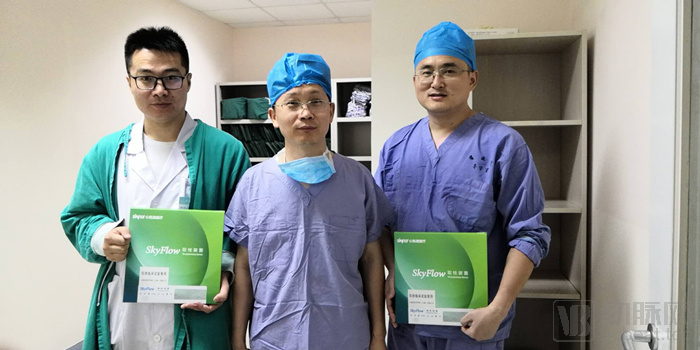
(SkyFlow Thrombectomy Stent Successfully Enrolled in Its First Case at Henan Provincial People's Hospital)
From a product structure perspective, Skynor Medical’s thrombectomy stent features a dual-helix closed-loop design, offering high flexibility and superior embedding into thrombi. In terms of radiopacity design, the stent incorporates multiple radiopaque markers, enabling physicians to better assess stent deployment morphology, thrombus engagement, and thrombus length, thereby improving thrombectomy success rates and procedural efficiency.
“We also designedThe 3-mm-diameter thrombectomy stent, designed for use in small intracranial vessels, demonstrates outstanding efficacy in treating thrombi in distal small intracranial vessels.“Zhao Zhenxin introduced. Based on the favorable product performance, in the randomized controlled trials of clinical studies,”The SkyFlow thrombectomy stent demonstrated excellent performance, achieving an intracranial vessel recanalization rate of nearly 90%.
Another core product is the intracranial flow diverter stent, this product is used for the treatment of intracranial aneurysm hemorrhage.In the early stages of product design, Zhao Zhenxin led his team in studying various cutting-edge intracranial flow diverter stent products and their characteristics both domestically and internationally. He stated that, in terms of current technological standards,The technical level of this product has basically reached that of the most advanced products currently in clinical use.. The product is scheduled to conduct domestic multicenter clinical studies in 2021.
Based on a rich product portfolio,The company has currently established collaborations with more than ten renowned medical centers in China, including five model Advanced Stroke Centers: Henan Provincial People’s Hospital, Nanyang Central Hospital, the First Hospital of Jilin University, Nanjing First Hospital, and the First Affiliated Hospital of Xi’an Jiaotong University.
“People are accustomed to categorizing products into low-, mid-, and high-end tiers. In my view, when manufacturing medical devices, particularly high-end interventional cardiovascular and cerebrovascular devices, it is imperative to aim for the high end. Only products of the highest caliber and quality will be accepted and utilized by clinicians. Domestic manufacturers, in particular, must place great emphasis on product quality control,” stated Zhao Zhenxin.
He revealed that the company expects to obtain registration certificates for seven Class III medical devices next year, including five products for cerebral ischemia and two balloon catheter products. Regarding future plans, he stated that the company will accelerate the clinical trials and regulatory approval of its intracranial flow diverter stents, aiming for market launch as soon as possible. The company also hopes to further enrich its peripheral intervention product portfolio to establish a comprehensive product pipeline.
“Ultimately, we hope that our neurointerventional and peripheral interventional business segments will complement each other, enabling our products to capture a significant market share and reach the pinnacle of high-end domestic medical devices, thereby benefiting a vast number of patients in China,” said Zhao Zhenxin.