

7Invensun Files IPO Prospectus: Global Leader in Eye-Tracking Patent Families Empowers Communication and Social Interaction Through Gaze-Based Assistive Devices

7invensun
Eye-tracking technology, machine vision developer

CAS Investment
Professional investment management institutions

Qualcomm Ventures
Investment Institutions Focused on the TMT Sector, Including Telecommunications and Information Electronics
To achieve a realistic visual experience in the virtual world, it is essential to ensure image fidelity, which requires powerful graphics cards for rendering. However, not every user has access to top-tier GPUs. To reduce the demand for GPU performance, foveated rendering technology has been introduced. This technique renders images at the point of gaze while selectively “ignoring” peripheral areas, thereby meeting users’ needs for realistic imagery and delivering an immersive visual experience. This technology is driving the development of the virtual reality industry.
ButThe core of foveated rendering technology lies in tracking the eye's point of gaze, which involves eye-tracking technology.With the development and rise of the virtual reality (VR) industry, 7invensun, a company specializing in eye-tracking technology, has frequently come into the spotlight among industry practitioners. Its partners include HTC VIVE, Pimax, and iQIYI, among others. This inevitably creates the misconception that eye-tracking technology is applicable only within the VR sector. The answer is obvious. Over years of development, 7invensun has been deeply cultivating the medical field. How have they achieved this? What applications does eye-tracking technology have in healthcare? To address these questions, VCBeat interviewed Huang Tongbing, founder of 7invensun.
As tech giants like Google and Apple expand into the virtual reality industry, they have been continuously acquiring companies with eye-tracking technology, drawing increasing attention to this field. However, this is not a new technology that has only emerged in recent years. 7invensun, for instance, has been dedicated to research and development in this area for 11 years.
Huang Tongbing, founder of 7invensun, is currently pursuing an EMBA at Tsinghua University. He graduated from Shenyang Aerospace University with a major in Aircraft Manufacturing Engineering. After graduation, he primarily focused on developing collaborative design platforms for aircraft and participated in multiple national projects, including the C919 large passenger aircraft. However, after three years in the industry, driven by his passion for eye-tracking technology,He hopes to further promote this technology in both military and civilian fields, so he chose to start a business.In 2009, he founded 7invensun.
Huang Tongbing told VCBeat that eye-tracking technology is applied in the helmets of fighter pilots and other aviation personnel. In fighter jets such as the U.S. F-22, pilots are allowed to lock onto targets using their eyes. His dedication to technological research led Huang to file an invention patent for an “Input System and Method Based on Machine Vision” as early as 2008, prior to launching his startup.
During the 2012 financing round, he met Peng Fan, who is now a co-founder of 7invensun. Peng Fan specializes in computer image processing, and both individuals were keen on expanding the applications of eye-tracking technology at that time.7invensun has been continuously expanding its team during its development. Currently, the team comprises over 70 members, with R&D personnel accounting for two-thirds of the total.
Currently, the team members of 7invensunThe scope of research encompasses core algorithm development, artificial intelligence model training, data acquisition and annotation, hardware circuit architecture, industrial design, and other fields.7invensun Shenzhen'sThe factory enables scaled-up product manufacturing and testing, as well as the development of upper-level software applications.
Over the past decade, 7invensun has continuously accumulated patents, building its own patent barrier.As of the second quarter of 2020, 7invensun held 407 patents, including 289 invention patents. Its eye-tracking technology patent family, comprising 94 patents, ranked first globally.Qualcomm has invested in 7invensun for three consecutive years, driven by its optimism about the company's development prospects within the industry.
Huang Tongbing stated, “Although eye-tracking technology is impressive, few companies have successfully commercialized it at the product level.” 7invensun has consistently achieved product commercialization by launching various devices and modules.Currently, 7invensun’s products span across platforms such as Android and Windows, covering virtual reality (VR) and augmented reality (AR) headsets, smartphones, tablets, and other devices. 7invensun has also optimized its solutions for the Qualcomm Snapdragon 835 and 845 platforms, enabling low-latency performance for smartphone-based VR applications.
7invensun's eye-tracking technology boasts a sampling rate of up to 380 frames per second. In view of the uniqueness of the human eye,7invensun interprets the human eye from multiple data dimensions, collecting extensive feature data from the pupil, eyelids, iris, and other sources.Huang Tongbing also noted that the human eye is complex. For instance, special data processing is required for users who wear glasses or have undergone eye surgery. This is also a key area of focus for 7invensun.
“In 2009, eye-tracking technology was not widely recognized. Wearable devices such as Google Glass, which gradually adopted eye-tracking technology, only emerged at a later stage.” At the inception of the company, Huang Tongbing stated, “We focused our efforts on addressing the needs of individuals with critical demands. In the healthcare-oriented sector, we developed eye-gaze communication assistive devices.”
With tech giants such as Google launching virtual reality devices, 7invensun has also begun to establish its presence in the VR sector. Leveraging its technological expertise, 7invensun subsequently introduced AI-based eye-tracking analytics data products in the field of eye tracking. Currently,7invensun’s products primarily include eye-tracking communication assistive devices, virtual reality products, and eye-tracking data analytics solutions.
Eye-tracking Communication Assistive Device,The product line primarily includes eye-controlled tablet all-in-one devices, head trackers, monocular/binocular eye trackers, and accessories compatible with the head and eye trackers. All these devices are independently manufactured by 7invensun.The price of eye-tracking communication aids ranges from a few thousand to hundreds of thousands of yuan. Users can employ these devices to input text (which can be converted to speech) for self-expression, and even engage in online chat. One user, who was avid about stock trading before falling ill, has since relied on the 7invensun eye-tracking communication aid to trade stocks and support his family.
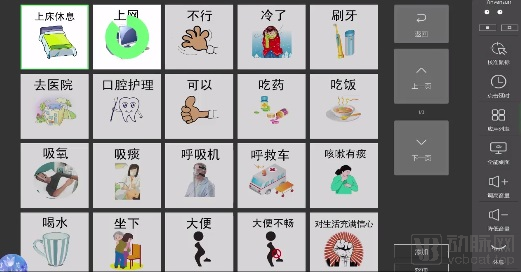
Eye-Tracking Communication Assistive Device Interface
7invensun's Eye-Tracking Communication Assistive DevicePrimarily targets patients with ALS, high-level paraplegia, and cerebral palsy.and other areas are also seeing some breakthroughs. Previously, 7invensun collaborated with Xuanwu Hospital on a project funded by the Beijing Municipal Science and Technology Commission, conductingStroke PatientsResearch on the Operation and Use of Eye Trackers. Currently, 7invensun is moving towardsDisabled, mobility-impaired elderly, providing simplified eye-tracking communication aids to help the elderly use technology for communication or accessing news and other information.
The virtual reality products discussed here do not refer solely to head-mounted displays equipped with eye-tracking technology, but rather to related devices used in the medical field. For instance, 7invensun is currently conducting clinical research in ophthalmology,Diagnosis and Subsequent Adjunctive Therapy for Amblyopia and Strabismus, which is achieved by combining VR wearable devices with eye-tracking technology.
7invensun is also conducting some experiments. For example,Detects changes in pupil size to enhance comfort during the eyeglass fitting process, relevant studies have been published. These were all conducted using 7invensun's eye-tracking technology on devices that are nearly indistinguishable from ordinary eyeglasses.
The eye-tracking analytics data product is powered by big data analysis of historical eye-tracking data.Eye-tracking data analysis enables the assessment of changes in users' psychological and behavioral patterns. 7invensun is integrating this technology with clinical healthcare to conduct research on psychological, behavioral, and cognitive aspects in both adults and children.In the future, 7invensun will further expand into the early diagnosis of ADHD and autism.
7invensun is currently collaborating with Ping An and the Spanish startup Braingaze on attention-deficit/hyperactivity disorder (ADHD), aiming to provide convenient and accurate diagnostic solutions. The project is currently in discussions with research teams from renowned universities. In the future, the Spanish team will promote this solution system in the treatment of specific syndrome populations in China by leveraging 7invensun’s eye-tracking technology.
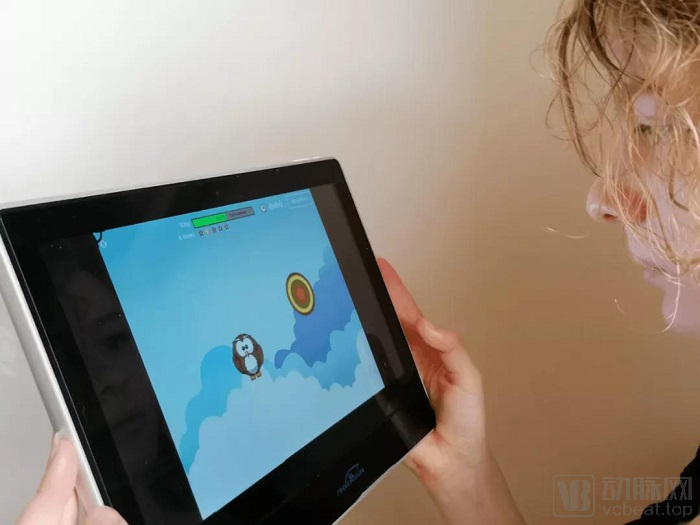
Spanish Team’s App for the Diagnosis and Treatment of ADHD
7invensun is striving to become an international company. It is not only targeting the domestic market but also placing greater emphasis on its performance in the international market.7invensun's products are mainly exported to Russia, Europe, the United States, Australia, Japan, and other regions.For the Japanese market, it has launched distinctive assistive communication devices for the elderly.
Huang Tongbing stated that 7invensun can provideDifferentiated solutions that offer not only finished devices but also chip-level eye-tracking technology.This allows vendors to make selections based on their own needs. Compared with Tobii, the eye-tracking technology company acquired by Apple,7invensun considers its technology platform to be more open. Compared with foreign manufacturers, 7invensun has a geographical advantage in implementing domestic projects, enabling faster response times.
Currently, 7invensunPlanning Series B+ funding round.This round of financing is planned to be used for the implementation of product production. In the future, 7invensun plans to focus on research projects related to autism and attention deficit hyperactivity disorder (ADHD).7invensun believes its technology can facilitate timely diagnosis for patients, transforming medical practices that previously relied on experience and intuition into precise, instrument-based measurements, thereby assisting physicians in diagnosis and treatment.
Huang Tongbing believes that eye-tracking technology falls within the field of human-computer interaction, and its application in the medical sector can address numerous issues. For example,In the face of infectious diseases such as COVID-19, non-contact operation of medical devices is enabled.By leveraging eye-tracking technology, physicians can operate devices in a contactless manner, thereby reducing the risk of infection. This will also be the next area of exploration for 7invensun.