Home Genesee BioMedical's ATLAAS Inflatable Left Atrial Appendage Closure Clip Receives FDA Approval

Genesee BioMedical's ATLAAS Inflatable Left Atrial Appendage Closure Clip Receives FDA Approval

Jun 04, 2026 18:50 CST Updated 18:50
Med-Zenith

Developer and Producer of Cardiac Surgery Products, Interventional Products, and Biologics

Image

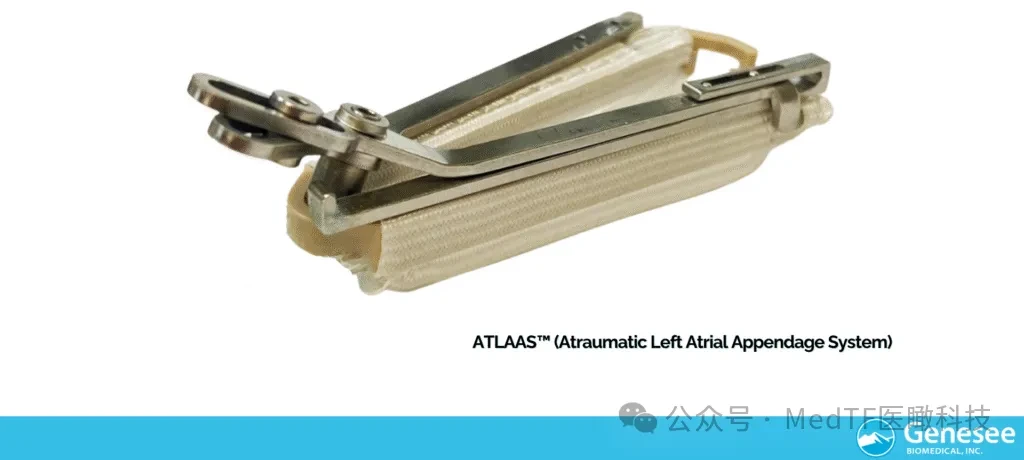
The U.S. FDA has recently officially approved the medical device developed by Genesee BioMedicalATLAAS Left Atrial Appendage Occlusion Clip Launched

This product is specifically designed forEpicardial Left Atrial Appendage Closure Device in Cardiac Surgery. Its core clinical value lies in preventing thrombus formation and embolization by blocking blood flow within the left atrial appendage of patients with atrial fibrillation, thereby reducing the risk of stroke (commonly known as apoplexy).

The launch of this device provides cardiac surgeons with a new option for managing the left atrial appendage during open-heart surgery, minimally invasive procedures, and robot-assisted surgery.
01

Inflation-Driven and Controllable Detachment for Repositioning

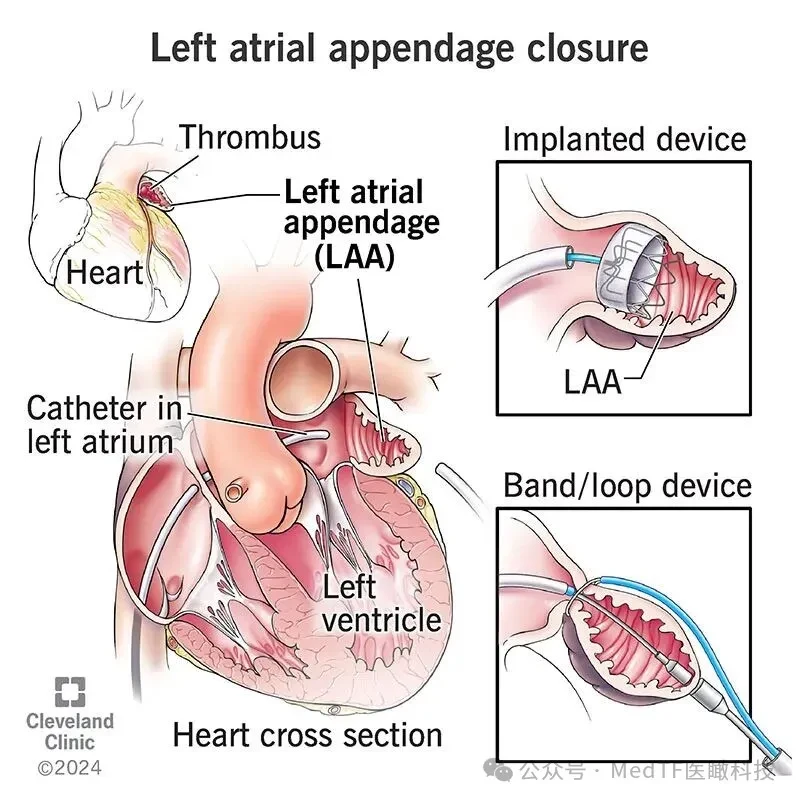
The left atrial appendage is a blind-ended structure located on the anterolateral aspect of the left atrium. In individuals without atrial fibrillation, the left atrial appendage contracts rhythmically in synchrony with the atria; however, in the setting of atrial fibrillation, it loses effective contractile function, leading to blood stasis and a high propensity for thrombus formation. Clinical studies have demonstrated that more than 90% of thrombi in patients with non-valvular atrial fibrillation originate from the left atrial appendage.

Image

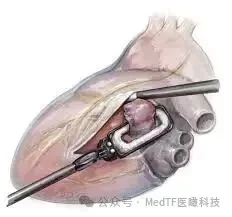
The ATLAAS system employs an epicardial occlusion approach, which involves clamping the base of the left atrial appendage from the external surface of the heart, thereby isolating the blind pouch of the left atrial appendage from the systemic circulation. The core technical principles are analyzed as follows:

Image
  • Non-spring inflatable closure system:

    Traditional similar cardiac surgical clamping devices mostly rely on the mechanical tension of metal springs for closure. ATLAAS changes this approach by adoptingPneumatic Driveto control the closing force.

  • Locking Closure Mechanism:

    The device is designed with a dedicated locking mechanism. Prior to full locking, the operator can adjust inflation and deflation to achieve gradual deployment and precise positioning of the instrument.

  • Controlled Release and Repositioning:

    During the implantation procedure, if imaging modalities such as transesophageal echocardiography (TEE) reveal suboptimal clip positioning or residual shunting, the locking mechanism allows the operator to release the clip and reposition it until satisfactory occlusion is achieved, at which point final locking is performed.

02

ChinaInventory of Surgical Epicardial Clipping Devices

In Left Atrial Appendage OcclusionField of Surgical Epicardial Clipping DevicesIn China, Chinese enterprises have demonstrated strong independent innovation capabilities in recent years.

1. Med-Zenith (Beijing) ——C-Clip®

  • Approved in 2019 (National Medical Device Registration No. 20193130278)

  • Material: Nitinol shape-memory alloy constant-pressure clip, PU soft cannula to prevent coronary artery injury
  • Surgical Approach: Thoracotomy, minimally invasive small-incision, and total thoracoscopy are all applicable; the device allows for repeated opening, closing, and repositioning intraoperatively prior to final deployment.
  • Clinical: The domestically produced cardiac surgery clip with the highest installation volume in China, routinely used at leading centers such as Fuwai Hospital and Anzhen Hospital.

2. Beijing Lingjian Medical (Beijing) — V-Clip®

  • June 2025 Approved (NMPA Registration No. 20253131237)

  • China's First V-Shaped Single-Opening Epicardial Clip, the World's Third V-Shaped Clip (Benchmarking Penditure/ATLAAS Design)

  • Key Highlights: The delivery sheath diameter is only one-third that of traditional systems, offering a more minimally invasive and thoracoscopy-friendly approach. Its single-end opening facilitates easier engagement of hypertrophic and lobulated left atrial appendages.

3. Puhui Biotechnology (Beijing) ——PerClip®

  • September 2022: Class III Registration Certificate Approved

  • Features: Full-range universal adjustment of the delivery system (360° pitch + deflection), compatible with eccentric and small-sized left atrial appendages, one-click self-locking release

  • Applicable to: Surgical thoracotomy / Minimally invasive simultaneous left atrial appendage closure, optimizing operational convenience in narrow thoracic cavities

03

Horizontal Review of Technological Pathways in the Sector

In the current field of stroke prevention in atrial fibrillation, the management of the left atrial appendage is primarily divided into two technical approaches: transcatheter interventional occlusion and surgical clipping, each with distinct technical characteristics in clinical application.

Traditional surgical spring clip systems (e.g., the AtriClip system)

  • This approach belongs to the epicardial pattern of extra-cardiac transmural clipping, with its driving mechanism relying on the mechanical tension of metal springs. Due to the physical properties of metal springs, such devices, once released intraoperatively,Challenging to perform in-situ fine-tuning

  • Primary Indicated Population:Atrial Fibrillation Patients Undergoing Concurrent Cardiac Surgery (Such as Heart Valve Surgery or Coronary Artery Bypass Grafting). Since the device remains outside the cardiac chambers and does not come into direct contact with blood flow, long-term anticoagulation therapy is not required for patients.

Image

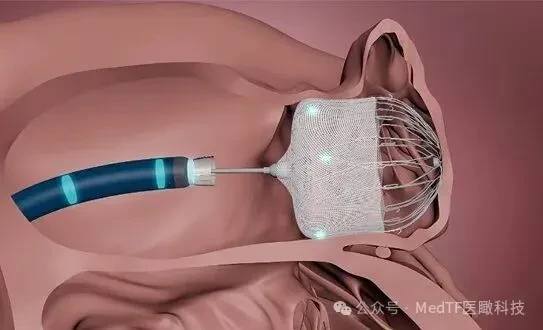
Medical transcatheter interventional occlusion system (e.g., the Watchman system).

  • This approach requires femoral vein puncture and transseptal puncture to deliver the occluder into the left atrium for self-expanding deployment. Devices via this endovascular route can be retrieved before lock release, butImproper operation may easily damage the endocardial tissue.

  • Target Population Primarily IncludesAtrial fibrillation patients intolerant to surgical procedures and requiring stroke prevention alone. Since the occluder remains entirely within the cardiac chamber, patients must undergo a period of endothelialization postoperatively and require strict anticoagulation or antiplatelet therapy in the short term.

Image

Image

? Click to view more content

AJC Releases New Metrics for Improved Quality of Life After Valve Surgery! Quantifying Patients’ Real-World Benefits

Copyright and Disclaimer: MedTF aims to build a platform for academic dissemination and media communication. The copyright of the information contained herein belongs to the respective holders, and we only provide it for the purpose of information transmission. If there is any infringement, please contact us for deletion.