



On August 9, Simcere and Bristol-Myers Squibb jointly announced the official launch of Enrize® (abatacept injection), a drug for autoimmune diseases co-developed and commercialized in the mainland China market by the two parties, marking its formal entry into commercial distribution in mainland China.
Since its approval in the United States in 2005, abatacept has accumulated nearly 15 years of clinical use experience, with global sales reaching nearly $3 billion in 2019. Its official commercial launch in China will provide new treatment options for the numerous patients with rheumatoid arthritis in the country.
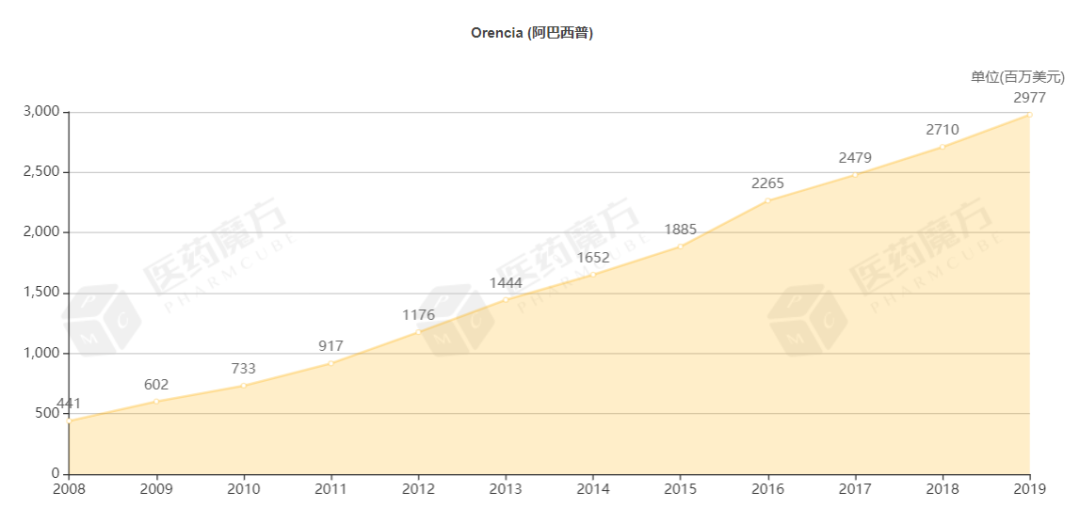
Source: Bristol-Myers Squibb Company Financial Reports, NextPharma
Leading Rheumatoid Arthritis Treatment into a New Era of Precision
Rheumatoid arthritis is characterized by high disease heterogeneity and significant inter-individual variability. The utilization of biomarkers may facilitate the establishment of personalized approaches for the prediction, diagnosis, treatment, and monitoring of immune-mediated diseases [1-2]. Particularly in terms of treatment, biomarker-guided therapeutic decision-making helps determine personalized treatment regimens, thereby shortening the time to reach treatment targets, prolonging the duration of disease control, and reducing the incidence of complications, which will significantly enhance clinical benefits for patients.
Abatacept is the first approved T-cell selective costimulation modulator in the global field of rheumatoid arthritis. It binds to CD80/CD86 on the surface of antigen-presenting cells, thereby blocking their interaction with CD28 on the surface of T cells, which inhibits T-cell activation and reduces downstream inflammatory responses [3]. Additionally, it suppresses antibody production in patients. In the context of rheumatoid arthritis, abatacept demonstrates greater efficacy in patients who are positive for anti-citrullinated protein antibodies (ACPA) compared to those who are ACPA-negative [4-5].
Multiple global studies have shown that abatacept yields higher treatment response rates in patients with ACPA-positive rheumatoid arthritis, which may help rheumatologists identify those who stand to benefit most from abatacept through a biomarker-guided approach. Furthermore, the unique pre-filled subcutaneous injection formulation of Enrui® offers greater ease of use for patients. Therefore, the launch of Enrui® may mark the entry of rheumatoid arthritis treatment in China into a “new era of precision.”
Professor Zeng Xiaofeng, Principal Investigator (PI) for the clinical trials of EnruiShu® (abatacept injection), stated:
With the advent of the biologic era, the treatment of rheumatoid arthritis has undergone significant changes. Enryshu® not only demonstrates greater efficacy in ACPA-positive patients but also offers considerable advantages in terms of safety. The launch of Enryshu® provides Chinese clinicians with a new therapeutic option for the management of rheumatoid arthritis.
Professor Zhang Fengchun, Director of the Department of Internal Medicine at Peking Union Medical College Hospital, Chinese Academy of Medical Sciences, and President of the Internal Medicine Branch of the Beijing Medical Doctor Association, pointed out:
Rheumatoid arthritis has many subtypes, with numerous therapeutic pathways available for treatment. Positive anti-citrullinated protein antibody (ACPA) status is a factor associated with poor prognosis in patients with rheumatoid arthritis. Abatacept has demonstrated significant advantages in both clinical efficacy and safety profile among ACPA-positive rheumatoid arthritis patients, making it a viable treatment option for this population. It is anticipated that, with the future clinical application of abatacept, Chinese physicians will identify additional therapeutic entry points and accumulate further experience, thereby benefiting rheumatologists in China and advancing our understanding of this medication as well as overall academic progress in the field.
Addressing the Unmet Needs of 6 Million Rheumatoid Arthritis Patients
Rheumatoid arthritis is an autoimmune disease characterized primarily by erosive polyarticular damage, which can occur at any age. Although its pathogenesis is not yet fully understood, it is well established that T-cell activation induced by autoantigens and a state of chronic inflammation are critical factors in the development of rheumatoid arthritis. The main pathological changes include synovitis and pannus formation. The most common early clinical manifestations are joint swelling and pain. As the disease progresses, gradual destruction of articular cartilage and bone may occur, ultimately leading to joint deformity and loss of function. Additionally, it may be complicated by pulmonary diseases, cardiovascular diseases, malignancies, and depression.
There are currently 6 million rheumatoid arthritis (RA) patients in China, and this number is increasing year by year. The "Report on the Development of Rheumatoid Arthritis," released in July 2020 by the National Clinical Research Center for Skin and Immune Diseases and the National Rheumatism Data Center, indicates that among existing RA patients in China, the age group of 40–60 years has the highest incidence, with more women than men affected among those over 50 years old. Currently, RA patients mainly exhibit four characteristics: high prevalence, long disease duration, a large proportion of moderate-to-severe cases, and numerous comorbidities. Rheumatoid arthritis not only leads to declines in patients' physical function, quality of life, and social participation but also imposes a significant economic burden on patients' families and society.
According to the "2018 Guidelines for the Treatment of Rheumatoid Arthritis" issued by the Chinese Medical Association, the proportion of patients in China using biologic agents is only 8.3%. The 2017 EULAR report indicates that in some developed countries, such as Belgium and France, approximately 70% of patients with rheumatoid arthritis are treated with biologic agents; this proportion is nearly 50% in the United Kingdom and South Korea. Behind these significant numerical differences lies a substantial unmet need.
Ms. Chen Siyuan, General Manager of Bristol-Myers Squibb for Mainland China and Hong Kong, stated:
On January 8, 2020, Enryshu®, a groundbreaking innovative drug in the field of autoimmune diseases co-developed by Bristol-Myers Squibb and Simcere in China, received marketing approval from the National Medical Products Administration of China. Today, we officially welcome the commercial launch of Enryshu®, which will bring new hope to patients with rheumatoid arthritis in China. In the future, we will continue to dedicate ourselves to providing innovative medicines for the treatment of the most severe and challenging diseases, and strive to expand the accessibility of our medications to help more Chinese patients overcome serious illnesses.
Ren Jinsheng, Chairman and CEO of Simcere, stated:
EnruiShu® is the second product we have launched in the field of rheumatoid arthritis (RA) treatment, following Aidesin®. Given the large population of RA patients in China, the proportion of patients opting for biologic therapies is expected to rise rapidly in the future, indicating a substantial unmet need in this therapeutic area. Simcere will continue to pursue scientific research and therapeutic development in the field of autoimmune diseases. The launch of EnruiShu® in mainland China today marks a significant advancement in RA treatment. The “State Key Laboratory of Translational Medicine and Innovative Drug Development” at Simcere will establish a series of open research projects, looking forward to collaborating with experts from key hospitals on in-depth studies regarding the broader clinical application of EnruiShu®, thereby faithfully fulfilling the corporate mission of “enabling patients to access more effective medications sooner.”
References:
[1]Plant D , Wilson A G , Barton A . Nature Reviews Rheumatology, 2014, 10(6):329.
[2]Willis J C D , Lord G M. Nature Reviews Immunology, 2015, 15(5):323-329.
[3] Bonelli M, Scheinecker C. Current opinion in rheumatology, 2018, 30(3): 295-300.
[4] Alemao E, Postema R, Elbez Y, et al. Clinical and Experimental Rheumatology, 2019.
[5] J. E. Gottenberg. et al. Arthritis & Rheumatology, Vol. 68, No. 6, June 2016, pp 1346–1352