

Subtle Medical Named to CB Insights' Digital Health 150 List; Advances AI-Powered Medical Imaging with SubtleGAD
Subtle Medical
Medical Imaging Software Developer

Infervision
Artificial Intelligence Product Developer

XtalPi
Computation-Driven Innovative Drug R&D Provider

Taimei
Life Sciences Industry Digital-Intelligence Operations Platform

MediTrust Health
Innovative Inclusive Health Medical Service and Security Platform

CB Insights
Market Intelligence Analysis Platform
Amid growing emphasis on healthcare, “digital health” has gradually become a global hotspot. Earlier this month, Teladoc, a U.S.-based telemedicine provider and leading digital health company, merged with Livongo, another leader in online health management, aiming to integrate telemedicine with chronic disease management and promote digital health services that combine primary and specialty care. Mergers and acquisitions activity also reflects the recent explosive growth in digital health, reaching a阶段性 peak.
On August 14, CB Insights, one of Silicon Valley’s most prominent think tanks, released the 2020 Global Digital Health 150 list (CB Insights Digital Health 150), selecting the 150 most promising digital health companies worldwide.
The rankings demonstrate that China’s overall strength in “digital health” is formidable. Notably, the renowned AI medical imaging company Subtle Medical has been included on the list. This marks another prestigious CB Insights award for Subtle Medical, following its inclusion in the 2020 CB Insights AI 100 list in March of this year. In addition to Subtle Medical, other companies on the list include Infervision in the screening and diagnostics sector, and players in the drug discovery field such asXtalPi, in the field of clinical trialsTaimei, such as Penguin Almond and WeDoctor in the health care and emergency care sectors, and MediTrust Health in the payment sector.
Meanwhile, companies are continuously advancing the research and clinical development of new products. As a global leader in AI-based medical imaging, Subtle Medical saw its third product, SubtleGAD, awarded a $1.6 million SBIR Phase II Grant from the U.S. National Institutes of Health (NIH) in early August this year. This funding supports further R&D and clinical implementation, aiming to deliver safer MRI examinations worldwide.
CB Insights Unveils Global Top 150 Digital Health Companies
As one of the world’s most renowned market research firms and think tanks, CB Insights sees its annual rankings eagerly anticipated by companies globally. On August 14, CB Insights announced the second edition of its “Global Digital Health 150” list, selecting the 150 most promising startups from thousands of candidates. The list covers 12 healthcare subsectors, with honored companies hailing from China, Canada, Israel, France, the United Kingdom, the United States, and other countries.
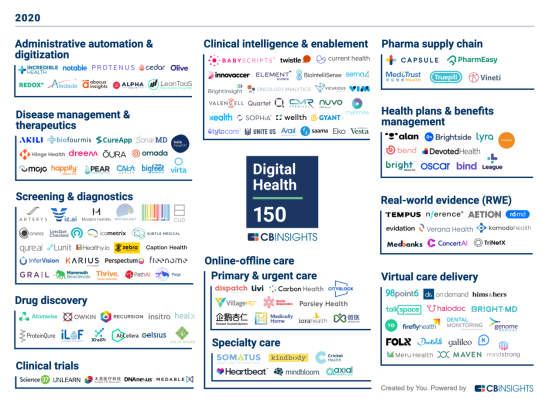
Figure: The Complete List of the 2020 CB Insights Digital Health 150
Inclusion in the “Global Top 150 Digital Health Companies” signifies strong recognition by leading global research institutions of the company’s innovation and future growth potential in the healthcare sector. It is reported that among the 150 companies on this year’s list, there are 13 unicorn enterprises (companies valued at over $1 billion) from around the world. Furthermore, in 2020, the top 150 companies collectively completed more than 600 financing rounds, securing a total of over $2 billion in funding from more than 900 investment institutions.
“This year’s Digital Health 150 is our most global list to date, featuring the leading healthcare companies from 17 countries and regions. These enterprises are driving comprehensive innovation across every segment of the healthcare value chain, with their innovative technologies enhancing outcomes for biopharmaceutical companies, hospitals, patients, insurers, and other stakeholders,” said Anand Sanwal, CEO of CB Insights. “Last year’s global ‘Digital Health 150’ honorees went on to raise approximately $5 billion in funding after being recognized, and we look forward to seeing this year’s winners achieve similar success.”
It is worth noting that in this year’s CB Insights Digital Health 150 list, Chinese healthcare companies delivered impressive overall performance, with multiple standout enterprises making the list across various medical subsectors.
This year, the core creative team originates fromStanford UniversitySubtle Medical, an AI medical imaging company affiliated with Tsinghua University, made the list.
Subtle Medical was founded in late 2017 with the mission of enhancing the quality, efficiency, and safety of medical imaging and its workflows by leveraging “AI + medical imaging,” combining deep learning with image reconstruction technologies. The company currently offers two FDA-cleared and CE-marked medical imaging enhancement products: SubtlePET and SubtleMR. Its clinical partners span the upstream, midstream, and downstream segments of the medical imaging industry. Recently announced clinical and commercial partners include Blackford Analysis, a renowned medical imaging analysis platform in the UK and US; CorTechs Labs, a global leader in brain image processing and AI-assisted diagnosis of brain disorders; RadNet, the largest imaging center network in the United States; and Affidea, a leading European imaging center group.
Subtle Medical’s products are highly innovative and have been clinically implemented in multiple countries worldwide, effectively improving the quality and speed of medical imaging and enhancing benefits for both hospitals and patients. Subtle Medical has launched multiple AI technologies to optimize clinical image acquisition. Its SubtlePET, launched in December 2018, is the world’s first FDA-approved AI-based image enhancement software, enabling hospitals and imaging centers to increase PET scan speeds by at least fourfold. SubtleMR is the world’s first FDA-cleared AI product for MRI (magnetic resonance imaging) enhancement, capable of improving image quality and accelerating imaging speeds by 2–4 times, while being compatible with all MRI scanner models.
In the field of screening and testing, in addition to Subtle Medical, Infervision, which specializes in AI-assisted lung detection products, is also included. Its products received multiple certifications, including FDA and CE approvals, in 2020, and played a significant role in the fight against the COVID-19 pandemic. In the field of drug development, XtalPi, a leading Chinese AI-driven drug R&D technology company, made the list. It has previously secured investments from Tencent Holdings and Alphabet, the parent company of Google,Sequoia Capitalwith total investments exceeding USD 70 million. In the field of clinical trials, listed companies include Taimei, a SaaS service provider for the pharmaceutical industry. In the health and emergency care sector, Penguin Almond, a leading domestic online-to-offline integrated medical chain network platform, and WeDoctor, a well-known online diagnosis and treatment platform for internet hospitals, were included. In the pharmaceutical supply chain sector, MediTrust Health, a leading enterprise in innovative healthcare payment solutions, was also listed.
SubtleGAD Receives $1.6 Million in Phase II Funding from the U.S. National Institutes of Health
In addition to being honored as one of CB Insights’ Global Digital Health 150, Subtle Medical has also achieved frequent breakthroughs in new product development. In August 2020, the research and development of Subtle Medical’s third product, SubtleGAD™, was awarded a $1.6 million grant by the U.S. National Institutes of Health (NIH) under the Small Business Innovation Research (SBIR) Phase II program.
SubtleGAD™ is an AI-based imaging software under development by Subtle Medical, designed to leverage deep learning to reduce the dosage of injectable contrast agents used in MRI scans, thereby minimizing the risk of deposition of heavy metal elements such as gadolinium commonly found in contrast agents.
The National Institutes of Health (NIH) was established in 1887 and is the premier medical and behavioral sciences research institution in the United States, with its fundamental mission being to supportFrontier BiologicsMedical Research. It is reported that Subtle Medical’s development of SubtleGAD™ has received funding from the Phase II Science and Technology Innovation Fund, primarily based on the achievements obtained during its first phase of R&D, as well as the project’s scientific and technological advantages and broad commercial potential.
Magnetic Resonance Imaging (MRI) is currently one of the most common diagnostic procedures, with over 40 million MRI scans performed globally each year. Among all MRI scans, approximately one-third involve the use of Gadolinium-based contrast agents (GBCAs). It has been reported that gadolinium may deposit in patients’ bodies, including the brain, months to years after GBCA-enhanced MRI. The use of GBCAs and subsequent gadolinium deposition can lead to Nephrogenic Systemic Fibrosis (NSF), a condition that causes pain and, in severe cases, may result in disability or even death. Recently, the U.S. Food and Drug Administration (FDA) issued a warning regarding the risk of gadolinium deposition following MRI scans and has required manufacturers of GBCAs to conduct studies in humans and animals to further evaluate the safety of these contrast agents.
SubtleGAD™ is specifically designed to reduce the dosage of contrast agents, thereby minimizing side effects associated with MRI scans. According to reports, low-dose contrast-enhanced MRI will not only benefit millions of patients with advanced chronic kidney disease (CKD) who are currently unable to undergo contrast-enhanced MRI, but also lower the risk of gadolinium retention after contrast-enhanced MRI for patients with normal renal function. Therefore, if this product achieves widespread clinical adoption in the future, it will significantly enhance the safety profile of MRI contrast agents, benefiting the global medical imaging industry. Furthermore, it can be integrated with Subtle Medical’s existing SubtleMR and SubtlePET products to provide hospitals with more comprehensive optimization of efficiency, quality, and safety across the clinical imaging workflow.
“Receiving the NIH SBIR Phase II funding is a strong endorsement of the R&D achievements of SubtleGAD™. Leveraging this technology, hospitals and imaging centers can provide safer MRI examinations with lower contrast agent doses while ensuring clinical image quality. We are deeply grateful to the NIH for its support of the Subtle Medical team and the development of SubtleGAD™, which has taken a solid step toward clinical implementation of our new product,” said Dr. Enhao Gong, Co-founder and CEO of Subtle Medical.
It is reported that SubtleGAD™ received a research award from the Radiological Society of North America (RSNA) in December 2018. In December 2019, Subtle Medical showcased its product at NeurIPS (Conference on Neural Information Processing Systems), one of the world’s most prestigious top-tier academic conferences on AI and machine learning, generating significant industry impact. Meanwhile, multicenter international clinical studies on SubtleGAD™ were selected for presentation at the 2020 annual meeting of the International Society for Magnetic Resonance in Medicine (ISMRM), which was held online this month.