

Link Health: From NDA-Filing In-Licensed Pipeline to Global Development of Proprietary Bone Regeneration Therapies – Assessing Its Growth Potential

Link Health Pharma
Innovative Drug Developer for New Targets
"In our interactions with Link Health Pharma, we have been impressed by the humility and vitality of this company, which was founded in 2012."
Dr. Song Yan, the founder, firmly believes in one principle: enterprises must adapt to change and accurately position themselves amidst such changes; otherwise, their competitive advantage in the future will increasingly diminish. During the interview, she even self-deprecatingly remarked, “Is our sense of crisis too strong?”
This sense of crisis is essentially the wisdom of being prepared for danger in times of peace. Prior to 2018, Link Health Pharma had not undertaken any financing rounds; instead, the company sustained its operations for six years through industrial consulting services and outsourced collaborative development services for new drug projects. In 2018, Link Health Pharma secured an RMB 100 million Series A financing round, led by Huahai Pharmaceutical’s Industrial Fund with participation from several other investors, thereby launching the company into a phase of accelerated growth.
From its origins in industrial consulting services, to licensing in and localizing mature overseas projects, Link Health Pharma has evolved over the past eight years into a scaled innovative drug R&D company with distinct therapeutic advantages—a journey akin to “leveling up by defeating monsters.”
In 2009, Dr. Song Yan earned her Ph.D. in Biomedical Engineering from the University of Twente in the Netherlands. During her six years of master’s and doctoral studies, Dr. Song studied under Professor Jan Feijen, a member of the Royal Netherlands Academy of Arts and Sciences, focusing on the development of drug delivery technologies and research in tissue engineering.

Dr. Yan Song, Founder of Link Health Pharma
Subsequently, Dr. Song Yan joined Bayer in Germany, where she held a scientific management position at the company’s central laboratory at its global headquarters. Like many overseas-educated professionals who return to China, Dr. Song recognized the blueprint and promising prospects for the future development of China’s healthcare industry, and returned home with great ambition. “In reality, ‘returnees’ often struggle to stay grounded in local contexts.” Dr. Song became aware of this challenge early on after her return. She then immersed herself in the industry by joining a contract research organization (CRO) as Director of Overseas Business Development, where she spearheaded efforts to expand services related to import registration of new drugs for foreign pharmaceutical companies and the conduct of international multicenter clinical trials.
Between 2012 and 2014, the biopharmaceutical industry experienced favorable development, with supportive policies further driving industrial reform and innovation. Leveraging this momentum and government funding support for overseas-returning talents to start businesses in China, Dr. Song Yan, who had already been deeply engaged in China’s healthcare industry, founded Guangzhou Link Health Pharma Co., Ltd. (hereinafter referred to as “Link Health Pharma” or “Link Health”) in August 2012.
At its inception, the company primarily provided consulting services to R&D-focused enterprises in Europe and the United States. “Overseas companies sought to gain a deeper understanding of patient and physician needs as well as relevant regulations in the Chinese market, but lacked professional support to facilitate the localization and implementation of their projects in China,” Dr. Song Yan told VCBeat. This approach leveraged the core competencies of the Link Health Pharma team, whose key members had each accumulated several years of experience working at multiple pharmaceutical CROs.
From providing industrial consulting services to overseas enterprises, to establishing a scaled pipeline through license-in deals, and further driving project translation and collaborative commercialization via value-added regulatory and clinical development, Link Health Pharma has developed a more profound understanding of the pharmaceutical industry. Meanwhile, an increasing number of European and American pharmaceutical institutions have engaged in collaborations with Link Health Pharma.
“We have basically completed an exhaustive search of the European market, and we have engaged in communication and cooperation with more than 300 European pharmaceutical companies to varying degrees,” said Dr. Song Yan.
The transition from simple consultation to initiating license-in agreements and advancing domestic registration-related clinical trials marked a significant milestone for the company in late 2014. This strategic shift aimed to enhance the company’s project development capabilities and participate in China’s new drug innovation landscape through the introduction of innovative assets. In late 2014, the company licensed in its first project, LH011, securing exclusive rights for development and commercialization in the Greater China region. This pipeline asset is an oral uPA inhibitor (best-in-class) that has received FDA Orphan Drug Designation, with pancreatic cancer as its first indication. Link Health Pharma has currently advanced LH011 into Phase II clinical trials, with regulatory submission for market approval expected by 2023.
Since 2014, Link Health Pharma has maintained a pace of introducing one European or American project per year. By 2017, the company held four Investigational New Drug (IND) applications for Class 1 innovative drugs. After 2018, following its initial round of financing, the company focused on licensing in mature products and aggressively advanced its R&D pipeline toward late-stage (post-Phase III) development. Currently, its most advanced asset, Project LH06, is undergoing regulatory review for import and market approval in China. The LH06 pipeline primarily targets postherpetic neuralgia (PHN). As the world’s first transdermal patch for PHN, it achieved peak annual sales of $1.4 billion in the United States. Currently, there is only one generic version available in the Chinese market.
Another new drug in its portfolio, LH041, is differentiated by its indication for severe oral mucositis (SOM) induced by tumor radiotherapy and chemotherapy. It has recently achieved positive results in two parallel Phase II clinical trials conducted in Europe and the Asia-Pacific region, respectively. The incidence of SOM was reduced by 39–45%, and patients who had already developed SOM experienced significant and accelerated relief. Following the analysis of Phase II data, there are plans to consider applying for international multicenter Phase III trials both domestically and abroad.
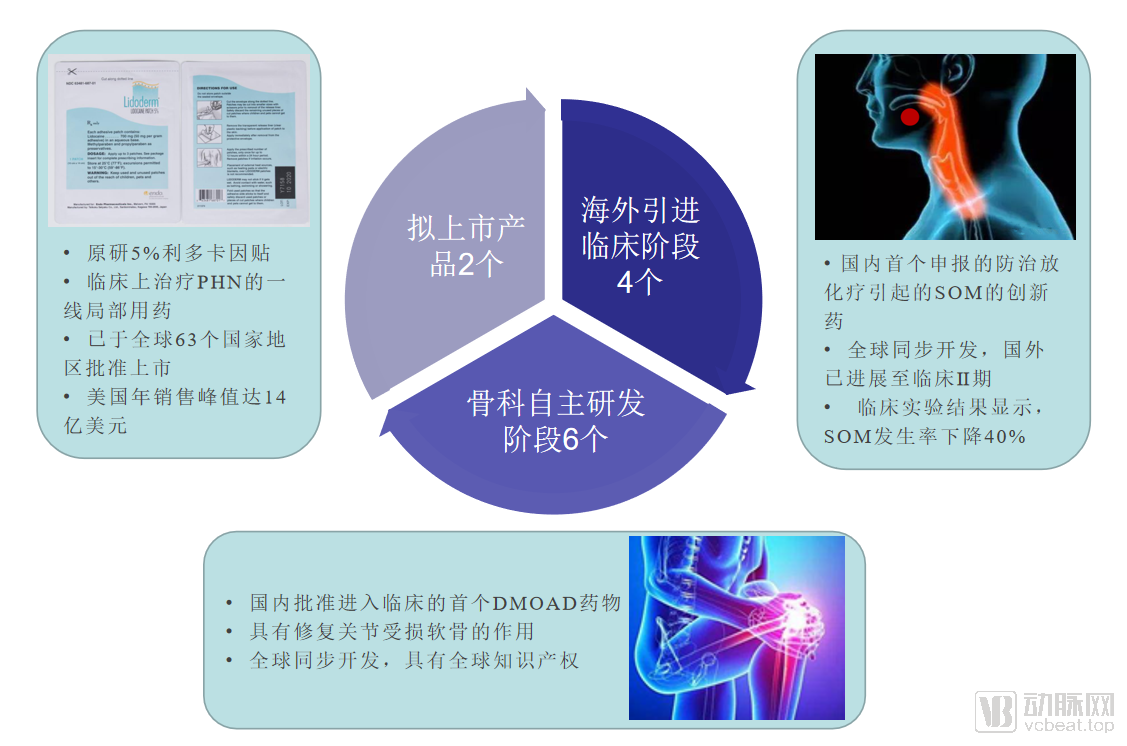
Link Health Pharma's Product Portfolio
Despite having several new drug pipelines in clinical trials, Link Health Pharma seems unsatisfied with merely limiting itself to the introduction and implementation of new drug projects.
“Amid increasingly fierce competition, charting a successful path forward requires not only accelerating R&D but also prioritizing strategic layout and accumulation in specific indication areas to build multiple competitive advantages.” Dr. Song Yan once again highlighted her “sense of crisis,” stating, “If we can gradually develop focused indication areas, it will not only facilitate the accumulation of medical resources but also prove critical for future market promotion. We need to shift our efforts from a dispersed product portfolio toward greater concentration.”
Dr. Song Yan emphasized, “Link Health Pharma started with medical services, rapidly developing introduced projects and achieving successful collaborations with enterprises. This is the value-creation process we have been committed to, and it represents the core know-how that Link Health Pharma has gradually accumulated. Moving forward, we aim to demonstrate that a platform-based enterprise like ours can still emerge as a leading player with significant competitive advantages in the orthopedics sector.”
Currently, Link Health Pharma is strategically restructuring by spinning off its peptide-based novel drugs and “Guxinsheng” bone materials into a new business segment named “Bone Regeneration.” Following this reorganization, “Bone Regeneration” will possess a portfolio of DMOAD (Disease-Modifying Osteoarthritis Drug) candidates in clinical development, active bone biomaterials, and combination drug-device products. Backed by a professional team primarily composed of international orthopedic surgeons and clinical experts, the segment is poised to become a leading enterprise focused on DMOADs and drug-device combinations.
DMOADs primarily target osteoarthritis (OA), a common chronic joint disease characterized by cartilage degeneration and destruction. OA patients undergo a prolonged process of joint aging, from the early onset of symptoms to severe deterioration requiring joint replacement. Throughout this lengthy disease progression, there is a lack of disease-modifying osteoarthritis drugs (DMOADs) capable of repairing damaged cartilage and promoting cartilage regeneration. Currently marketed OA treatments mainly focus on pain relief and symptom improvement, lacking substantial regenerative effects on damaged cartilage and failing to fundamentally address cartilage pathology. Precisely because no DMOADs have yet been approved (with the most advanced candidates only reaching Phase III clinical trials), the value of the OA pharmaceutical market is significantly underestimated.
It is reported that Link Health Pharma is actively advancing the development of a series of disease-modifying osteoarthritis drugs (DMOADs) and “Guxinsheng,” a novel bone material that promotes osteoinduction, while simultaneously establishing a comprehensive system for the acquisition and evaluation of orthopedic imaging data. “Link Health Pharma” is poised to emerge as a versatile newcomer in the orthopedic pharmaceutical and medical device sector.
About the 2020 Maker Guangdong · Biomedicine Special Competition
The 2020 “Maker Guangdong” Biopharmaceutical SME Innovation and Entrepreneurship Competition, guided by the Provincial Department of Industry and Information Technology and the Provincial Department of Finance, and hosted by Guangdong Medical Valley, focused on the biopharmaceutical sector. With over 100 registered projects, the competition comprised five online preliminary rounds and one offline thematic final. Twelve high-quality projects were recommended to advance to the provincial semi-finals, all of which ranked within the top 10 in their respective Enterprise and Maker categories.
Guangdong Medical Valley is a service provider for medical industry clusters, specializing in investment and incubation within the biopharmaceutical and medical device sectors. Its inaugural medical industrial park, located in Nansha, Guangzhou, is designated as a key municipal project with a total gross floor area of 180,000 square meters. Currently, the park hosts over 180 enterprises, including two founded by academicians of the Chinese Academy of Sciences or Chinese Academy of Engineering, and 13 led by recipients of national major talent programs. It has attracted numerous industry leaders such as Boya Edgene, Genetron Health, and Tianke Ya, covering diverse sub-sectors including biopharmaceuticals, gene editing, vaccines, immunotherapy, high-end medical devices, stem cells, and medical industry funds. The valley is committed to building a world-class international innovation center for the medical industry.