XtalPi Invited to Contribute Chapter on Crystal Structure Prediction to 'Comprehensive Medicinal Chemistry IV'

XtalPi
Computation-Driven Innovative Drug R&D Provider
Recently, XtalPi(XtalPi,2228.HK)The solid-state R&D team was invited to contribute to the international core pharmaceutical monograph *Comprehensive Medicinal Chemistry* (4th Edition), authoring Chapter 2.24, “Prediction of Small Molecule Crystal Structures.”This content was publicly released in April 2026 by Elsevier, a leading global academic publisher.This invited contribution fully underscores the high recognition by the global academic and pharmaceutical industries of XtalPi’s technological leadership, industrialization capabilities, and significant contributions to the field of Crystal Structure Prediction (CSP), marking a major milestone in securing authoritative endorsement from academia, industry, and research institutions for the company’s solid-state R&D technologies.
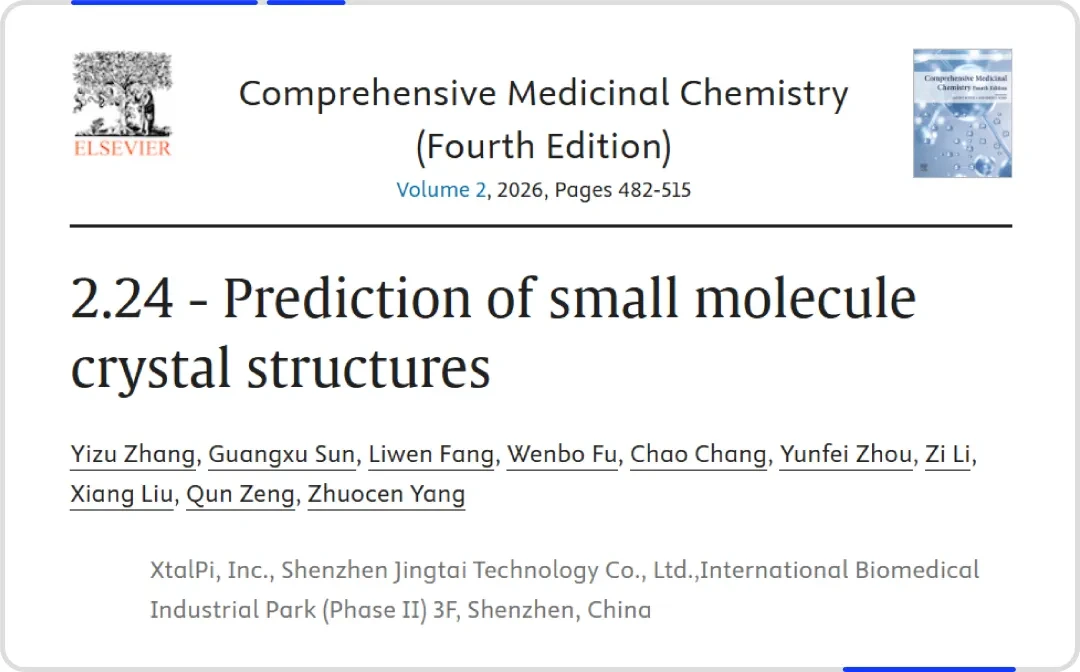
(Click “Read Original Article” at the end of the article to access the original chapter)

XtalPi’s “Hard Power” in Crystal Form Prediction Technology
This international recognition is no accident; it stems from the “hard power” accumulated by XtalPi through nearly a decade of deep engagement in the field of crystal form prediction. Crystal form prediction is a cutting-edge technology that predicts stable crystal structures based on compound structures, holding immense application value in drug development, materials science, and chemical engineering. Its predictive accuracy and scope of applicability have long been core concerns within the industry.
As a leader in the field of crystal form prediction, XtalPi had already topped the Pfizer Crystal Form Prediction Challenge as early as 2016,For many years, leveraging Crystal Structure Prediction (CSP) as its core technology, XtalPi has driven R&D innovation in the fields of small-molecule drugs and materials, continuously helping large pharmaceutical companies both in China and abroad to refine their crystal form research systems, guide development decisions, and strategize intellectual property portfolios. Related research findings have been published in multiple international academic journals.[1-6], for CSPFieldmade significant contributions to the scientific development.
In addition to academic achievements,XtalPi also stood out among 28 teams worldwide in the 7th Crystal Structure Prediction Blind Test organized by the Cambridge Crystallographic Data Centre, becoming one of the two best-performing teams.
Since its inception in 1999, the Crystal Structure Prediction Blind Test has consistently tracked the world’s most cutting-edge advancements, driving enhancements in professional industry capabilities, and has become a widely recognized and prestigious competition globally. In this blind test, the XtalPi team leveraged its self-developed, AI-driven crystal structure prediction software, employing an adaptive Monte Carlo method to significantly improve computational efficiency while ensuring prediction accuracy. The team successfully completed high-difficulty crystal structure prediction tasks with high quality, achieving a substantially higher number of successful predictions than other participating teams, thereby fully demonstrating its exceptional technical prowess in predicting crystal structures within complex chemical systems.
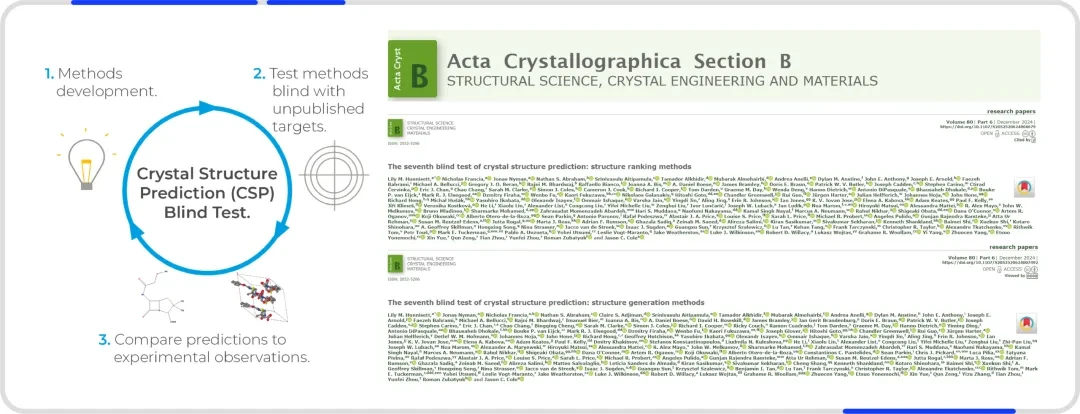
Article on the Results of the 7th Blind Test Competition for Crystal Form Prediction
From winning the Pfizer crystal form prediction competition to claiming victory in the seventh blind test challenge, these milestones collectively affirm that XtalPi has established a complete technological closed loop in crystal form prediction, spanning algorithm development, software R&D, and industrial application. Its prediction accuracy, computational efficiency, and scalable delivery capabilities have all reached internationally leading levels.It is precisely the technological depth accumulated through sustained in-depth development that has laid a solid foundation for XtalPi to receive invitations from internationally authoritative academic publications.

References
[1] Cryst. Growth Des., 2025, 25, 20, 8522-8535.
[2] Mol. Pharmaceutics, 2024, 21, 8, 3800-3814.
[3] Mol. Pharmaceutics, 2023, 20, 7, 3380-3392.
[4] J. Chem. Inf. Model, 2021, 61, 3, 1412-1426.
[5] Cryst. Growth Des., 2021, 21, 4, 1972-1983.
[6] RSC Adv., 2021, 11, 17408-17412.