



Recently, Audentes Therapeutics (“Audentes”), a subsidiary of the Japanese pharmaceutical company Astellas (TYO: 4503), announced a third death in its clinical trial of the gene therapy AT132. The patient was participating in Audentes’ gene therapy trial for XLMTM (X-linked myotubular myopathy), a rare neuromuscular disorder, and died after receiving a high dose of the AAV8 (adeno-associated virus serotype 8) vector-based treatment. However, Audentes stated that it remains “committed” to the research despite the rising mortality rate in the high-dose cohort of its Phase I/II clinical trial. The company is currently collecting data to provide the FDA with further information on the study.
In May and June of this year, Audentes announced the first and second patient deaths following high-dose AT132 gene therapy, respectively. Now, a third death has occurred. In the first two cases, the patients died from sepsis. Regarding the third death, Audentes stated that preliminary investigations indicated the patient died from gastrointestinal bleeding.
Audentes stated in its announcement that the patient was one of the previously disclosed recipients of AT132 gene therapy at a dose of 3×10¹⁴ vg/kg. This dosage represents the highest used in gene therapy, equivalent to administering 300 trillion genome copies delivered by AAV vectors per kilogram of body weight. The higher the patient’s body weight, the greater the total administered dose.
The patient began to show signs of progressive liver dysfunction within three to four weeks after administration, but no similar liver function abnormalities were observed in any patients in the low-dose trial group (1x10^14 vg/kg). According to Audentes, a total of 23 patients have received AT132 gene therapy, with 6 patients receiving the low dose and 17 patients receiving the high dose. In all three fatal cases, the patients developed liver disease. Audentes stated that it is investigating why these three deceased patients experienced symptoms of progressive liver dysfunction and will closely monitor all patients in the study; no additional cases of liver disease have been observed to date.
The successive fatal incidents disrupted Audentes’ “grand plan.”
Last October, Audentes presented new positive data on its AT132 gene therapy at the 24th Annual World Muscle Society Congress. Natalie Holles, President and Chief Operating Officer of Audentes, stated, “We are on track to submit a Biologics License Application (BLA) in the United States by mid-2020 and a Marketing Authorization Application (MAA) in Europe in the second half of 2020.” However, the clinical trial was put on hold following a second death. Currently, the FDA has indefinitely delayed the company’s regulatory approval plans for this therapy.
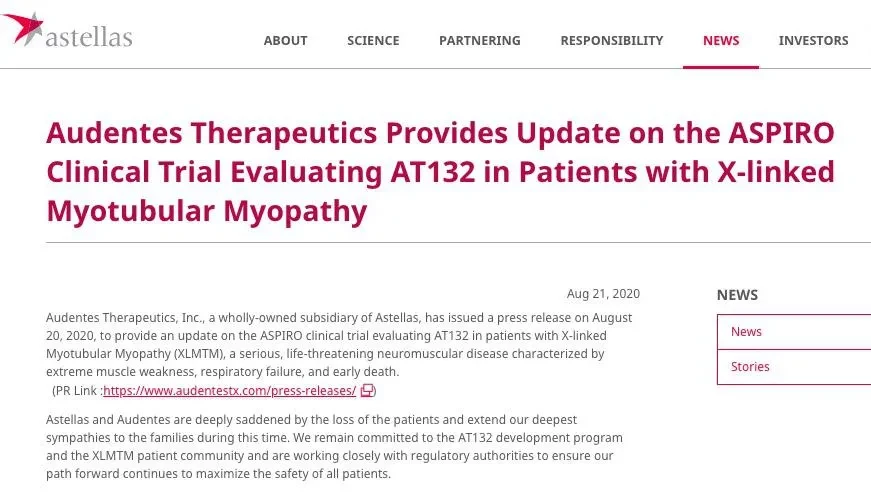
Figure | Astellas' Statement on the Fatal Incident Involving AT132 (Source: Astellas Official Website)
AT132 is a gene therapy for the treatment of XLMTM (X-linked myotubular myopathy). XLMTM is caused by mutations in the MTM1 gene, which lead to a deficiency or dysfunction of myotubularin, a protein essential for normal human development, thereby affecting skeletal development. Patients present with symptoms such as bone fragility, joint deformities, muscle weakness, and even respiratory failure. The disease almost exclusively affects males, and affected individuals typically survive only into early childhood. It is estimated that the mortality rate among infants with this condition reaches 50% within the first 18 months of life; among those who survive infancy, 75% live to age 10. Currently, the disease occurs in approximately 1 in 40,000 to 50,000 live male births. There is currently no effective treatment for this rare disease. Audentes’ gene therapy, AT132, aims to treat the condition by delivering a functional MTM1 gene into patients’ bodies using an AAV8 vector. In addition to Audentes, companies such as Ultragenyx, RegenxBio, and Biogen are also developing AAV8-based gene therapies.
In late 2019, Astellas, Japan’s second-largest pharmaceutical company, spent $3 billion to acquire Audentes Therapeutics, primarily attracted by Audentes’ gene therapy AT132. In January 2020, Astellas officially completed the acquisition of Audentes and stated that gene therapy would be a “key driver” for the company’s future, with Audentes operating as an independent subsidiary. Following the suspension of the AT132 gene therapy program, Astellas’ anticipated benefits were adversely affected. The therapy had originally been scheduled for submission to the FDA for approval this year, but the submission deadline has now been postponed. This incident also had a slight impact on Astellas’ stock price. After Audentes announced the third death in its clinical trials on August 20, Astellas’ share price fell from ¥1,730 per share to ¥1,716 per share, before rebounding to ¥1,726 per share on August 24. As of August 24, 2020, securities analysts maintained a “Buy” rating on Astellas’ stock, with an average target price of ¥2,222, implying an expected price increase of 28.81%.
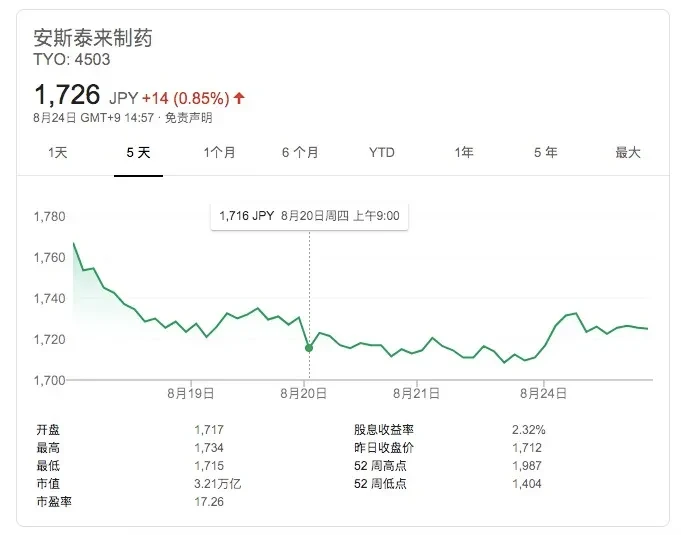
Figure | Astellas' 5-day stock price trend chart (Source: Google Finance)
The frequent negative news recently has cast a "shadow" over gene therapy.
On August 18, the U.S. Food and Drug Administration (FDA) rejected the Biologics License Application for Roctavian, BioMarin Pharmaceutical Inc.’s one-time gene therapy for hemophilia A. As the world’s first gene therapy for hemophilia, this decision greatly disappointed physicians, patients, and Wall Street, causing BioMarin’s stock price to drop by 25% on that day. The primary reason for the rejection was that BioMarin’s Phase I and Phase II clinical trials involved only a small number of patients with several years of follow-up. Due to variability among patients in the company’s trials, the FDA expressed concerns about the durability of the treatment effect.
Poseida Therapeutics, which just listed on NASDAQ this July, has suspended an ongoing clinical trial of CAR-T therapy for prostate cancer following a patient death. The FDA is investigating whether the death was related to Poseida’s treatment. As a result, Poseida’s stock price plummeted, with its market capitalization dropping by nearly one-third.
Like other research endeavors in the history of science, the development of gene therapy has not been smooth. In 1999, the first clinical trial of gene therapy resulted in a patient’s death, prompting the FDA to halt all such trials. In recent years, although gene therapy research has gained momentum, some experts argue that caution should be exercised regarding cases such as those involving Audentes Therapeutics until more robust evidence becomes available.
Two years ago, gene therapy pioneer Jim Wilson expressed concerns about high-dose gene therapy research, stating, “Based on my thirty years of experience, AAV remains one of the safest delivery systems. We should maintain realistic expectations for any biologic product; however, pushing the dose to sufficiently high levels can lead to dose-limiting toxicity.”
Some experts pointed out that caution should be exercised regarding the fatal incidents involving Audentes until more information becomes available.
Alison Rockett-Frase, Chair and Co-Founder of the Joshua Frase Foundation, which participated in the AT132 gene therapy study, stated, “This is a true setback for our community. On a personal level, I believe we need to re-evaluate this therapy, and science must continue to advance.”
Alison Rockt-Vras stated that some young children with XLMTM in Audentes' trials have already achieved "remarkable results."