








Synthego Announces $100 Million Series D Financing Led by Wellington Management, RA Capital Management, and 8VC to Advance “Virtual Biology”Recently, Synthego announced that it has secured $100 million in Series D financing led by Wellington Management, RA Capital Management, and 8VC, with a commitment to advancing “virtual biology.” Other participating investors include Founders Fund, Menlo Ventures, and Intel Capital. This marks the third time 8VC has increased its investment in the company: in 2017, Synthego raised $41 million in Series B financing led by 8VC; in 2018, it secured $110 million in cash financing with participation from 8VC. This latest round brings Synthego’s total private funding to over $250 million, and the company currently has plans for an initial public offering (IPO).
Regarding this financing round, Paul Dabrowski, CEO and Co-Founder of Synthego, stated, “We collaborate with dozens of world-class academic institutions and Fortune 500 biopharmaceutical companies, and we are delighted to have the support of such strong investors as we continue to execute our vision and further develop our platform technology, empowering scientists to rapidly discover and develop new therapies for serious diseases.”
“What Exactly Is ‘Virtual Biology’? Why Has Synthego Repeatedly Prompted 8VC to Invest?”
First, Synthego developed an automated system for synthesizing RNA. In 2016, Synthego launched gene editing kits based on synthetic gRNA; in 2018, it introduced cell line editing services, delivering edited cell lines to customers; in 2019, it rolled out gene editing services for induced pluripotent stem cells (iPSCs), a service in high demand by pharmaceutical companies; earlier this year, Synthego launched GMP-compliant gene editing services, marking its entry into the clinical market for gene therapy.
The company’s core product is CRISPRRevolution, which enables the synthesis of RNA in a high-precision automated laboratory setting. It reduces the cost of synthesizing guide RNA by 80% while significantly increasing production speed. Furthermore, this product optimizes guide RNA to achieve up to 90% efficiency in intracellular editing and gene knockout, concurrently reducing processing time. Additionally, the synthesized RNA boasts high purity and is completely free of DNA contamination.
For conventional CRISPR-Cas9 gene editing systems, gRNA is mainly derived from the following sources: chemically synthesized RNA, in vitro transcribed (IVT) sgRNA, gene fragment expression, sgRNA expression plasmids, or lentiviral sgRNA vectors. Among these, synthesizing sgRNA via IVT is not only time-consuming but also makes it difficult to control the quality of the synthesized sgRNA. Furthermore, sgRNA synthesized through IVT may introduce DNA or other contaminants into cells.
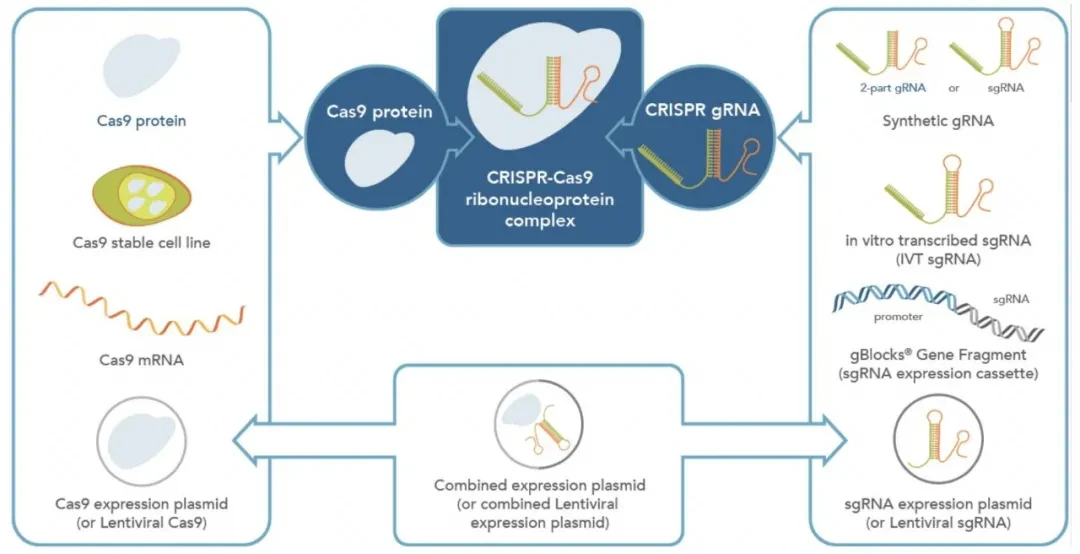
Figure | Different forms of Cas9 protein and gRNA (Source: IDT official website)
Currently, Synthego offers full-stack genome engineering via CRISPR, making CRISPR accessible to all scientists to advance their research, with all tools hosted in the cloud. The platform covers more than 120,000 genomes and 9,000 species, providing guides for gene knockout. Underlying machine learning models can predict overall editing efficiency and even the mutation profile of any given edit. Services for gRNA and cell engineering—including mammalian cell lines, primary cells, and more—support editing experiments by providing guides resistant to degradation and designed to prevent detrimental immune responses. Users can view and modify these guides at any time.
After editing, Synthego provides analysis software capable of validating up to 700 samples at a time. The company stated that the software’s performance surpasses similar products from competitors such as GE Healthcare, reducing scientists’ workload from weeks to days.
Looking ahead, Synthego plans to leverage current and future funding to propel the company toward new objectives—such as integrating algorithms and other strategic initiatives to construct “virtual biology.”
Regarding the concept of virtual biology, Dabrowski stated, “In the tech industry, you have cloud server infrastructure, similar to Amazon Web Services (AWS). You don’t need to build your own server infrastructure; you simply swipe your card and move on, allowing you to focus on content, websites, and media. I foresee this becoming a reality within the next 5–10 years. Applying this approach to the life sciences would enable scientists to concentrate on their areas of research—including biology, cellular models, and disease mechanisms—without having to worry about the challenges that arise in experimental work.”
Dabrowski stated that “virtual biology” represents a leap forward for them. Currently, more tools are also under development. Regarding plans for an initial public offering (IPO), he indicated that the company is proceeding with caution.