

Cogen Bio Announces Two Ocular Drug Delivery Platforms and Three First-in-Class Therapies to Transform Current Ophthalmic Treatment Standards
Pleryon
Ophthalmic Disease Therapeutics Developer
Ocular drug delivery systems have been one of the most prominent focal points in both academia and industry in recent years. In Europe and the United States, major pharmaceutical companies such as Roche and Allergan, as well as startups like Graybug and Kodiak, have positioned advanced drug delivery systems at the core of their ophthalmic drug development strategies. In China, however, due to high technical barriers, few enterprises are dedicated specifically to the development of ocular drug delivery systems; most focus instead on developing generic drugs or securing Greater China licensing rights for foreign products.
The high barriers to entry in ocular drug delivery systems are determined by the unique physiological structure of the eye and the specific characteristics of the industry. As the only organ of the central nervous system that extends to the body surface, the eye is protected by numerous static and dynamic “mechanisms” designed to shield it from external disturbances. However, these protective mechanisms also hinder the delivery of drugs to diseased ocular tissues. Furthermore, drug delivery systems involve multidisciplinary knowledge spanning biology, medicine, polymer physics, and biomaterials, requiring researchers to possess interdisciplinary thinking and collaborative capabilities.
Pleryon Biopharmaceuticals is an innovative ophthalmic pharmaceutical company built on advanced drug delivery systems. Pleryon has independently developed two ocular drug delivery platforms: the elaSS® ocular surface drug delivery system and the DynaMC® sustained-release system for long-acting protein therapeutics targeting the posterior segment of the eye. Its pipeline focuses on addressing significant unmet clinical needs in conditions such as contact lens discomfort, dry eye disease, age-related macular degeneration, and diabetic macular edema.
Professor Zhou Ying, Co-founder and Advisory Scientist at Pleryon, is an expert in innovative drug delivery systems.Professor Zhou Ying graduated from the Robert Langer Laboratory at the Massachusetts Institute of Technology and has four years of R&D experience in multinational pharmaceutical companies. He currently serves as a Professor in the Department of Chemical and Biological Engineering, Program Director of Bioengineering, and Vice Chairman of the Hong Kong Biotechnology Organization at the Hong Kong University of Science and Technology.
Dr. Yu Yu, Co-founder, CEO, and CSO of Pleryon, obtained his bachelor’s and doctoral degrees from the Hong Kong University of Science and Technology. He has served as a co-applicant and key participant, leading multiple government or industry projects in the Hong Kong Special Administrative Region, mainland China, and the United States.With over 13 years of experience in the research and development of innovative ocular drug delivery systems, he/she is the inventor of seven core patents held by Pleryon.

Left: Professor Zhou Ying, Co-founder and Advisory Scientist of Pleryon
Right: Dr. Yu Yu, Co-founder, CEO, and CSO of Pleryon
More than a decade ago, when ocular drug delivery systems were still a niche field, the founding team of Pleryon foresaw their significant development potential. Over the subsequent ten-plus years, they conducted extensive research on polymer theories and biomaterials, filed multiple patents for foundational innovative technologies, and gradually established Pleryon’s technical barriers. By 2015, Dr. Yu observed that both ocular surface and fundus drug delivery systems were gaining favor among pharmaceutical companies and the capital market. With the founding team’s technological expertise having matured, Dr. Yu established Pleryon in late 2016, and the company officially commenced operations in 2018.
Dr. Yu Yu stated that Pleryon’s core R&D team possesses strong capabilities in the commercial translation of innovative products, with members bringing extensive experience from both industry and academia. Mr. Zhou Guanqun, R&D Director, was a key member of the new drug R&D team at Lee's Pharmaceutical prior to joining Pleryon, and has 16 years of experience in new drug development. Ms. Li Lan, an R&D Engineer, graduated from the Ningbo Institute of Materials Technology and Engineering, Chinese Academy of Sciences, and has many years of experience in R&D and scale-up production at WuXi AppTec’s Process Research and Development Department. Dr. Sun Zhexun, Chief Chemist, earned his master’s and doctoral degrees from Cornell University and has previously conducted R&D work at multinational corporations.
Traditional ocular surface drug delivery systems focus on developing formulations that interact with the tear film, such as ion-sensitive in situ gels, thiol-containing polymers, or mucoadhesive nanoparticles. These interactions are typically limited to the interface. Since the volume of an eye drop (~50 μL) is ten times that of the ocular surface mucous layer (~5 μL), the majority of the instilled solution is cleared from the ocular surface via the lacrimal drainage system.
Pleryon believes that the key to developing ocular surface drug delivery systems lies in slowing down the clearance rate of substances from the ocular surface by the lacrimal canaliculi. The company’s elaSS ocular drug delivery system utilizes a covalently cross-linked flexible gel with dual solid-liquid properties. It is the softest synthetic solid documented in existing literature, with a hardness two to three orders of magnitude lower than that of conventional medical gels. This innovation was developed over seven years by Pleryon’s core R&D team.
On one hand, elaSS is an elastomer with fixed characteristics that can significantly reduce the clearance rate of the lacrimal canaliculus; on the other hand, its liquid properties allow it to be instilled like eye drops and evenly distributed across the ocular surface, providing long-lasting lubrication without causing a foreign body sensation.
Animal studies have shown that both the elaSS gel itself and the encapsulated molecules can remain on the ocular surface for several hours,Achieves sustained drug release and lubrication on the ocular mucosal surface, with sustained-release capacity improved by at least 20-fold compared to traditional methods.
PN-A001 is a novel drug for dry eye disease developed by Pleryon based on the elaSS platform. Dry eye disease is one of the most common ophthalmic conditions. Relevant data indicate that its prevalence is 20% among individuals aged over 20 years and as high as 65% among those aged over 65 years, with a global market size reaching RMB 20 billion. In preliminary studies, Pleryon collaborated with Dr. Zhou Weixian from the Academy of Veterinary Sciences to conduct a clinical study in pets involving more than ten dogs that had failed to respond to cyclosporine treatment. After one month of therapy,In pets that were initially unresponsive to cyclosporine, over 65% showed improvement in at least one clinical sign, and over 55% showed improvement in four clinical signs. This suggests that PN-A003 has the potential to become the new standard of care for dry eye disease.
PN-A001 is a rapidly commercializable product developed by Pleryon based on the elaSS platform for the treatment of contact lens discomfort. Contact lens discomfort is a specific form of dry eye disease, characterized by periodic or persistent ocular discomfort associated with contact lens wear. Among the more than 150 million contact lens wearers worldwide, approximately 50% suffer from contact lens discomfort. The global market size exceeds RMB 7 billion.
PN-A001 forms a soft, long-lasting cushioning layer between the contact lens and the cornea, protecting corneal epithelial cells from damage caused by friction between the lens and the cornea. Pleryon believes that PN-A001 will be a revolutionary therapy for treating contact lens discomfort.PN-A001 can be registered as a medical device in China, the United States, and the European Union, and is expected to enter the European market first within three years.
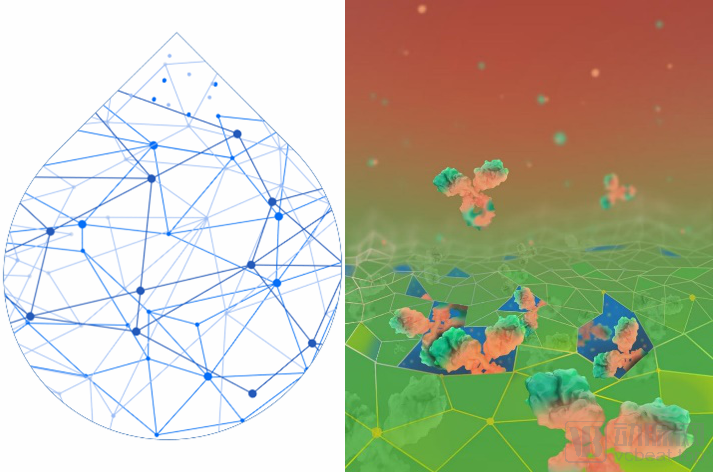
Left: Schematic diagram of the elaSS structure
Right: Schematic diagram of DynaMC structure
DynaMC: A Long-Acting Protein Drug Sustained-Release System for the Fundus, Another Ocular Drug Delivery System by Pleryon
Traditional sustained-release systems for the fundus require organic solvents and other processes incompatible with protein-based drugs during drug coating, making them unsuitable for the sustained release of antibodies. Furthermore, the hydrophilic nature of proteins causes many sustained-release systems to release and degrade too rapidly, failing to achieve the desired six-month duration. Additionally, the unique immune environment within the eye can trigger severe immune reactions when biocompatible sustained-release systems (such as PLGA microspheres) are administered via intravitreal injection.
Therefore,Ocular Drug Delivery Systems: The “Holy Grail” of Controlled-Release TechnologiesVirtually all multinational pharmaceutical companies developing ophthalmic drugs are actively advancing multiple long-acting anti-VEGF sustained-release projects for ocular applications. Furthermore, under the “Horizon 2020” program, the European Union has allocated €4 million to jointly support 15 research institutions in carrying out a key technological project named “OcuTher,” focused on ocular drug delivery systems. However, to date, most of these projects remain in the preclinical or early clinical stages.
Through over a decade of continuous research, the founder of Pleryon pioneered a novel polymer physics theory, which serves as the rational design basis for ocular protein sustained-release carriers, thereby abandoning the previous trial-and-error development paradigm. DynaMC consists of a densely cross-linked degradable polymer network that physically encapsulates proteins. By modulating the polymer’s microstructure and degradation rate, it achieves long-acting delivery of protein therapeutics.
The company has developed PN-P001, an ophthalmic sustained-release anti-VEGF protein drug based on the DynaMC platform, for the treatment of wet age-related macular degeneration and diabetic retinopathy. This technology enables precise control over the initial pore size of the carrier and the degradation rate of its scaffold.Extend the sustained-release duration of anti-VEGF proteins to over 6 months,and through unique biomaterial design, avoid immune responses in the eye, as reported in published research findingsThe only biocompatible system capable of achieving sustained intraocular anti-VEGF release in primates for six months.
According to reports, all projects initiated by Pleryon are aimed at addressing unmet clinical needs globally. Its products under development, PN-A001, PN-A003, and PN-P001, are all first-in-class therapies. Moving forward, the company will rapidly advance its existing pipeline into clinical and market stages, further expand its two drug delivery platforms, and develop additional ophthalmic drug candidates.
In the future, Pleryon’s R&D pipeline can expand from ophthalmology to other areas with unmet clinical needs that urgently require advanced drug delivery systems. The company aims to become a globally leading innovative pharmaceutical company focused on drug delivery systems. By maintaining a forward-looking strategy, pursuing continuous innovation, and adhering to a “patient-centric” product development philosophy, Pleryon seeks to rapidly secure a competitive position within the industry.
Pleryon secured seed funding from a renowned venture capital firm earlier this year and is currently raising its Pre-A round.