

Huatai 3D: An Emerging Leader in Orthopedics Leveraging 3D Printing for Innovative Implantable Medical Devices

Hua Tai 3D
3D Printing Companies in the Orthopedic Treatment Field
3D Printing Has Entered the Commercialization Stage in the Medical Field.
Zhu Weiwei, COO of Hua Tai 3D, told VCBeat: “The current market for orthopedic implant consumables has exceeded RMB 40 billion. All orthopedic implants on the market can be replaced by 3D-printed products, and the relevant 3D printing technologies are already mature. Therefore, the market potential for 3D printing in the field of orthopedic implants exceeds RMB 40 billion. Additionally, 3D printing can also be applied in fields such as dentistry, indicating a very broad market prospect.”
This year, Hua Tai 3D stood out in the 2020 “Maker Guangdong” Biopharmaceutical Special Competition by virtue of its leading 3D printing technology, earning favor from professional judges including clinicians and investors. Zhu Weiwei stated, “The competition judges provided us with new perspectives and ideas, from which we benefited greatly. The organizer, Guangdong Medical Valley, helped us connect with numerous entrepreneurial partners and investors, laying the foundation for future inter-enterprise collaborations.”
Hua Tai 3D is a high-tech medical device enterprise co-founded by Zhu Xianwen, one of the "Top Ten Elite MBA Figures in China," and Professor Wu Xinhua, a Fellow of the Australian Academy of Technological Sciences and Engineering. The company aims to collaborate with orthopedic expert teams to research, develop, and manufacture international-grade orthopedic implants using 3D printing technology, thereby achieving import substitution.
One of Hua Tai 3D’s advantages lies in its core team. Zhu Weiwei stated, “The founding team and the technical team complement each other’s strengths, facilitating the rapid development of Hua Tai 3D.”
For example, Zhu Xianwen, Chairman and CEO, is a senior engineer who was honored as one of Guangzhou’s Industrial Leading Talents in 2019, a Guangzhou Innovation Hero in 2018, and one of China’s Top Ten MBA Elites in 2014. In 1988, Mr. Zhu founded an aluminum alloy factory, growing it from scratch to achieve an annual output value of RMB 100 million, thereby demonstrating extensive experience in entrepreneurship and management.
Academician Wu Xinhua is a Fellow of the Australian Academy of Technological Sciences and Engineering, Deputy Vice-Chancellor of Monash University, Director of the Australian Centre for Light Metal Research, and Director of the Monash Centre for Additive Manufacturing (3D Printing). He is a world-leading scientist in the field of 3D printing of metallic materials. In 2014, Academician Wu unveiled the world’s first full-scale aircraft engine produced via 3D printing. In 2017, he supplied the only 3D-printed metal components with international airworthiness certification for China’s large aircraft programs. Additionally, Academician Wu has provided titanium alloy 3D-printed surgical instruments and artificial joints for research purposes to medical institutions in Australia and China.
Leveraging over two decades of mature control expertise across the entire metal 3D printing process chain, Academician Wu Xinhua’s team has positioned Hua Tai 3D’s orthopedic implant 3D printing at the global forefront from its inception.
In addition, Hua Tai 3D has partnered with China’s leading orthopedic experts to develop orthopedic surgical tools and implants through an integrated “science-industry-medicine” approach. To this end, Hua Tai 3D has established an Orthopedic Research Institute to collaborate with elite orthopedic specialists in advancing the application of 3D printing in the field of orthopedics.
In addition, the other core team members of Hua Tai 3D all come from prestigious universities such as the University of Birmingham in the UK, McMaster University in Canada, Sun Yat-sen University, and Hebei University, and they all have extensive industry experience.
Zhu Weiwei stated, “Developed by a world-class research and development team, Hua Tai 3D has currently launched multiple core products, including interbody fusion cages, artificial vertebral bodies, hip joints, and knee joints.”
During this period, Hua Tai 3D collaborated with mainstream medical institutions in Guangzhou to perform multiple world-first surgeries:
On February 7, 2018, Dr. Zheng, Associate Chief Physician of the Department of Spinal Orthopedics at Nanfang Hospital, performed the world’s first 3D-printed personalized “integrated artificial vertebral body and lumbar disc” implantation surgery.
On December 22, 2018, Professor Li, Director of the Oncology Department at Guangdong Provincial Orthopedic Hospital, successfully performed the world’s first implantation surgery using a 3D-printed alloy sacrum-pelvis combined prosthesis.
On August 23, 2019, Professor Jiang, Deputy Director of the Department of Spinal Orthopedics at Nanfang Hospital, successfully performed the world’s first surgery using a patented integrated product featuring personalized cervical spine internal fixation devices.
On January 23, 2020, Chief Physician Lin from the Department of Joint Orthopedics at a Grade A tertiary hospital successfully performed an implantation surgery using a Hua Tai 3D-printed distal tibial prosthesis. According to a novelty search report issued by the Guangdong Provincial Institute of Pharmaceutical Information, this was the first case of its kind worldwide.
All of the aforementioned world-first surgeries utilized products developed by Hua Tai 3D. Zhu Weiwei stated, “Hua Tai 3D collaborates with multiple medical institutions to conduct research-oriented surgeries, which will validate the quality of its 3D-printed products and lay a solid foundation for future product promotion.”
“The initial choice to focus on orthopedic implant products is due to the mature application of 3D printing technology in the orthopedic field, where it can replicate any of the 206 bones in the human body. Another reason is the urgent demand from orthopedic patients and the substantial market potential in this sector. It is projected that the orthopedic implant market will exceed RMB 40 billion this year, with a relatively low share held by domestic brands, indicating significant potential for import substitution. Hua Tai 3D has greater development opportunities in this field.”
Compared to Traditional OrthopedicsImplant, 3D-printed products will perfectly fit the patient's injured area.According to reports, after orthopedic surgery, patients may experience prosthetic displacement during movement, which can cause mutual wear between the bone and the prosthesis or lead to prosthetic collapse, necessitating a second surgery.
Leveraging 3D printing technology, Hua Tai 3D can manufacture various complex structures that are difficult to produce through conventional machining, such as its patented trabecular bone structure. This innovative design facilitates the ingrowth of adjacent healthy bone tissue into the prosthesis, creating a stable integration and preventing revision surgery caused by wear between the bone and the implant.
Taking the artificial vertebral body developed by Hua Tai 3D as an example, its structure combines a sponge-like microporous architecture with a topological framework. This embedded metallic "trabecular bone" topological framework not only facilitates the ingrowth of osteocytes from adjacent normal vertebrae, ultimately achieving osseointegration, but also ensures the overall mechanical performance of the vertebral body. The posterior aspect of the vertebral body features a U-shaped plate design to enhance support for the middle column of the spine, while its recessed areas prevent compression of the dural sac, spinal cord, and nerve roots.
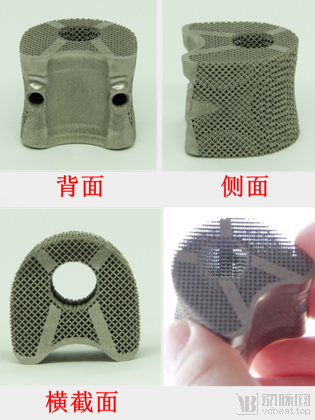
(Hua Tai 3D's 3D-printed artificial vertebral body, image provided by the company)
Meanwhile, the widened bilateral edges of the U-shaped plate structure enhance the stability and support strength of the 3D-printed artificial vertebral body. This U-shaped design facilitates intraoperative implantation into the human body, minimizing the risk of injury to the spinal cord, nerve roots, and surrounding soft tissues. A pair of screw holes are located on both sides of the U-shaped plate, allowing for the insertion of pedicle screws for posterior connection and fixation, thereby ensuring a more secure attachment of the artificial vertebral body. Oblique grooves designed beneath the screw holes are positioned in accordance with the anatomical course of the spinal nerve roots. Furthermore, the dimensions of these oblique grooves are optimized to prevent compression or injury to the nerves passing through them. The world’s first successful implantation surgery of a 3D-printed personalized “integrated artificial vertebral body and lumbar disc” prosthesis, performed on February 7, 2018, unequivocally demonstrated the superiority of this product.
Another advantage of Hua Tai 3D’s 3D-printed products is the ability to produce customized implants.Specifically, based on each patient’s anatomical structure, injury site, and surgical approach, Hua Tai 3D can customize and manufacture prostheses for patients. As a result, patients will experience significantly reduced intraoperative blood loss, minimized surgical trauma, and shorter operation times. Shorter surgical durations facilitate more efficient utilization of limited medical resources.
The typical R&D and certification cycle for orthopedic medical devices ranges from 8 to 10 years. However, leveraging its prior accumulations, Hua Tai 3D expects to obtain Class III medical device registration certificates for multiple initial products within three years, significantly reducing its R&D costs. In terms of production costs, 3D printing technology minimizes material waste and enables product manufacturing in a single step. Combining these advantages, Hua Tai 3D’s 3D-printed products possess strong market competitiveness.
To promote product sales, Hua Tai 3D is currently making relevant preparations. First, Hua Tai 3D collaborates with various medical institutions to conduct research-oriented surgeries and participates in orthopedic academic conferences to enhance corporate influence and brand awareness. Second, Hua Tai 3D will engage medical device distributors to promote its products. Finally, Hua Tai 3D will establish some proprietary channels by leveraging its own hospital resources to penetrate the market.
In addition to applying 3D technology in the field of orthopedics, Hua Tai 3D will also develop new products in areas such as dentistry. Zhu Weiwei stated, “Currently, Hua Tai 3D is jointly developing new dental products with leading dental hospitals.”
Zhu Weiwei concluded by stating, “Hua Tai 3D is currently undertaking a new round of financing, raising RMB 30 million, which will be allocated to clinical trials and research and development.”
About the 2020 Maker Guangdong · Biomedicine Special Competition
The 2020 “Maker Guangdong” Biopharmaceutical SME Innovation and Entrepreneurship Competition, guided by the Provincial Department of Industry and Information Technology and the Provincial Department of Finance, and hosted by Guangdong Medical Valley, focused on the biopharmaceutical sector. With over 100 projects registered, the competition comprised five online preliminary rounds and one offline specialized final round. Twelve high-quality projects were recommended to advance to the provincial semi-finals, all of which ranked within the top 10 in their respective Enterprise and Maker categories.
Guangdong Medical Valley is a service provider for medical industry clusters, specializing in investment and incubation within the biopharmaceutical and medical device sectors. Its first medical industrial park, located in Nansha, Guangzhou, is a key municipal project with a total gross floor area of 180,000 square meters. Currently, it hosts over 180 enterprises, including two companies founded by academicians of the Chinese Academy of Sciences or Chinese Academy of Engineering, and 13 recipients of National Major Projects. The park has attracted numerous industry leaders such as Boya Life Science, Genetron Health, and Tianke Yaxing, covering various sub-sectors including biopharmaceuticals, gene editing, vaccines, immunotherapy, high-end medical devices, stem cells, and medical industry funds. It is committed to building a world-class international innovation center for the medical industry.