

When Brain-Computer Interfaces Become Reality: Will Neuralink Be the Sole Medical Compass?

ZhenTec
Brain-Computer Interface Medical Industrialization Developer

Neuracle
Developer and Manufacturer of Brain-Computer Interface Systems and Related Equipment
iNEURO
Provider of Comprehensive Brain Science Medical Solutions

Neuralink
Brain-Computer Interface System Developer
In Homo Deus: A Brief History of Tomorrow, Harari raises new questions about humanity. He argues that neural networks will be replaced by intelligent software, enabling humans to navigate seamlessly between virtual and real worlds, unbound by the constraints of organic chemistry. The so-called “free individual” will also become a fictional narrative, transformed instead into a combination of biochemical algorithms.
Whether the prophecy of “human-machine” integration will come true remains uncertain; however, this July, news that Neuralink’s brain-computer interface (BCI) technology achieved a major breakthrough and its device received clearance under the FDA’s “Breakthrough Devices Program” served as an announcement, declaring that the convergence of humans and machines has become a reality.
“Brain-Computer Interfaces” are not a new topic; both Black Mirror and The Matrix have explored the future implications of “brain-computer” technology from a dystopian perspective. However, reality has not followed the trajectory depicted in science fiction films. Most BCI technologies were initially developed for medical applications.

As early as the 1970s, Jacques Vidal proposed the concept of brain-computer interfaces (BCIs), focusing BCI research and development on neural prosthetics to help patients restore impaired vision, hearing, and motor function. With technological advancements, the first generation of human-use neural prosthetic devices emerged in the mid-1990s.
In 1998, Philip Kennedy successfully implanted electrodes into a human brain for the first time, enabling the patient to control a computer cursor using “brain signals.” One year later, the First International BCI Meeting provided a clear definition of Brain-Computer Interface (BCI): “A BCI is a communication system that does not depend on the normal output pathways of peripheral nerves and muscles.” This brought BCI technology to the forefront. Its ability to facilitate communication between the brain and a computer without relying on peripheral nerves and muscles highlights its value in assistive therapy for patients with disabilities caused by conditions such as stroke and epilepsy.
Amidst technological advancements and the gradual expansion of market demand,BCI technology has evolved from initially providing assistive therapy solely for patients with complete immobility to expanding into applications such as spelling and cursor control.Furthermore, various brain-computer interface (BCI) systems and signal processing technologies capable of controlling neuroprosthetic functions have begun to develop on this foundation.
At the opening ceremony of the 2014 FIFA World Cup in Brazil, Juliano Pinto, a young man with high-level paraplegia, kicked off the match with the assistance of brain-computer interface (BCI) and robotic exoskeleton technologies. In 2016, Nathan Copeland used his thoughts to control a robotic arm and shake hands with then-U.S. President Barack Obama. In 2017, Facebook announced its “mind-typing” project. In 2020, Neuralink unveiled “Link v0.9.” Each step forward in the development of brain-computer interfaces has seemed to clarify the path toward practical application; however, there is still a considerable journey ahead before BCI technology can be truly realized in widespread use.
An ideal brain-computer interface (BCI) can not only assist researchers in acquiring neuronal signals but also encode specific instructions and transmit them to other parts of the body via the BCI, thereby facilitating efferent signal transmission from the brain.However, to achieve this process, at least four steps must be completed: signal acquisition – signal decoding – re-encoding – feedback.
These four processes may appear simple, but in reality, they are as difficult as scaling the heavens. Merely the first step—“signal acquisition”—has stymied a large number of explorers seeking to strike gold in the field of brain-computer interfaces (BCI). After all, the human brain contains nearly 100 billion neurons, and there are 19 layers between the outermost surface of the head and the interior of the skull. Furthermore, between the skull and the brain lie tissues such as the dura mater, arachnoid membrane, and arachnoid trabeculae. Overcoming these numerous impediments to achieve precise signal collection remains fraught with challenges.
We celebrate every step forward in brain-computer interface (BCI) development, but we must also remain rational. After all, the human brain is akin to a mysterious black forest; beyond the challenge of “signal acquisition,” there are numerous other hurdles to overcome. Even minor errors can easily lead to severe consequences such as patient paralysis or brain death. Moreover, compared to other tissues in the human body, the human brain possesses a far more intricate structure. Unlocking the “secrets” of the human brain may therefore require more time.

Neuralink: Entering the Brain-Computer Interface Field
Brain-Computer Interfaces Stir Up Controversy Again, Thanks to Neuralink’s Press Conference a Month Ago
At the press conference, Musk linked BCI to mental health disorders. In his speech, he mentioned that many people may encounter various neurological issues at different stages of their lives, such as amnesia, blindness, deafness, paralysis, depression, insomnia, addiction, epilepsy, stroke, and traumatic brain injury. The value of Neuralink lies in providing an affordable and reliable solution to these troubling problems by implanting electronic devices into the brain, a method that has already been medically proven feasible.
In summary, Neuralink aims to develop a sufficiently powerful brain-computer interface to cure human brain diseases and endow users with enhanced capabilities.
At the press conference, Musk introduced two devices.One is a chip measuring just 23mm × 8mm, supporting 1,024 channels, capable of receiving, decoding, and transmitting neural activity information. The other is a novel surgical robot that can scan brain structures to avoid blood vessels and critical areas, thereby minimizing soft tissue damage during implantation while precisely placing the chip at the predetermined location. Compared to its early days, Neuralink appears to have taken another step forward in the development of brain-computer interfaces.
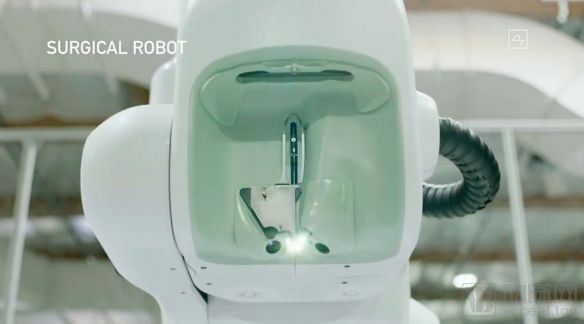
Neuralink's New Surgical Robot
From Musk’s perspective, the ideal brain-computer interface (BCI) should not only help researchers collect neuronal signals but also encode specific instructions and transmit them to other parts of the body through the BCI, thereby assisting the brain in signal output. This is one of the key reasons why Neuralink’s BCI has evolved from a “sewing machine” into today’s “invasive coin”—only by placing the electrode network sufficiently close to neurons can we obtain high-resolution signals.

“Dimensions and Size of Invasive Coins”
In the pig video released by Musk, staff members read in real time and synchronously displayed Pig B's brainwaves on a large screen.
The Neuralink device implanted in Pig A’s head is reading electrical currents from neurons associated with its snout, with each contact of the snout producing a spike in brainwave activity. In the video featuring the second pig on the treadmill, Neuralink used brainwave signals to predict its movement trajectory. The chart shows that the predicted trajectory closely aligns with the actual one.
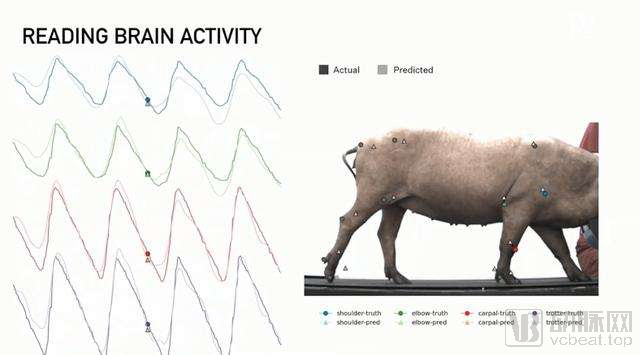
Neuralink predicts movement and posture by collecting EEG signals from pigs.
The ability to predict the movements and postures of piglets to a certain extent indicates that the signals collected by Neuralink have achieved a remarkably high level of precision. However,Although Neuralink has achieved significant breakthroughs in signal acquisition, there have been no major advances in the second stage of BCI implementation—signal decoding.
“What was disappointing about this press conference was the lack of any progress in neural signal decoding; it merely demonstrated the relationship between limb movements and intracranial neural discharges in piglets, indicating that there is still a long way to go before implanted brain-computer interfaces can communicate with mobile phones.”Professor Hong Bo, an expert in brain-computer interfaces at Tsinghua University, stated: “Currently, research on the decoding of motor information in brain-computer interfaces (BCIs) has become quite mature. Institutions such as Brown University and Stanford University in the United States have successfully demonstrated this technology multiple times in both monkey and human brains. However, although the U.S. FDA previously approved small-scale clinical trials in humans conducted by companies like Cyberkinetics and BlackRock, none of these trials achieved the expected outcomes.”
Thus, if Musk can resolve the decoding challenges in his upcoming work, the re-encoding process may prove less daunting. Nevertheless, the feedback loop could still emerge as another formidable obstacle.
The feedback loop requires acquiring environmental feedback information via BCI before applying it to the brain. Generally, we rely on vision, hearing, touch, and audition to obtain environmental information, which is then transmitted to the brain in real time. However,Even computer vision technology, which is currently highly popular and widely applied in daily life, remains largely confined to two-dimensional image processing. Issues such as the large volume of three-dimensional image data and the difficulty in encoding have become significant obstacles in the feedback process.
Although Neuralink’s launch event drew industry attention to BCI technology, the company did not demonstrate significant advances in neural signal decoding, suggesting that mature brain-computer interface technology may still be a long way off.
BrainGate: Controlling Robotic Arms with Consciousness
Another company with outstanding performance in the field of brain-computer interfaces, BrainGate, was founded in 2001. Its research team mainly consists of neurologists, neuroscientists, engineers, computer scientists, neurosurgeons, mathematicians, and other researchers from Harvard Medical School, Brown University, Cleveland Clinic, Stanford University School of Medicine, and other institutions.
In the realm of BCI technology R&D, BrainGate primarily focuses on adjunctive therapies for neurological disorders, communication impairments, and motor disabilities. By implanting sensors into the brains of paralyzed patients to monitor their neural activity, the system translates their intentions into computer commands, thereby enhancing their ability to operate computers and empowering individuals with amyotrophic lateral sclerosis (ALS), spinal cord injuries, and stroke to regain control over their lives.
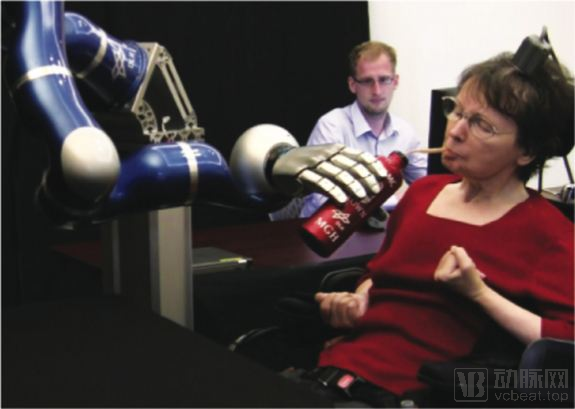
The patient controls the robotic arm through conscious intent to perform drinking activities.
In the current phase of research, BrainGate is developing a new generation of wireless medical neurotechnology to record and monitor neural activity for the diagnosis and management of neurological disorders.

While we often covet emerging overseas BCI technologies featured in the news, academic research on BCI has also made significant strides in China.
Professor Hong Bo told VCBeat“Currently, Zhejiang University and Tsinghua University are primarily engaged in BCI-related research. Zhejiang University has adopted the Utah electrode array mentioned by Elon Musk, successfully implanting it into the cerebral cortex of monkeys and human patients to achieve brain-computer interface control of robotic hands. In contrast, Tsinghua University, in collaboration with the 301 Hospital and Xuanwu Hospital, is conducting research on minimally invasive implanted brain-computer interfaces in epilepsy patients using a different approach. Their recording electrodes are embedded within the skull without penetrating the dura mater, thereby avoiding damage to neural cells and enabling long-term, stable acquisition of intracranial EEG signals; this team has already achieved BCI-based typing, among other applications. It should be noted that both research groups are still in the preclinical trial phase and have not yet obtained medical device approval.”
Unlike the grand blueprint for brain-computer interfaces (BCI) outlined by Musk, China’s brain research focuses more on the diagnosis and treatment of brain disorders and brain-inspired artificial intelligence. Currently, a foundational consensus has been reached within China’s scientific community regarding the “one body, two wings” framework as the directional focus of the national Brain Project.
“The Whole” refers to the “Cognitive Brain,” focusing on understanding how the cognitive functions of the human brain originate.The core lies in understanding the essence of cognitive brain regions and functional neural networks, aiming to elucidate the working principles of the brain.
Academician Mu-Ming Poo, a leader and advocate of the China Brain Project, stated, “To analyze the functions of a computer, we must understand its architecture. Similarly, to understand brain function, we must elucidate the brain’s network architecture, known as the ‘Whole-Brain Mesoscopic Connectome,’ which is a key component of our major initiative.”
“The two wings” refer to the two main strategic directions: “brain protection” and “brain creation.”
Among these, “Brain Protection” primarily focuses on improving the diagnosis and treatment of major brain disorders, including Alzheimer’s disease, epilepsy, Parkinson’s disease, and depression. In the field of neurological diseases, there is significant potential for the emergence of unicorn companies valued at tens of billions of yuan.
“Brain Creation” primarily focuses on the research and development of brain-inspired artificial intelligence, with its core strategic goal being the development of neuromorphic computers. This initiative comprises two components: first, the advancement of brain-like devices and architectures; and second, the design and development of systems for brain-like information generation and processing.
The immense value of the China Brain Project lies in its sustained implementation over the next five to ten years, which will vigorously promote the deep integration of artificial intelligence and brain science. Its research achievements will significantly advance the development of brain-inspired AI technologies, and breakthroughs in this field will lead a new round of technological revolution.
Under this initiative, China is making every effort to advance treatments for diseases that pose a significant societal burden, including Alzheimer’s disease, Parkinson’s disease, epilepsy, schizophrenia, and depression. Research in this field has already made substantial progress. Meanwhile, leveraging its demographic advantages, China will accumulate more big data on brain disorders over time, thereby identifying more pathways to cure these conditions.

Driven by policy support and technological advancements, China has achieved certain results in the field of brain science over the past decade, with applications extending to neurological disorders, psychiatric conditions, and rehabilitation.
The First Company in China to Commercialize the Brain-Computer Interface IndustryNeuracle TechnologyAs a representative enterprise in the brain-computer interface (BCI) field, it relies on the Neural Engineering Laboratory of Tsinghua University and is primarily engaged in research in neuroscience, psychology, and neural engineering.
In the field of neurological disease diagnosis, Neuracle’s product portfolio includes EEG and evoked potential instruments (brain function monitors) as well as high-frequency, high-density EEG acquisition systems. The former is primarily used for the diagnostic monitoring of neurological conditions such as epilepsy and cerebral hemorrhage, while the latter is mainly employed for auxiliary localization in neurosurgical procedures. In terms of therapeutic products, Neuracle focuses primarily on minimally invasive implantable feedback therapy and active brain-computer interface (BCI)-based intelligent rehabilitation. Minimally invasive implantable feedback therapy is designed for the treatment of neurological disorders such as epilepsy and Alzheimer’s disease.
At this year’s World Robot Conference, in the “BCI Brain-Controlled Robot Competition and the 3rd China Brain-Computer Interface Competition,” Neuracle provided the brain-computer interface (BCI) signal acquisition devices and data analysis platform for the event. Wei Siwen from Tianjin University set a new national record for BCI-based typing by achieving an output rate of 691.55 bits per minute on a computer screen (equivalent to 69 Chinese characters per minute).
In China, besides Neuracle, companies such as iNEURO and ZhenTec have also made breakthroughs in the BCI field.iNEURO has centered its product line on medical EEG data services, adopting an AI algorithm-centric approach that integrates bidirectional development of both hardware and software. ZhenTec provides brain-controlled intelligent rehabilitation solutions to assist in the recovery from neurological disorders. The company plans to expand these solutions to cover the full spectrum of rehabilitation training scenarios, including physical therapy and occupational therapy. By conducting comprehensive, full-cycle EEG data collection and assessment, ZhenTec precisely customizes rehabilitation treatment plans for patients. To date, the company has accumulated over 1,000 patient trials.

Given the current pace of BCI research and development, unresolved challenges remain, such as how to evade immune surveillance by preventing immune cells from recognizing implants as foreign bodies and forming scar tissue, and how to achieve precise monitoring of billions of neurons using only a limited number of electrodes.
However, the truly viable path lies in taking step-by-step measures to deeply accumulate disease databases for addressing brain disorders, thereby driving the further advancement of BCI technology.
In *Homo Deus: A Brief History of Tomorrow*, Harari also noted, “We cannot truly predict the future, because technology does not yield deterministic outcomes. The same technology can give rise to vastly different societies.”
The healthcare sector is, after all, a serious field.
Driven by policy and capital, if we can continue to research and develop brain-computer interface (BCI) technology and find technological breakthroughs, perhaps the current progress is slow, but we still believe that this technology will bring a glimmer of hope for the treatment of brain diseases.