

Klone4.0 Launches: AI-Powered Cell Line Development Platform Revolutionizes Biopharma R&D
GBB
AI Biomedical R&D Company
Hong Kong, Oct. 16, 2020 /PRNewswire/ -- Cell line development is the source and foundation of biopharmaceutical process development. While pharmaceutical companies both in China and abroad have their own methods and experience in cell line development, they struggle to break free from the traditional constraints of "high investment, high risk, and long cycles" inherent in biopharmaceutical development, often requiring substantial investments in manpower, resources, and time. In recent years, artificial intelligence (AI) technology has been widely applied across various industries, and cell line development has also begun to harness the power of AI.
On October 15, 2020, the Klone4.0 platform, independently developed by Great Bay Bio Holdings Limited, was officially launched. For the first time, it deeply integrated artificial intelligence with cell line development, achieving “rapid, efficient, and high-quality” outcomes in cell line development. This innovation has opened up new avenues for addressing industry pain points and may propel the cell line development sector into a new era.
Klone4.0 Platform Emerges, Sounding the Clarion Call for AI-Driven Cell Line Development
A high-quality cell line must meet stringent requirements for key performance indicators, including yield (fixed investment and cost per production batch), quality (efficacy and safety), stability, scalability (compatibility with large-scale manufacturing scale-up), and regulatory compliance (monoclonality and completeness of experimental documentation throughout the entire process).
Engels stated, “Once society has a technological need, that need will drive science forward more effectively than ten universities.” The principle of cell line development is not complex: it involves transfecting plasmids into cells and integrating them into the host cell genome. However, constructing a cell line suitable for industrial-scale application is no easy task. In fact, the probability of obtaining high-yield, high-quality cell lines is extremely low, and the process is both time-consuming and labor-intensive. How to more efficiently obtain high-quality cell lines has become a critical challenge for researchers in biopharmaceutical development.
In addressing the challenges of improving cell line development processes, various distinctive methods have continually emerged at different stages. According to ICH guidelines, production cell lines must be derived from a single cell. Commonly used single-cell cloning methods include limited dilution, flow cytometry-based single-cell sorting and plating, ClonePix, and the costly Beacon® Optofluidic System.
Since 2017, international pharmaceutical giants such as Merck, Novartis, Roche, Pfizer, and Johnson & Johnson have increasingly deployed artificial intelligence (AI) in research and development, leveraging its high efficiency to accelerate new drug discovery. AbbVie has utilized AI systems to gain deeper insights into schizophrenia research, reduce the scale of clinical trials, and optimize its manufacturing processes. AstraZeneca has applied AI and machine learning to develop novel therapies for chronic kidney disease and idiopathic pulmonary fibrosis; notably, a project by Berg, in collaboration with AstraZeneca, employed Schrödinger’s advanced computational platform to accelerate drug innovation and elucidate the pathogenesis of diseases such as Parkinson’s disease. (Source: Smith, S., 2019)
Leveraging AI’s capacity for rapid computation on massive datasets, which has yielded exceptional performance across numerous fields, Mr. Liang Guolong, Chairman of Great Bay Bio (GBB) and a long-time leader in biopharmaceutical product development, keenly recognized that the characteristics of artificial intelligence align closely with the needs of cell line development. This insight led to the creation of Klone4.0, an AI-powered platform for cell line development.
What Makes the Klone4.0 Platform Different: 4-Hour Monoclonalization
Building an excellent cell line development platform requires attention to every aspect. Key factors in evaluating the quality of such a platform include high productivity (efficient generation of high-yield cell lines), sufficient candidate volume (rapid acquisition of adequate recombinant protein for manufacturing feasibility studies and in vitro/in vivo drug testing), stability, development timeline (accelerating clinical progression of drugs), and workload (reducing labor costs and human errors).
Klone4.0 is GBB's proprietary cell line development platform. It screens hundreds of thousands of cells in a single run, captures cellular images, and leverages AI combined with precise cell picking technology to rapidly analyze, locate, and select high-yield cells. This enables the acquisition of high-yield, high-quality cell lines within 4 hours, achieving intelligent application in cell line construction.
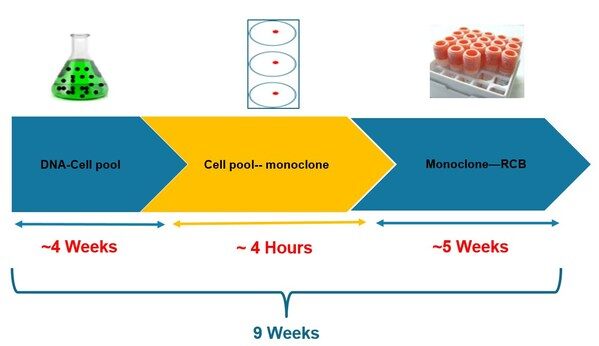
Introduction to the Klone4.0 Platform
Automated Imaging Technology: Rapid Acquisition of Basic Cellular Attribute Data
“Seeing is believing”; in the pharmaceutical and healthcare industry, it can be said that “imaging brings intelligence.” In recent years, various medical images, such as X-rays, ultrasounds, CT scans, and NMR, have been utilized for clinical decision-making through artificial intelligence. The Klone4.0 platform has applied this technology to the cell line development process, enabling the one-time screening of hundreds of thousands of cell images.
Digital Localization Technology: Rapid Analysis of Cell Data for Precise Identification of High-Yield Cells
The forefront of machine learning is deep learning, which employs complex hierarchical artificial neural networks. Deep learning is particularly well-suited for drug discovery and development due to its unprecedented ability to extract key features from raw, unprocessed data and datasets. The Klone4.0 platform leverages deep learning to make the precise identification of high-yield cell lines a reality.
Precision Selection Technology: Ensuring Cell Monoclonality
To shorten the cell line development cycle, reduce labor costs and human errors, Klone4.0 utilizes an autonomous single-cell picking platform to rapidly select high-yield monoclonal cells.
The Value of the Klone4.0 Platform: Leading Cell Line Development into the Era of Industrial Informatics 4.0
For a long time, the industry pain points of “high investment, high risk, and long cycles” have constrained the experimental field of pharmaceutical development like barren frozen soil. The inherent “nutrients” of artificial intelligence—such as efficiency, intelligence, and precision—have provided fertile new ground for biopharmaceuticals. Klone4.0 not only breaks through the blind, trial-and-error approach of traditional drug discovery and resolves the challenge of extensive repetitive labor, but also significantly improves screening success rates. Featuring “short cycles, high yields, and zero risk,” it leads cell line development into the era of Industrial Informatics 4.0.
Platform Value
1. High expression level, exceeding industry standards
Machine Learning and AI-Driven Prediction for Cell Line Development Facilitates the Identification of High-Expressing Cell Lines;
2. 3-5 times the candidate cell lines, above the industry standard
Data mining to identify additional target cell lines, providing customers with more options and greater possibilities;
3. Predictive Stability, Industry Innovation
Pioneering Short-Term Prediction of Cell Line Stability Using Deep Machine Learning Methods
4. Simple process, cost-effective
The inherent “time- and labor-saving” advantages of AI have yielded equally remarkable results in cell line development, holding significant potential to create a new milestone for humanity by reducing drug prices.
Recognized in both domestic and international markets,Klone 4.0 Has Broad Application Prospects
Prior to its official launch, the Klone4.0 platform was preliminarily deployed in the market and has engaged in cell line development collaborations with more than ten pharmaceutical companies both domestically and internationally. To date, it has successfully delivered the required cell lines to two clients, with remaining projects progressing smoothly. The platform’s efficient delivery of target cell lines has earned the trust and recognition of its partners.
Due to the rigorous nature of the industry, the biomedical R&D sector is often slower to adopt artificial intelligence technologies. Dr. Chen Liang stated, “The integration of artificial intelligence with biomedicine is an inevitable trend and the very direction in which we are striving. It will undoubtedly shine brightly in the near future. On this fertile ground of artificial intelligence, we look forward to seeing more platforms like Klone4.0 blossom here and yield abundant fruits.”