

Johnson & Johnson Supports the Successful Hosting of 'The Fourth Industrial Revolution and Smart Medicine Forum' During the Third China International Import Expo

Johnson & Johnson
Healthcare Product Manufacturers, Health Service Providers
Shanghai, November 9, 2020 /PRNewswire/ -- Recently, the "Fourth Industrial Revolution and Smart Healthcare Forum," supported by Johnson & Johnson, was successfully held during the third China International Import Expo. Co-hosted by the Investment and Technology Promotion Office of the United Nations Industrial Development Organization (UNIDO) and the Guoshi Forum of China News Service, the forum brought together representatives from government, academia, industry, and the healthcare sector. Centered on the theme "Healthcare Innovation and Digital Transformation Leading the Future of Health," participants shared their professional insights on hot topics related to smart healthcare and the development of digital public health.
At the opening ceremony of the forum, Dr. Bernard Calzadilla Sarmiento, Executive Director of the Directorate General for Digitalization, Technology and Agri-business and Director of the Division for Digitalization, Technology and Innovation at the United Nations Industrial Development Organization (UNIDO), and Wang Xiaohui, Editor-in-Chief of China News Service, delivered opening remarks respectively, extending warm congratulations on the commencement of the forum.
Zong Ming, Deputy Mayor of Shanghai, pointed out at the forum that in recent years, with the continuous integration of cutting-edge technologies in fields such as digital technology and biomaterials, the Fourth Industrial Revolution, represented by artificial intelligence, is ushering in a new era of human development. She stated that China’s smart healthcare sector has broad prospects for development. As demand in China’s smart healthcare market grows rapidly and its scale expands swiftly, various regions are actively exploring smart healthcare solutions, bringing significant transformation and change to the medical industry and accelerating the practical application of new technologies.
Ren Hongbin, a member of the Party Leadership Group and Assistant Minister of China’s Ministry of Commerce, stated that the market size of smart healthcare in China is expanding rapidly. According to statistics from relevant institutions, China has become the third-largest smart healthcare market globally, trailing only the United States and Japan. With the development of China’s economy and society and the rise in residents’ income levels, the smart healthcare market in China will continue to expand.
Driven by Innovation Collaboratively Promote the Development of Smart Healthcare
In the new economic era of the “Fourth Industrial Revolution,” centered on technological transformation, China’s healthcare industry has made significant progress as healthcare reforms deepen. Coupled with the rapid advancement of new technologies such as big data and artificial intelligence, smart healthcare—powered by emerging technologies—has become a key direction for deepening healthcare reform, upgrading and improving the future healthcare system, and advancing the Healthy China initiative. At the themed forum “The Drive Behind Smart Healthcare: Innovation Leading Health,” participants engaged in in-depth discussions on how government, industry, and enterprises can join forces to promote the development of smart healthcare and accelerate the adoption of innovative payment models to benefit patients.
The Outline of the Healthy China 2030 Plan proposes to improve a multi-tiered medical security system with basic medical insurance as the main body, supplemented by other forms of supplementary insurance and commercial insurance. Zhou Yanli, a member of the National Committee of the Chinese People's Political Consultative Conference, special researcher at the State Council Counselors' Office, and former deputy secretary of the party committee and vice chairman of the former China Insurance Regulatory Commission, stated that commercial insurance played an important role during the recent COVID-19 pandemic. The market size of health insurance is very large, and it is expected that in the next three to five years, the market size will exceed two trillion yuan. In the future, commercial health insurance can be further explored. In terms of service cooperation and data sharing, the insurance industry can actively participate, hoping that these data can be shared to help the insurance industry provide higher-end and comprehensive medical and health services.
Cai Jiangnan, Founder and Executive Chairman of the Shanghai Chuangqi Health Development Institute, believes that three key issues must be addressed in the development of the healthcare industry: adhering to established principles, promoting value-driven innovation, and balancing the interests of stakeholders within the healthcare ecosystem. It is essential for the healthcare sector to cultivate a healthy industry ecosystem. “An excessive focus on low prices, without reasonable profit margins, will lead to an imbalance in this ecosystem.”
Song Weiqun, Senior Vice President of Johnson & Johnson and Chairman of its China region, stated that China is witnessing rapid innovation and development in fields such as artificial intelligence, 3D printing, 5G, and surgical robotics. As frontier technologies accelerate their integration with the healthcare sector, smart healthcare holds broad prospects in China. With China increasingly becoming a global leading engine for innovation, Johnson & Johnson hopes to bring more innovations originating from China to the global market in the future, thereby better serving the health needs of patients and consumers. “China serves as Johnson & Johnson’s dual engine for ‘innovation and growth.’ We will engage in extensive collaboration with the Chinese government, industry sectors, enterprises, medical institutions, and research organizations to build an innovative ecosystem. Meanwhile, only by establishing patient-centric, efficient innovative healthcare payment models can true smart healthcare be realized.”
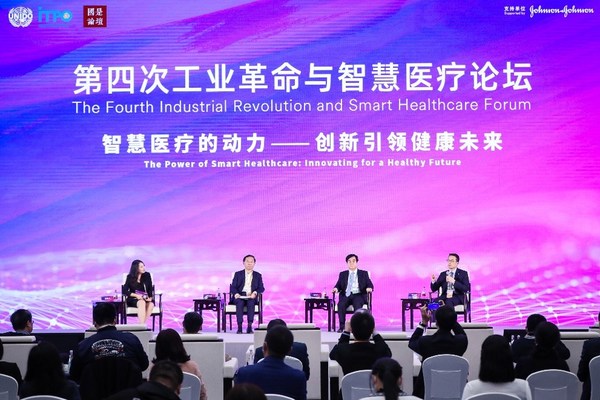
(From left, second) Cai Jiangnan, Zhou Yanli, and Song Weiqun attended the thematic forum “The Power of Smart Healthcare – Innovation Leading Health”
Leveraging Digitalization as a Key Driver Strengthening the Public Health System
During the COVID-19 pandemic, digital technologies and services played a crucial role in epidemic monitoring, virus tracing, prevention and control, treatment, and resource allocation. At the thematic forum titled "The Future of Smart Healthcare: Building a Robust Digital Public Health System," panelists analyzed the current state of public health development in China from multiple perspectives, including health informatization construction, infectious disease prevention and control systems, Internet-plus healthcare, and collaboration with social forces. They also explored the new opportunities that a robust digital public health system could bring to the prevention and control of infectious diseases.
The construction of information systems is a crucial measure for deepening the reform of the medical and healthcare system and promoting the implementation of the Healthy China strategy. Qi Guixin, First-Level Inspector of the Department of Planning Development and Informatization of the National Health Commission, stated, "During the 14th Five-Year Plan period, opportunities and challenges coexist in health informatization work. We urgently need to adhere to problem-oriented and goal-oriented approaches, promote further upgrades of infrastructure construction, and gradually open up the main information arteries for the development of the health industry. At the same time, we will expand and deepen convenient and beneficial services for the public; vigorously develop the digital economy in the health sector; and further consolidate and strengthen cybersecurity, adhering to the development concept of ensuring development through security and promoting security through development."
Zeng Guang, a member of the high-level expert group of the National Health Commission and former chief scientist of epidemiology at the Chinese Center for Disease Control and Prevention (China CDC), stated that after the SARS outbreak, China implemented a direct online reporting system for infectious disease data. This system allows even township health centers to submit reports to the China CDC in real time, with data shared across provincial, municipal, and county levels. During the current epidemic prevention and control efforts, digitalization has become one of the tools in the “toolbox” for epidemic response. “In the past, we only reported data on incident cases and deaths. Now, digital methods help us identify risk factors, such as population gatherings and human movement trajectories, enabling us to detect individuals who have visited high-risk areas and those who have had close contact with confirmed cases.”
The proliferation of the internet, particularly mobile internet, has facilitated the establishment of new healthcare models such as telemedicine and tiered diagnosis and treatment. Lu Qingjun, Director of the National Center for Telemedicine and Internet Medicine and Director of the Hospital Development Office at China-Japan Friendship Hospital, stated that telemedicine represents a collaborative relationship between hospitals and among physicians. It serves as a supportive mechanism to address complex and critical cases that referring hospitals are unable to manage independently. In contrast, internet-based medical consultations are designed to provide convenient and beneficial services to the public, primarily focusing on follow-up visits and continuous treatment for diagnosed common diseases, chronic conditions, and frequently occurring illnesses. Leveraging the “Internet + Healthcare” model can enhance clinical diagnostic and therapeutic capabilities at the primary care level while utilizing information technology to deliver convenient and beneficial services to the public.
When discussing the application of successful experiences in “Internet + Healthcare,” Zhang Wenhong, Head of the Shanghai Expert Group for Medical Treatment of COVID-19 and Director of the Department of Infectious Diseases at Huashan Hospital Affiliated to Fudan UniversityZhang Wenhong statedThe successful convening of the third China International Import Expo was inseparable from China’s smart epidemic control efforts. Zhang Wenhong regarded epidemic control as a “systematic project,” in which China had “properly addressed” every link. He specifically pointed out that within the entire system, the contribution of smart epidemic control must not be overlooked. Its role in areas such as population management and information collection is evident to all. “Whether this experience can be carried forward to future prevention and control of infectious disease outbreaks is, in fact, critically important.”
“Addressing health and hygiene issues requires leveraging modern technology. Currently, China is at the forefront of digital technologies, and the development of internet-based healthcare is also leading globally,” said Asgar Rangoonwala, President of Janssen Pharmaceutical Companies of Johnson & Johnson in China and Chairman of the Executive Committee of the R&D-Based Pharmaceutical Association Committee (RDPAC) of the China Association of Enterprises with Foreign Investment. He specifically cited that, to ensure sustainable treatment outcomes for patients with critical illnesses, Janssen is collaborating with multiple partners to actively explore new patient-centric models of internet hospitals, enabling patients to receive the right products at the right time with appropriate reimbursement. In the future, Janssen will continue to deepen the impact of digital technology applications in the healthcare sector, working hand in hand with the government and industry peers to co-build a digital public health system.
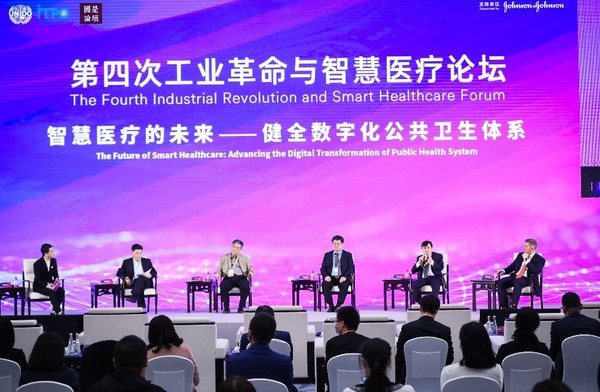
(From left, second) Qi Guixin, Zeng Guang, Lu Qingjun, Zhang Wenhong, and Asgar Rangoonwala attended the thematic forum “The Future of Smart Healthcare: Strengthening Digital Public Health Systems.”
# Sharing the Opportunities of a Healthy China
At the forum on that day, the Guoshi Institute of China News Service, the Institute for China Development Planning at Tsinghua University, and the Institute for Hospital Management at Tsinghua University jointly released the White Paper on Sharing the Opportunities of Healthy China (2020). The white paper provided an in-depth analysis of key issues facing human health and offered proactive recommendations for the development of China’s broader healthcare industry over the next decade, particularly during the 14th Five-Year Plan period, in areas such as the medical innovation ecosystem, smart healthcare, diagnosis and treatment of major diseases, and innovative payment models.
The white paper points out that China has the world’s second-largest health market, with enormous potential for future development. Coupled with China’s increasingly open market environment and mature policy framework, this presents significant opportunities for multinational healthcare companies. To meet the public’s strong demand for high-quality health services, in addition to government public fiscal support, it is essential to mobilize social forces to participate in the provision of health services, establish a multi-stakeholder ecosystem for medical R&D innovation and healthcare payment systems, vigorously introduce new technologies, enhance local R&D capabilities, and promote the healthy development of smart healthcare.
Professor Yang Yongheng, Executive Deputy Director of the Institute for China Development Planning at Tsinghua University and Co-Lead of the White Paper Research Group, stated that he looks forward to deepening win-win cooperation between Chinese and foreign counterparts in the healthcare sector, accelerating the availability of innovative health products and services to meet patient needs, and sharing new opportunities in the development of a Healthy China.
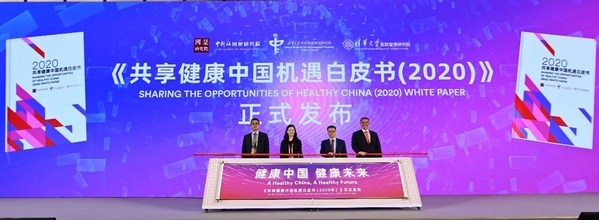
“White Paper on Sharing the Opportunities of a Healthy China (2020)” Released; From left: Song Weiqun, Global Senior Vice President and Chairman of Johnson & Johnson China; Yu Lan, Director of the Economic Department of China News Service, Editor-in-Chief of Guoshi Zhichetong, and Executive Dean of Guoshi Research Institute; Professor Yang Yongheng, Executive Deputy Dean of the Institute for China Development Planning at Tsinghua University; Asgar Rangoonwala, President of Janssen Pharmaceutical Companies of Johnson & Johnson in China and Chairman of the Executive Committee of the R&D-based Pharmaceutical Association Committee (RDPAC) of the China Association of Enterprises with Foreign Investment
Looking Ahead to the Next Decade of Healthy China: Digital Technological Advances to Drive Rapid Development of Smart HealthcareSong Weiqun, Senior Vice President of Johnson & Johnson and Chairman of its China Region, stated, “We are pleased to see that reform, development, and innovation have become the key themes for China’s economic and social development in the next phase, with a stronger Chinese market and a new development pattern emerging. In particular, the government’s comprehensive inclusion of the Healthy China initiative in the 14th Five-Year Plan provides strong momentum for foreign healthcare companies, including Johnson & Johnson, to continue their growth in China. We remain firmly confident in the new chapter and dynamic energy of the Chinese market. We are committed to further deepening our development in China, working hand in hand with the government and industry partners to continuously promote the aggregation, integration, and collaborative innovation of multi-party resources across the industrial chain, thereby driving high-quality development in China’s healthcare sector and contributing to the realization of the grand vision of Healthy China.”