

METiS Pharmaceuticals Secures Over RMB 100 Million in Back-to-Back Series Angel+ and Pre-A Funding Led by Sequoia China and Lightspeed China to Target Billion-Dollar Drug Formulation Optimization Market with AI
METiS TechBio
AI-Driven Drug Formulation Developer
XtalPi
Computation-Driven Innovative Drug R&D Provider

HongShan
Business Consulting, Enterprise Management Consulting Investment Institutions

FreeS Fund
Venture Capital Firms

Morningside Ventures
Well-known early-stage venture capital institution

China Renaissance
Financial Services Investment Institutions

Forcefield
Mobile and Desktop Software Developer
36Kr Exclusive:「METiS Pharmaceuticals Hangzhou Metis TechBio」Official AnnouncementCompleted angel+ and Pre-A financing rounds totaling over RMB 100 million. The angel+ round was led by HongShan, with participation from FreeS Fund, Source Code Capital, XtalPi, and Forcefield Venture. The Pre-A round was led by Lightspeed China Partners, with participation from Morningside Ventures (formerly Chenxing Capital), while existing shareholders continued to increase their investments. CRP-FANYA Investment Consultants (Beijing) Co., Ltd. served as the exclusive financial advisor for both financing rounds.
In the AI-driven drug development sector, METiS stands out as a unique enterprise—the world’s first company to leverage artificial intelligence for “formulation optimization,” enhancing the properties of active pharmaceutical ingredients through advanced formulation techniques, thereby improving the efficiency of new drug development.
AI-driven drug development is an emerging technology that leverages artificial intelligence algorithms to enhance the efficiency and success rate of new drug development. It primarily encompasses two directions: one is formulation optimization, where METiS operates—a field with extremely high technical barriers and currently no global competitors; the other is AI-enabled drug molecule discovery, a sector that has already seen the emergence of a number of high-quality enterprises.
“Currently, 90% of new drugs in development suffer from poor pharmacokinetic properties, and some new modality drugs also lack solutions for drug delivery,” said Dr. Caida Lai, Co-founder and CEO of METiS TechBio.
The core advantages of formulation optimization are a faster R&D pace, lower risk, and quicker time-to-market for innovative drugs. This approach leverages the "shoulders of giants" by improving the delivery methods of known drugs or repurposing existing ones, thereby developing 505(b)(2) innovative pharmaceutical formulations.
From the perspective of market segments, the development cycle for new formulation drugs is shorter (averaging 5 years), the cost is lower ($50 million), and the success rate is higher (22%–46%). Meanwhile, new formulation drugs possess the high value characteristic of novel drugs; a typical example is the paclitaxel formulation developed by Celgene, which generated $1.1 billion in sales.
“Formulation optimization is akin to designing a rocket; the drug molecule itself is the explosive payload, which must be precisely delivered to the lesion site while avoiding collateral damage to healthy tissues along the way. The formulation serves as the high-precision rocket that safeguards and guides the drug molecules.” To facilitate understanding of the principles underlying drug delivery systems (DDS) and formulation optimization, Dr. Lai employed this analogy.
So, compared with traditional enterprises engaged in formulation optimization, what advantages does METiS have by applying artificial intelligence to formulation optimization? In which stages is AI applied?
Dr. Lai stated that traditional approaches heavily rely on expert experience and employ trial-and-error methods to seek optimized solutions. However, in areas such as prescription selection and ratio optimization, process parameter development, and drug carrier design, there are typically 10^20 to 10^30 possible combinations, making it impossible to test each one individually through empirical rules. In contrast, METiS’s self-developed AI-driven formulation development platform leverages a high-throughput simulation experimental platform and quantum chemistry algorithms to identify the optimal formulation strategy.
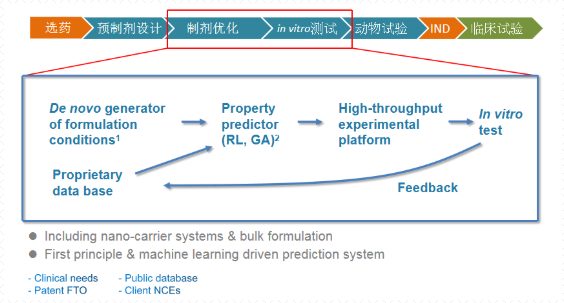
METiS Technology Platform (Image sourced from the official METiS website)
METiS has conducted computational formulation development for 20 different active pharmaceutical ingredients (APIs), including formulation optimization for remdesivir, a widely discussed drug for COVID-19. Remdesivir itself suffers from drawbacks such as poor water solubility, instability, significant systemic toxicity, and prolonged infusion time. By improving the formulation, METiS identified a delivery method with lower toxicity, greater convenience, and a five-fold increase in bioavailability. The company has developed multiple innovative drug R&D pipelines, with two expected to enter the Pre-IND stage in 2021. Notably, it took less than one year for these two pipelines to progress from project initiation to preclinical candidate (PCC) selection.
METiS launched its experimental platform this year and established strategic collaborations with multiple leading pharmaceutical companies both domestically and internationally. In the Chinese market, the new chemical drug registration classification introduced in 2016 redefined the concept of improved new drugs, providing clear policy guidelines. It is expected that, driven by the recent trend of volume-based procurement, the domestic market will offer broader growth opportunities.
METiS’s core team comprises multiple scientists from the Massachusetts Institute of Technology (MIT). Dr. Caida Lai, CEO, previously worked at the Novartis-MIT Center for Continuous Manufacturing and McKinsey & Company, specializing in pharmaceutical manufacturing processes and digital strategies for new drug development. Dr. Hongmin Chen, Director and Scientific Advisor, is a member of the U.S. National Academy of Engineering, a serial entrepreneur in the pharmaceutical industry, and an expert in pharmaceutical formulation research; he previously led a pharmaceutical startup to a successful initial public offering (IPO). Dr. Wenshou Wang, Chief Operating Officer, specializes in polymer chemistry and artificial intelligence research and was a co-founder of Inkbit. Additionally, the team includes numerous senior professionals with extensive experience in new drug R&D, clinical development, and pharmaceutical digitalization.
It is reported that the funds from this financing round will be primarily used to expand collaborations with pharmaceutical companies, advance novel formulation pipelines into clinical trials, and extend AI-driven formulation technologies to the fields of intracellular delivery and macromolecular drugs.
Dr. Lai Caida, Co-founder and CEO of METiS TechBio, stated: “In the broader context of declining returns on new drug development driven by improved R&D efficiency and significantly compressed value for generic drugs, the pharmaceutical industry urgently needs efficient drug innovation. Meanwhile, substantial unmet clinical needs persist, and many novel therapeutic modalities continue to face significant challenges in achieving druggability. In recent years, artificial intelligence has achieved landmark breakthroughs across various fields, such as AlphaFold’s resolution of the long-standing protein folding problem. METiS is dedicated to building new AI-driven infrastructure for drug delivery R&D, establishing core technologies in AI algorithms, molecular simulation, mathematical modeling, and high-throughput experimentation. By collaborating with global pharmaceutical companies, we are exploring and validating the value of our platform, while actively working with partners to advance improved new drugs with differentiated clinical profiles.”
Cao Xi, Partner at HongShan (Sequoia Capital China), stated: “METiS TechBio enters the market through formulation optimization, addressing critical pain points with rapid implementation, while further extending into new drug development for formulations, representing a vast market opportunity. The core team possesses interdisciplinary expertise in computation, pharmacy, chemical engineering, and materials science, and has successfully validated its technological advantages, making it an exceptional and scarce talent pool.”
Gao Jiankai, Assistant Partner at Lightspeed China Partners, stated, “The COVID-19 pandemic has made healthcare and biopharmaceuticals key sectors of high expectation for both capital investors and the public. New drug development is characterized by three major high-risk factors: high costs, long R&D cycles, and low success rates. Major pharmaceutical companies are urgently seeking solutions that can shorten development timelines, effectively improve success rates, and develop competitive, cutting-edge drugs.”
Jing Xutian, Executive Director at Morningside Ventures, stated, “AI in new drug development has manyPolycyclicplay a pivotal role in every stage. Identifying new drug molecules targeting specific sites is naturally one of the core areas; however, the development of drug formulations represents a scenario closer to practical application and has long been an underserved critical vertical segment within the industry. Finding the appropriate formulation can optimize the clinical performance of drug molecules. METiS has not only independently developed AI algorithms for screening drug formulations but also established a high-throughput, automated formulation testing platform, enabling the rapid accumulation of large-scale data to build feedback loops.
Zhou Xiang, Head of the Financial Advisory Division at China Renaissance, stated, “Amidst the practical challenges of traditional new drug development—characterized by long cycles, high investment costs, and significant risks of failure—AI-assisted drug discovery has become a sector attracting substantial capital attention in recent years.”