

ONL Therapeutics Secures $46.9M Series B Financing to Advance Innovative Fas Inhibitor ONL1204 for Retinal Diseases
ONL Therapeutics
Ophthalmic Drug Developer
ONL Therapeutics (hereinafter referred to as “ONL”), founded in 2011 and headquartered in Ann Arbor, Michigan, USA, is a biotechnology and pharmaceutical company. The company primarily develops novel therapies for retinal diseases to protect and improve patients’ vision.
Recently, ONL Therapeutics announced the completion of a $46.9 million Series B financing round. The new round was led by new investors Bios Partners, PSQ Capital, Johnson & Johnson Innovation, KaiTai Capital, and Michigan Capital Network Venture Fund III. Existing investors InFocus Capital Partners, ExSight Ventures, Capital Community Angels, and the Michigan New Technology Ventures program at the University of Michigan participated as co-investors.
To date, ONL Therapeutics has completed five rounds of financing. Previously, the company closed a $4.5 million Series A financing round in May 2017 to develop drugs for the treatment of retinal detachment.
Ophthalmology has long been hailed as a “golden track” due to its vast market potential and high barriers to entry. In an increasingly saturated ophthalmic market, why has ONL Therapeutics garnered favor from investment institutions? VCBeat seeks answers by examining the company’s history and business operations.
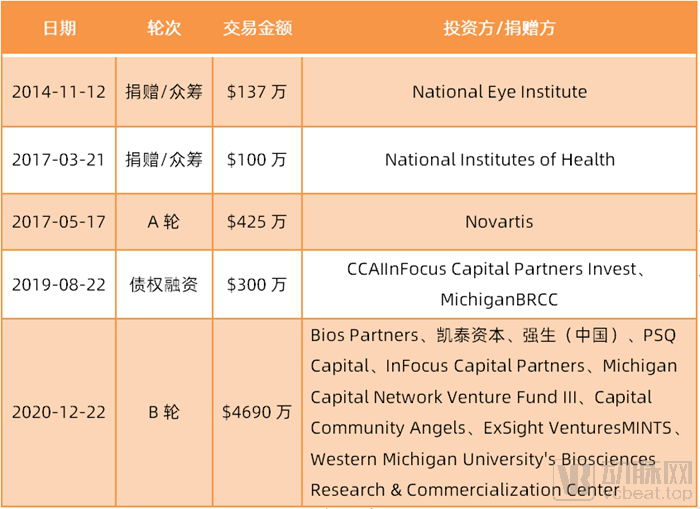
ONL Financing History (Data Source: VCBeat)
ONL’s management team comprises seasoned executives from the life sciences industry and renowned experts in the field of ophthalmology.
David Esposito, President and Chief Executive Officer of ONL Therapeutics, possesses extensive industry knowledge and management experience. His career began as a sales representative at the pharmaceutical company Merck, where he steadily advanced through the marketing department of Merck’s U.S. division.
Prior to joining ONL Therapeutics, David Esposito served as Chief Executive Officer of Armune BioScience, a life sciences company, where he led the development and commercialization of blood-based diagnostic technologies. The company successfully launched the only non-PSA blood test designed to improve the detection quality of prostate cancer. Subsequently, he served as President of Phadia US, a biotechnology enterprise, and played a key role in selling the business to Thermo Fisher Scientific (TMO), a life sciences company, in 2011.
David Zacks, Ph.D., Co-Founder and Chief Scientific Officer, is a Professor of Ophthalmology and clinical expert at the Kellogg Eye Center, University of Michigan. Over the past 15 years, Dr. Zacks’ research has focused on molecular regulatory mechanisms controlling photoreceptor death or survival in retinal diseases. He is a recognized expert in the fields of retinal neuroprotection and photoreceptor cell physiology.
As a recognized expert in the field of retinal disease research, Dr. Zacks has received numerous honors for his work, including the 2011 W. Richard Green Lecture and Award from the Macula Society. In addition, he earned his M.D. from Albert Einstein College of Medicine and completed his fellowship in ophthalmology and vitreoretinal surgery at Massachusetts Eye and Ear Infirmary, Harvard Medical School.
Dr. Kocab, Director of R&D, earned his Ph.D. in Immunology from the University of Michigan, where he focused on researching cell signaling pathways associated with cell death and inflammation. Specifically, his work centers on elucidating signaling mechanisms closely related to Fas (a protein receptor) to leverage Fas inhibitors for the treatment of retinal diseases.
After joining ONL, Dr. Kocab authored grant applications for the U.S. National Institutes of Health (NIH) and coordinated the submission of orphan drug applications, playing a pivotal role in the company’s research and development operations.

From left to right: David Esposito, David Zacks, and Kocab (Image source: ONL official website)
Human photoreceptors are divided into two categories: cone cells and rod cells, which are distributed and arranged on the retina of the human eye. The death of retinal cells is the primary cause of vision loss.
Fas is a cell surface protein receptor that induces apoptosis. It is distributed in various tissue cells and plasma, playing a crucial role in cellular homeostasis. Fas-mediated signal transduction is one of the fundamental mechanisms by which the body activates cell death. Numerous studies have demonstrated that Fas plays a significant role in a range of retinal diseases, including retinal detachment, uveitis, diabetic retinopathy, glaucoma, and optic neuropathy. Therefore, inhibiting the Fas signaling pathway can mitigate its adverse effects.
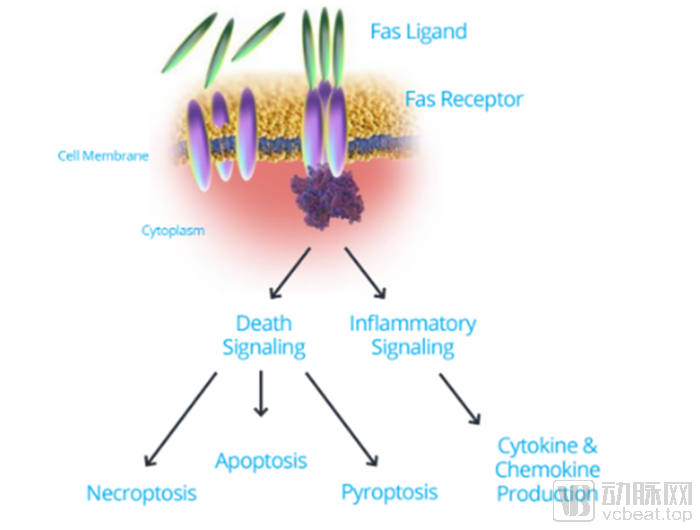
Fas-Mediated Cell Death and Immune Signal Transduction Mechanisms (Image source: ONL Therapeutics official website)
Based on the aforementioned mechanism, ONL Therapeutics has developed ONL1204, a small-molecule Fas inhibitor. ONL1204 can protect ocular structures, including photoreceptors, in patients with retinal diseases and maintain the viability of retinal cells. Currently, ONL1204 has been granted Orphan Drug Designation by the U.S. Food and Drug Administration (FDA) primarily for the treatment of patients with retinal detachment.
It is reported that this round of financing will be used to advance the Phase I clinical trial of ONL1204 for the treatment of retinal detachment. In addition, ONL is also exploring its efficacy in other diseases such as glaucoma, inherited retinal degeneration, and age-related macular degeneration (AMD).
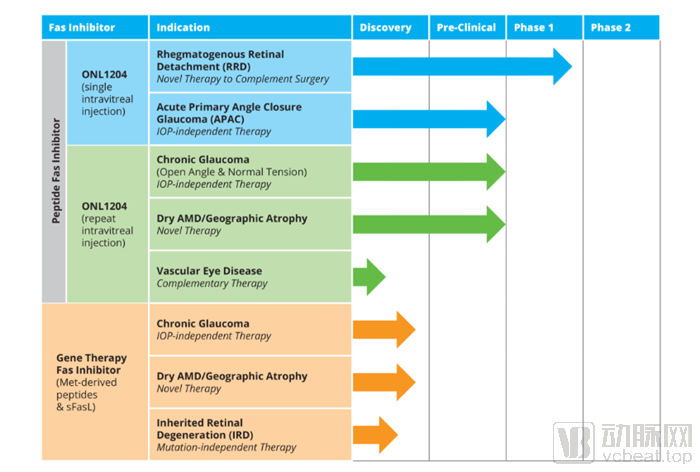
ONL1204 Enters Phase I Clinical Trial (Image source: ONL Therapeutics official website)
A Decade of ONL: A Chronicle of the Fight Against Ocular Diseases
In February 2011, ONL Therapeutics was founded in Ann Arbor, Michigan, USA, marking the beginning of its journey.
In March 2013, after two years of effort, ONL Therapeutics’ ONL-101 received Orphan Drug Designation from the U.S. FDA for the treatment of retinal detachment diseases. For ONL, achieving this milestone within two years was highly encouraging.
In October 2013, ONL appointed Dr. Anna Schwendeman to lead the company’s preclinical development programs. Dr. Schwendeman previously worked at the biotechnology companies Cerenis and Esperion, possessing extensive expertise in peptide drug manufacturing and regulatory affairs. This appointment facilitated the implementation of ONL’s clinical programs.
In November 2014, ONL Therapeutics received a $1.37 million grant from the National Eye Institute (NEI) of the United States. ONL utilized these funds for the preclinical development of ONL101 and to submit an Investigational New Drug (IND) application to the U.S. Food and Drug Administration (FDA).
In June 2015, ONL discovered the small-molecule peptide ONL1204, which inhibits the Fas pathway (the primary mediator of photoreceptor apoptosis), and filed a patent for it. ONL elevated ONL1204 to its lead development candidate and planned to advance it into clinical trials for the treatment of retinal detachment. This discovery marked a milestone for ONL and paved the way for ONL1204 to become the company’s flagship product.
In October 2015, ONL established a Scientific Advisory Board (SAB) composed of five world-leading experts in the field of retinal diseases. The SAB was formed to guide the development of the company’s novel vision preservation technology platform for retinal diseases.
In May 2017, after two years of intensive development, ONL Therapeutics secured a $4.25 million Series A financing round led by Novartis. The company utilized these funds to continue supporting the final development of ONL1204 and to prepare for clinical trials targeting retinal detachment.
In October 2019, after another two years of development, Australian regulatory authorities approved the Phase I clinical trial of ONL1204, marking another milestone in ONL’s journey to combat retinal diseases. Building on this achievement, ONL successfully transitioned into a clinical-stage pharmaceutical company.
In December 2020, ONL Therapeutics completed a $46.9 million Series B financing round. With this funding, ONL Therapeutics will advance ONL1204 into clinical development for ophthalmic diseases such as glaucoma and macular degeneration within the next two years.
By reviewing the milestone events in ONL’s ten-year history, it is evident that ONL’s decade of endeavor has been firmly centered on retinal diseases. From the cycle of fundraising–R&D–fundraising–R&D, we can see how ONL has been steadily writing its own history, one step at a time. The discovery of ONL1204, the filing of an Investigational New Drug (IND) application for clinical trials, and the expansion of ONL1204 to other ophthalmic indications demonstrate ONL’s focus and perseverance in the field of ophthalmic pharmaceuticals. “Ten years to sharpen a sword”—ONL’s sustained efforts in treating eye diseases have finally yielded rewards.
The ophthalmology industry is divided into three segments: ophthalmic services, ophthalmic devices, and ophthalmic pharmaceuticals. According to an ophthalmology report released by Haitong International in September 2020, among the three segments, ophthalmic services have the largest market size (accounting for 70%), ophthalmic devices exhibit the fastest growth rate (reaching 15%), and ophthalmic pharmaceuticals have the smallest market size.
According to a market research report by TMR, the U.S. ophthalmic drug market is projected to reach $34 billion in 2025, driven by the rising incidence of eye diseases. Compared with other therapeutic areas, there are fewer innovative drugs in ophthalmology; mainstream ophthalmic medications remain in a blue ocean market, offering substantial potential for market penetration.
Currently, some of the major players in the global ophthalmic drug market, including Allergan, Aerie, Pfizer, Valeant, Bayer, Genentech, and Novartis, are continuously developing innovative ophthalmic drugs.
Based on disease indications, the global ophthalmic drug market can be segmented into retinal diseases, glaucoma, infectious and inflammatory conditions, uveitis, allergies, and others. Retinal disorders can be further subdivided into wet macular degeneration, age-related macular degeneration, diabetic retinopathy, and more. For these ocular conditions, drugs developed by certain leading pharmaceutical companies have received approval from the U.S. Food and Drug Administration (FDA).
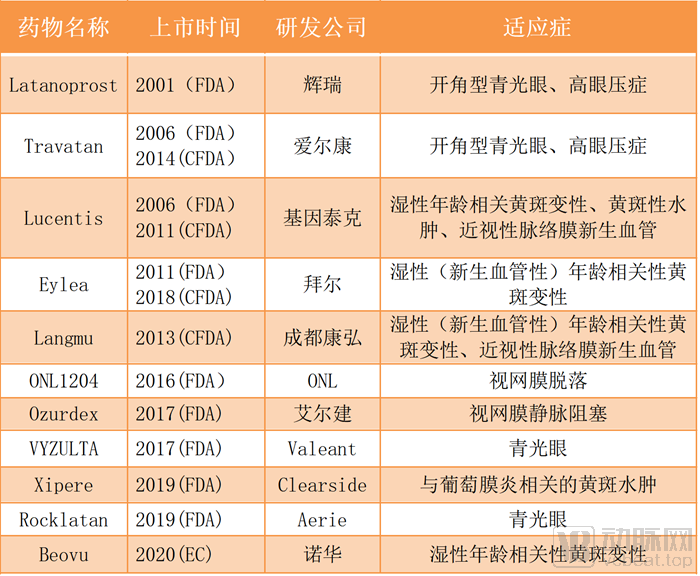
Selected FDA-Approved Ophthalmic Pharmaceuticals (Source: VCBeat Orange)
According to survey data from ONL, retinal detachment alone represents a $500 million global market, while the associated latent sequelae constitute a multi-billion-dollar market. Currently, ONL’s research portfolio has expanded to other blinding conditions, including glaucoma and age-related macular degeneration, underscoring its significant potential in the future ophthalmology market.
According to Frost & Sullivan’s forecast, the market size of China’s ophthalmic pharmaceutical industry is expected to reach RMB 24.7 billion in 2021. Companies are vying for market share, a trend that is particularly evident in the ophthalmic pharmaceutical sector. Over the past decade, traditional pharmaceutical companies such as Hengrui, CMS, Kelun, Kanghong, and 3SBio have actively expanded into ophthalmology. Meanwhile, Ocumension Therapeutics has emerged as the most typical rising star through its series of strategic moves in the ophthalmic pharmaceutical field over the past three years.
Compared with other ophthalmic pharmaceutical companies in the industry, Ocumed’s most distinct feature is its extensive drug portfolio. Based on its current pharmaceutical products, Ocumed’s ophthalmic drug layout covers both the ocular surface and the fundus, including indications such as glaucoma, myopia, chronic non-infectious uveitis posterior segment (NIU-PS), conjunctivitis, dry eye disease, postoperative inflammation, optic neuritis, and macular degeneration. From candidate drugs to commercialization, Ocumed maintains a continuous product pipeline to ensure sustained output.
It is worth noting that, at this stage, Ocumension Therapeutics possesses a star candidate drug—the steroid implant OT-401 (YUTIQ). This is currently the only steroid implant undergoing Phase III clinical trials in China. Upon expected approval, it will become the first ocular implant approved in China for the treatment of uveitis, with its revenue potential being self-evident.
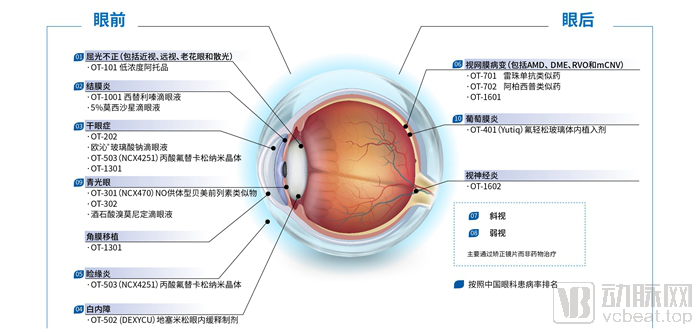
Ocunexus Therapeutics’ Product Pipeline (Image source: Ocunexus Therapeutics official website)
In July 2020, Ocumension Therapeutics was listed on the Main Board of the Hong Kong Stock Exchange. In late December 2020, Ocumension Therapeutics entered into a share purchase agreement with EyePoint Pharmaceuticals, acquiring 3.0107 million shares of EyePoint for a total consideration of approximately USD 15.7048 million, thereby sustaining the continuous growth of its pharmaceutical business.