

Bayer Successfully Defends Kangwang Trademark Rights and Takes a Stand Against Unfair Competition

Bayer
Pharmaceutical Product R&D Developer
Shanghai, January 19, 2021 /PRNewswire/ -- Recently, two civil mediation statements brought an end to the three-year-long trademark infringement and unfair competition case involving the Kangwang® brand. Under the auspices of the Shanghai Intellectual Property Court, the three defendants jointly reached a mediation agreement with the trademark owner, Dihon Pharmaceutical Group Co., Ltd. (hereinafter referred to as "Dihon"), a subsidiary of Bayer. The defendants committed to immediately ceasing all trademark infringement and related unfair competition practices, compensating Dihon for economic losses in the amount of RMB 1 million, and publishing an apology statement on Toutiao and its WeChat official account.。
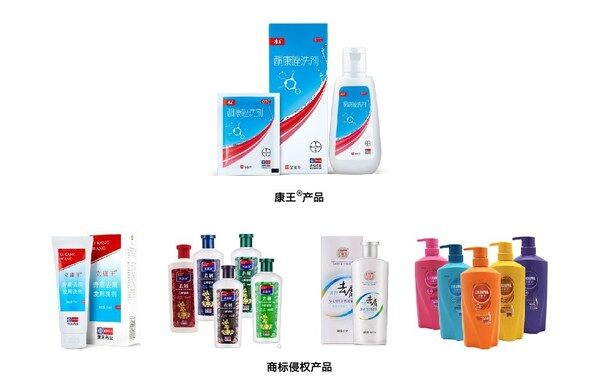
Kangwang® Products and Trademark-Infringing Products
"Li Gui" Keeps Reappearing "Kangwang" Takes Decisive Action
Kangwang® is a well-known brand in the medicated anti-dandruff shampoo category, with a history spanning nearly 25 years. In 2014, it became part of Bayer following Bayer’s successful acquisition of Dihon Pharmaceutical Group Co., Ltd. As one of Bayer’s flagship brands rooted in the Chinese market, Kangwang® has consistently received significant corporate support and has maintained its position as the number-one brand in the medicated anti-dandruff shampoo segment.
In 2017, Bayer noticed the appearance of "Bai Kangwang" in the market”Shampoo: Investigations and evidence collection confirmed that the product was manufactured and sold by Company A, a former distributor of Dihon Pharmaceutical Group Co., Ltd., and its subsidiary, Company B. In response to the malicious trademark infringement involving the intentional registration and use of the “Baikangwang” mark—despite the perpetrators’ clear knowledge that the Kangwang® brand belonged to Bayer—Bayer filed an administrative complaint with the Qingpu District Market Supervision Administration in Shanghai. In 2019, a penalty decision was issued, ordering Companies A and B to immediately cease their infringing activities and imposing a fine of RMB 200,000.
However, in 2018, the company resumed operations involving a new infringing product, “Likangwang” shampoo, selling it through both online and offline channels, promoting it extensively in media and at pharmaceutical exhibitions, and inviting public figures to endorse it. Its affiliated company, Company CAlsoThe use of the characters “Kangwang” in a company name, self-styled as “Kangwang Pharmaceutical,” constituted an act of unfair competition. In response, Bayer filed civil infringement lawsuits against “Baikangwang” and “Likangwang” with the Shanghai Intellectual Property Court. Ultimately, in December 2020, the parties reached a settlement through court mediation, under which the defendants immediately ceased infringing activities, provided compensation, and issued apologies. The settlement addressed all claims brought by Bayer and additionally encompassed other unfair competition practices by the defendants, thereby achieving a comprehensive resolution of all infringing acts to the greatest extent possible and preventing the defendants from further free-riding on the “Kangwang” brand in the future.
The Business Environment Is Improving Corporate Rights Protection: Steadfast Steps
As a mark that indicates the source of goods to consumers, a trademark is intended to ensure that the origin of the products purchased by buyers is authentic and reliable, thereby preventing harm to their interests caused by trademark confusion. By actively enforcing their rights against infringement, trademark owners not only defend their own legitimate rights and interests but also strive to safeguard the lawful rights and interests of consumers, ensuring that consumers purchase genuine products of true value and are not deceived.
From “Baikangwang” to “Likangwang,” Bayer has launched multi-dimensional actions against infringers, demonstrating its firm stance of “zero tolerance” for intellectual property rights infringement. During the rights protection process, Bayer also felt the determination of relevant administrative departments in protecting intellectual property rights. Between 2018 and 2020, all rights protection actions initiated with different administrative departments regarding the infringing products “Baikangwang” and “Likangwang” yielded favorable outcomes. In addition, platforms such as Tmall, Taobao, and JD.com supported Bayer’s complaints against infringement, resulting in the removal of over a thousand links to infringing products.
The successful defense of the Kangwang® trademark highlights China’s increasingly favorable environment for intellectual property protection. The new Trademark Law and the Civil Code of the People’s Republic of China have both strengthened penalties for malicious infringement at the legislative level, encouraging rights holders to utilize legal instruments to safeguard their legitimate rights and interests while fully leveraging the deterrent effect of the law, thereby making infringers aware that such violations will inevitably incur substantial costs.
Bayer, as one of the earlier innovative foreign enterprises to enter China, has witnessed the development and progress of intellectual property protection in China, and towards ChinaBusiness Environmentconfidence continues to grow, and the steps taken to safeguard rights have become more resolute. Meanwhile, Bayer also hopes that consumers will enhance their self-protection awareness, identify trademarks accurately, and clearly recognize the source of goods. The company also looks forward to collaborating with all sectors of society to effectively protect intellectual property rights and uphold the legitimate rights and interests of the public.
Forward-Looking Statements
This document includes forward-looking statements made by the management of Bayer Group based on current assumptions and forecasts. Various known and unknown risks, uncertainties, and other factors may cause the company's actual future operating results, financial position, development, or performance to differ materially from the estimates presented in these forward-looking statements. These factors include those listed on Bayer’s official websitehttp://www.bayer.com/the reports published by Bayer. The Company has no obligation to update these forward-looking statements or to conform them to future events or developments.