

Hongpu Medical Secures Tens of Millions in Pre-A Funding to Advance Peripheral Interventional Devices

Hope Medical
Medical Device R&D Manufacturer
36Kr has learned that, focusing on the R&D and production of high-end medical devices for peripheral interventionsShanghai Hope Medical Devices Co.,Ltd(hereinafter referred to as “Hope Medical”) completed a Pre-A financing round of tens of millions of yuan, with joint investment from institutions including Jiuzhi Xinfei, SPINNOTEC, Chengwei Investment Management Advisory (Shanghai) Co., Ltd., and Shenzhen Timesbole Venture Capital Investment Management Co., Ltd. It is reported that the funds raised in this round will be primarily used for clinical studies of new products in the peripheral intervention pipeline and for building the sales system for inferior vena cava filters.
Hope Medical, founded in 2014, specializes in the research and development of interventional medical devices for peripheral diseases. The company has strategically positioned itself in three key therapeutic areas: venous thromboembolism (VTE), peripheral arterial stenosis or occlusion, and portal hypertension (cirrhosis-related), providing platform-based solutions for peripheral disease medical devices. Currently, Hope Medical’s main products under development include inferior vena cava filters, peripheral vascular covered stents, and drug-coated TIPS covered stents.
It is reported that venous thromboembolism (VTE) has become the third most common cause of death from cardiovascular diseases, following ischemic heart disease and stroke. VTE includes deep vein thrombosis (DVT) and pulmonary embolism (PE). The annual incidence of new VTE cases in the United States is approximately 1.17 per 1,000 individuals, with about 350,000 new cases occurring each year. Based on population proportions, it is estimated that there are approximately 1.5 million new cases of VTE annually in China. In 60%–70% of patients with untreated lower-extremity DVT, PE may develop. For patients who have contraindications to anticoagulation (e.g., major surgery) or who experience severe complications during anticoagulant therapy (indicating anticoagulation failure), an inferior vena cava filter is the only effective method for preventing fatal PE.
To this end,Hope Medical independently developed an inferior vena cava filter. According to reports, it features a proprietary three-dimensional S-shaped filter mesh structure and a unique retrieval hook opening design, while employing nickel-titanium alloy connecting nuts. Consequently, it offers superior thrombus capture, retrievability, and corrosion resistance. To date, clinical trials and follow-up studies involving 200 human subjects have been completed, and the Class III medical device registration certificate applied for is expected to be approved in 2021.
As for other products, from the perspective of industry demand,The typical clinical symptom of lower extremity arteriosclerosis obliterans is intermittent claudication. Traditional interventional approaches primarily involve balloon angioplasty and bare-metal stent implantation; however, patients are prone to postoperative complications such as arterial elastic recoil, stent fracture, and in-stent restenosis.
To this end, Hope Medical has developed a heparin-coated peripheral covered stent with high technical barriers. The graft coverage and surface heparinization effectively inhibit neointimal hyperplasia, significantly improving the long-term patency rate of the stent. Featuring a nitinol monofilament braided structure and a fish-scale surface design, the stent demonstrates markedly enhanced flexibility and fatigue resistance, making it particularly suitable for the iliac, superficial femoral, and popliteal arteries, which are subject to significant torsion and bending in daily activities. It is reported that, in addition to most indications applicable to bare-metal stents, this product can also be used to treat conditions such as arterial rupture and pseudoaneurysms, thereby offering a broader range of applications.
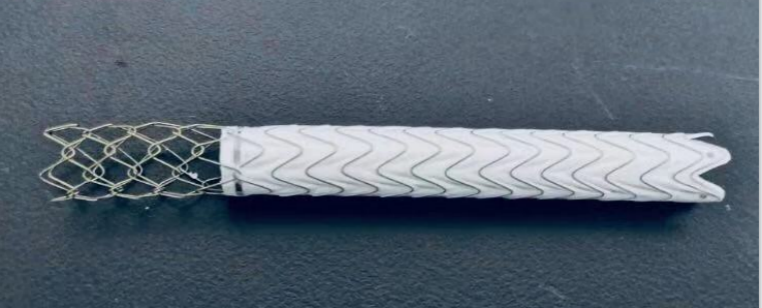
Fig.: TIPS Covered Stent
Meanwhile, Hope Medical has also developed a heparin-coated TIPS covered stent for conditions such as portal hypertension. It is reported thatPortal hypertension is an inevitable consequence of liver cirrhosis progressing to a certain severity. At advanced stages, rupture of esophageal and gastric fundal varices can lead to massive upper gastrointestinal bleeding, triggering a series of complications such as hepatic encephalopathy, hepatorenal syndrome, and ascites. Transjugular Intrahepatic Portosystemic Shunt (TIPS) is an interventional treatment for portal hypertension. Compared with surgical portosystemic shunting, TIPS has a higher success rate, with an effective hemostasis rate exceeding 90%.
Currently, there are over 7 million patients with liver cirrhosis in China, and the number of cases is continuously increasing, with approximately 330,000 deaths annually related to portal hypertension due to liver cirrhosis. At present, all TIPS stents used in clinical practice in China are imported products, indicating a significant demand for domestic substitution.
As of now, Hope Medical’s two core products have completed animal studies and are poised to enter human clinical trials. Upon regulatory approval, these products are expected to break the monopoly held by imported alternatives. In addition to the disclosed core products, Hope Medical maintains several undisclosed backup pipelines currently under development.
Regarding the team, Founder and CEO Li Hu formerly served as Deputy General Manager of MicroPort Group. He has previously held key positions including Head of Product R&D, Senior Director of Supply Chain, and General Manager of a subsidiary at MicroPort Group. With over two decades of experience in the medical device industry, he possesses extensive industrial expertise.
Investor Perspectives
Jiuzhixinfei Partners Xia Kun and Xin Zhenlei stated:
Currently, the peripheral arterial and venous market is still dominated by imported products. The Hope Medical team possesses a spirit of continuous breakthrough and the potential for iterative innovation. We believe that the company is poised to break the import monopoly in the peripheral vascular field and become the most high-growth enterprise in this sector.
An investment manager at SPINNOTEC stated:
Drawing from international market development experience, the treatment volume for peripheral vascular diseases is expected to rise significantly alongside improvements in national health awareness and income levels. Hope Medical has demonstrated forward-looking strategic positioning with its specialized product portfolio in the peripheral vascular sector. It is believed that the company will continue to innovate and emerge as a key player in the field of peripheral vascular intervention.
Yan Di, Head of Healthcare at Chuangban Investment, stated:
Currently, China's peripheral interventional market is in its early stages, with no mainstream products being widely adopted. Overall industry attention remains confined to cardiovascular and cerebrovascular diseases with high mortality rates. However, population aging is progressively exacerbating lower extremity vascular diseases, leading to a continuous increase in the volume of peripheral interventional procedures. Consequently, the corresponding device market is poised to reach an inflection point for explosive growth.
Timesbole Medical Team:
Liu Xiayue, Senior Investment Manager, pointed out that peripheral vascular disease has not received sufficient attention in the past. Despite the large patient population, the market remains in its early stages of development, with limited therapeutic products available to patients. Hope Medical is building a diverse product portfolio with high technical barriers, integrating arterial and venous solutions, and is poised to become a Chinese enterprise with global influence in the peripheral vascular field.
Partner Zhou Bo emphasized that the absolute increase in the aging population, the introduction of more innovative and comprehensive treatment solutions, and heightened public awareness regarding the diagnosis and treatment of age-related diseases will serve as three powerful drivers. The market in related niche segments is approaching an inflection point for explosive growth, and high-quality domestically produced medical devices hold promising prospects.