

NeuralFLEX Technologies Files IPO Prospectus: Leveraging Non-Invasive BCI to Deliver EEG Analytics Solutions Across Multiple Sectors

Neural FLEX
Intelligent Medical Device R&D and Provider
The brain is the highest-level component of the human nervous system and serves as the material basis for higher-order neural activities such as consciousness, cognition, language, and learning. In recent years, countries including the United States, China, and Japan have launched brain science initiatives, among which the collection and analysis of brain signals reflecting neural activity is a commonly employed research approach.
As a cutting-edge technology in the field of brain science, brain-computer interfaces (BCIs) establish an interaction mechanism between the human brain and the external environment, thereby enabling direct control of devices and expression of thoughts through brain activity. BCIs hold immense application potential across various sectors, including education, military, entertainment, and healthcare.
By integrating brain-computer interface (BCI) technology, Neural FLEX has developed a comprehensive signal decoding platform and health-focused solutions through its independently developed hardware, software, and algorithms capable of reading and interpreting electroencephalogram (EEG) signals.
Brain-Computer Interfaces Gradually Entering the Application Level
Feng Chao, Founder & CEO of Neural FLEX, graduated from Huazhong University of Science and Technology. He later pursued exchange studies at the University of Tokyo in Japan, where he engaged in R&D of artificial intelligence technologies. He is currently a Ph.D. candidate in Computer Science and Engineering at the Hong Kong University of Science and Technology.
Systematic learning and application of artificial intelligence technologies have made Feng Chao realize that there are still many mysteries of the brain waiting to be unraveled and explored at this stage. Taking the decoding mechanism of brain neurons as an example, although extensive research has been conducted on the encoding mechanism of brain neurons, the second-stage decoding mechanism remains in the exploratory phase.
In recent years, the rapid advancement of computer technology has driven progress in brain-computer interface (BCI) technology. However, BCI is a high-threshold, complex systematic engineering endeavor involving multiple disciplines, including neuroscience, cognitive science, artificial intelligence, and materials science. Therefore, overall, BCI technology remains in its early stages of development.
Currently, the implementation of brain-computer interfaces (BCIs) primarily involves two approaches: invasive and non-invasive. Invasive BCI technology, which involves directly implanting electrodes into the cerebral cortex's gray matter, yields higher-quality neural signals. However, due to individual biological variability and the formation of scar tissue following implantation surgery, signal quality is prone to degradation or even complete loss over time.
Non-invasive brain-computer interfaces do not require implantation into the brain and are more convenient to wear on the human body. However, due to factors such as signal attenuation by the skull and interference from physiological noise, extensive denoising and analytical processing of the acquired signals is required in subsequent stages.
In terms of signal acquisition quality, invasive brain-computer interfaces (BCIs) capture information with significantly higher accuracy. However, compared to invasive interfaces, non-invasive BCIs are more readily applicable in the consumer electronics sector. Currently, Neural FLEX’s EEG analysis solutions are based on non-invasive brain-computer interface technology.
Regarding its team, Neural FLEX has assembled elite talent from fields such as neuroscience, psychology, artificial intelligence, intelligent hardware development, and supply chain management. In terms of product R&D, Neural FLEX has established collaborative partnerships with institutions including Northwestern University’s Feinberg School of Medicine, the College of Biomedical Engineering at Shenzhen University’s Medical Department, and the Institute of Psychology of the Chinese Academy of Sciences. These collaborations enable the refinement of product models through data sharing and the accumulation of user data over time.
Hardware + Software + Algorithms: Bringing EEG Analysis to Life Scenarios
Non-invasive brain-computer interface (BCI) technology typically relies on electroencephalogram (EEG) acquisition devices to capture and amplify EEG signals. These devices are commonly designed as EEG caps that can be directly worn on the head. However, prior to use, EEG caps require preparatory procedures such as hair washing and application of conductive gel, which consume a certain amount of time. Consequently, portable wearable EEG monitoring devices have become a strategic focus for some companies.
Neural FLEX has developed a versatile smart wearable device, “XinYing,” for general scenarios by employing flexible, measurement-grade general-purpose chips. The device captures raw electroencephalogram (EEG) data and outputs processed EEG signals via the “YiNian” mobile app, thereby reducing users’ data processing costs.
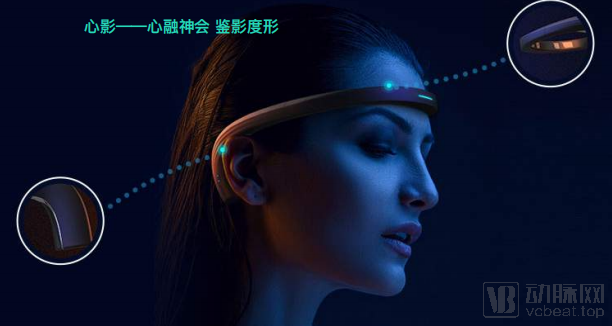
Visually, Neural FLEX’s XinYing headband does not cover the entire head like a traditional electrode cap. This design choice is primarily based on the fact that during meditation and interoceptive awareness, brain activity is predominantly concentrated in the prefrontal cortex. Consequently, the product incorporates four sensors positioned at the forehead, along with a reference electrode and a ground electrode on each side. All electrodes are made of highly conductive materials to facilitate high-quality signal acquisition.
In contemporary society, a growing number of individuals are paying attention to their mental states and psychological well-being, a demand that has driven the development of mental health products and the meditation market. However, most people are unable to quantify the effects of their mindfulness meditation practices, making it difficult to obtain more precise, personalized meditation plans tailored to their individual conditions.
In response, Neural FLEX’s XinYing headband uses brain-computer interface technology to read users’ EEG signals in real time. After processing, the data is displayed on the YiNian APP, which also outputs quantified metrics such as meditation level, stress level, and concentration level to analyze and assess the user’s meditation state. Based on the user’s meditation state and EEG data, the APP can automatically recommend different types of music and generate personalized brainwave music tailored to the user’s EEG patterns, helping them regulate their mental state.
Furthermore, by integrating with “smart home” systems, the XinYing headband and the YiNian app can intelligently adjust smart devices such as lighting and aromatherapy diffusers based on the user’s state, providing interventions to enhance meditation efficiency.
It is understood that Neural FLEX has currently obtained 13 invention patents, 2 US patents, 1 utility model patent, and 7 software copyrights. Moreover, its independently developed Cardio-Headband has successfully achieved mass production, obtained CE certification, and is available for sale both domestically and internationally.
Integrate Online and Offline Channels to Develop Multi-Scenario Comprehensive Solutions
Next, Neural FLEX will leverage its existing product portfolio to continuously expand its online consumer user base and further enlarge its market share. In response to the growing demand for group meditation among certain users, Neural FLEX will launch an online multi-user meditation module on its YINIAN App, while simultaneously establishing offline meditation studios to deliver immersive meditation experiences to a broader audience.
In terms of B2B business, Neural FLEX builds service platforms and customized solutions for enterprises in sectors such as healthcare and education, while opening API interfaces to foster cross-industry collaboration. This approach also enables the accumulation of substantial user data, facilitating subsequent product development.
In terms of products, Neural FLEX is developing a sleep device that combines transcranial electrical stimulation with physical environment adjustment to help users relax quickly and enter a sleep state. It is understood that this sleep device not only enables comprehensive health monitoring of EEG signals but also adds monitoring modules for routine physiological indicators such as respiration and body temperature, making it applicable to fields beyond sleep.
Furthermore, leveraging its extensive data and technological reserves, Neural FLEX is expanding the deployment of brain-computer interface (BCI) technology into a broader range of application scenarios. It is reported that Neural FLEX is currently exploring the integration of brain-computer interaction technology into the screening and diagnosis of neurological disorders, aiming to facilitate the auxiliary diagnosis of conditions such as depression and autism.
To ensure the continued advancement of product R&D, Neural FLEX will continue to expand its technical and product teams. It is reported that Neural FLEX is currently undertaking a new round of financing, aiming to raise RMB 7.5 million, which will be primarily used for product research and development, market promotion, and team expansion.