





Reporter |
Editor |Xu Yue
Although global vaccine distribution is underway under intense pressure, vaccine production capacity remains a major hurdle to achieving herd immunity.
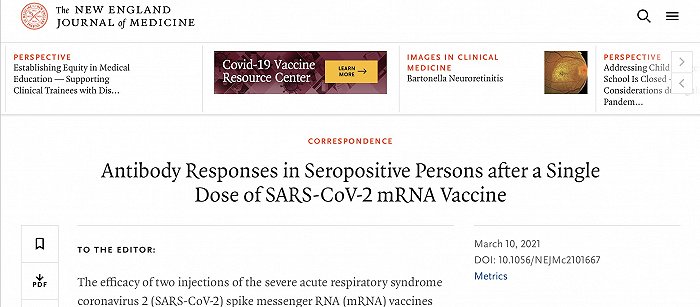
On March 10, The New England Journal of Medicine published a study indicating that a single dose of the BioNTech/Pfizer or Moderna COVID-19 vaccine may be sufficient to provide immunity to previously infected individuals, thereby eliminating the need for a second dose.
The BioNTech/Pfizer and Moderna vaccines, which were the first to receive Emergency Use Authorization in the United States, both require a two-dose regimen. This finding can reduce unnecessary side effects from the second vaccine dose in previously infected individuals and help alleviate the severe shortage of vaccine supplies.
The lead authors of this study are Viviana Simon and Florian Krammer, Professors of Microbiology and Medicine at the Icahn School of Medicine at Mount Sinai.
The study included 110 participants, of whom 43 had a prior history of SARS-CoV-2 infection and 67 had never been infected with SARS-CoV-2.

110 subjects received a single dose of the BioNTech or Moderna mRNA COVID-19 vaccine in 2020. The study found that vaccinated individuals with a prior history of SARS-CoV-2 infection rapidly developed antibodies within days after receiving the first dose, and their antibody titers were 10–45 times higher than those in individuals without prior infection. After the second dose, the antibody titers in previously infected individuals were more than six times the median titer observed in those without prior infection.
The intensity of the response to the first vaccine dose in previously infected individuals appears similar to that observed in previously uninfected individuals after their second dose. Researchers speculate that this may be because immune cells have already learned to recognize the SARS-CoV-2 spike (S) protein, leading to a more robust cellular response and, consequently, a stronger reaction to the vaccine.
Viviana Simon stated that research has demonstrated that the antibody response to the first vaccine dose in individuals with prior infection even surpasses the response observed in uninfected individuals after their second dose. “We believe that a single vaccine dose is sufficient to induce immunity in those with prior infection.” Furthermore, she indicated that if an individual’s prior infection status is unknown, antibody testing can be conducted before vaccination; if antibodies are detected, administration of the second vaccine dose may be omitted.
Previously, Andrew T. McGuire, an immunologist at the Hutchinson Cancer Research Center, also led a similar study. The study found that the number of neutralizing antibodies in the blood of COVID-19 recovered patients was amplified by a thousand times after receiving one dose of the BioNTech/Pfizer or Moderna COVID-19 vaccine. It was also concluded that the antibody levels in subjects after receiving one dose of the vaccine were superior to those in healthy individuals after receiving two doses of the vaccine.
New York University also conducted a similar study, concluding that for individuals who have recovered from COVID-19, the second dose of vaccine contributes little to increasing antibody levels.