Medtronic Reports Best Quarterly Results in a Decade, Strategically Invests in Two ICE Catheter Innovators in the U.S. and China

Medtronic
Medical Device Manufacturer

When global medical device giants discovered that their flagship product lines were missing a key component, they chose to bet on two companies at entirely different stages of their life cycles simultaneously—one being a Silicon Valley-based startup technology team, and the other a Chinese commercial enterprise possessing both 2D and 4D ICE capabilities.
This is not risk diversification, but a proven "time arbitrage" strategy: leveraging early-stage technologies from mature markets to secure future possibilities, while utilizing validated products from emerging markets to address current gaps.
June 3, 2026,Medtronic(NYSE: MDT)While releasing its strongest quarterly earnings report in nearly a decade, it announced strategic investments in two intracardiac echocardiography (ICE) catheter companies:California'sBeluga Medical(Pre-market R&D Phase) with ShenzhenCardioACC XinHuan Technology(Approved by the NMPA in 2025; FDA/CE registration in progress). Both companies will continue to operate independently, but their technological pathways will be incorporated into the long-term roadmap for Medtronic’s Affera Ablation System.
The uniqueness of this transaction lies in the fact that it simultaneously covers"Technology Incubation" and "Market Access"Two Dimensions Reveal the Typical Decision-Making Framework of Multinational Giants in Completing Their Product Ecosystems.

# Why the Shortage of ICE? The Structural Gap in the Affera Ecosystem
ICE catheters provide real-time, high-resolution intracardiac imaging for cardiac electrophysiology procedures (such as atrial fibrillation ablation) and are currently a standard essential component of ablation workflows. However, the Affera system does not yet offer this capability.
Medtronic CMO Khaldoun Tarakji stated in a press release that ICE can support operators in making more confident decisions throughout the ablation procedure, with integration aimed at advancingIntegrated Workflow for Mapping and Imaging, improving surgical efficiency.
Affera currently includes two PFA products:
Sphere-9: Currently the only dual-energy, fully functional mapping and ablation catheter covering both persistent atrial fibrillation and typical atrial flutter (CTI-dependent), approved in the United States, Europe, Australia, New Zealand, and Japan
Sphere-360: The nitinol alloy-based, fully mapped, single-shot PFA catheter has been approved in Europe, and patient enrollment for its pivotal clinical trial in the United States is rapidly progressing.
The absence of ICE indicates that Affera has a significant shortfall in its complete surgical closed-loop system.
# Why Now? The Pressure of 78% Growth
Medtronic’s fiscal 2026 Q4 data (for the period ended April 24, 2026) underscores the urgency of this investment:
Cardiac Ablation Solutions’ global revenue grew by 78%, with the U.S. market experiencing a year-over-year increase of 124% and an additional gain of 8 percentage points in market share during the same period.
The primary driver stems from commercial demand for the Sphere-9 Pulsed Field Ablation (PFA) catheter. CEO Geoff Martha stated outright that this is Medtronic’sStrongest Full-Year Revenue Growth in the Past Decade。
When a product line grows at triple-digit rates, filling any gaps in supporting infrastructure becomes a strategic priority—otherwise, competitors will seize the opportunity.
# Why Two Companies? The Underlying Logic of Dual-Track Investment
Medtronic has adopted a dual-track strategy to cover varying levels of regulatory maturity and market access stages:
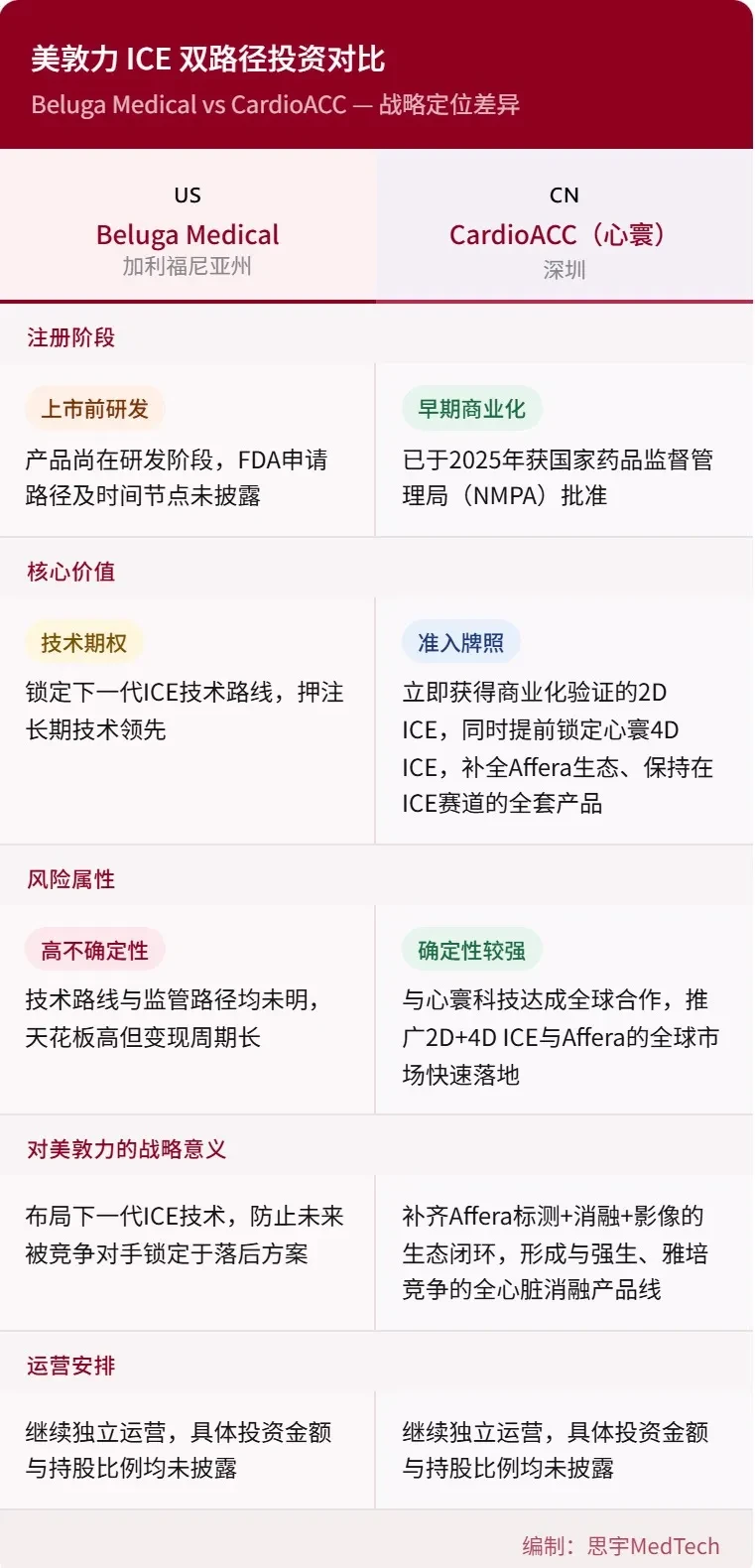
This is not an "either-or" choice, but a combined strategy of "now + future."
# China's ICE Market: Coexistence of a Surge in Domestic Approvals and Johnson & Johnson's Monopoly
Medtronic Chooses CardioACC at a Critical Juncture in China’s ICE Market
Domestic substitution is accelerating, but the competitive landscape has not yet solidified.As of early 2026, the NMPA has approved at least five domestically produced ICE catheters:
Tingsheng Technology(TINGSN Sonic Eyes 10, approved in November 2023, the first domestically produced)
Saihe Medical(Approved in July 2024, the first complete ICE system in China)
Xinhuan Technology(Approved in March 2025, the 2D ICE catheter has a diameter of only 7.5F; a strategic partnership has been established with Medtronic, and its 4D ICE technology is leading in China. Meanwhile, it is actively laying out next-generation ICE technologies such as AI and single-crystal.)
MicroPort EP(EasyEcho/Jianxin, approved in January 2026)
However,The Monopoly Pattern of Imports Remains Unbroken. Johnson & Johnson’s SoundStar series holds over 90% of the intracardiac echocardiography (ICE) market share in China, with Abbott, Siemens, and Boston Scientific dividing the remaining share. Although domestically produced ICE systems have seen a surge in regulatory approvals, their commercial scale-up still faces barriers such as hospital access, physician preferences, and the ecosystem of compatible host systems.
Medtronic’s investment in XinHuan Technology, rather than a direct acquisition, likely targets the window period where the company has crossed the “registration threshold” but has not yet established strong brand recognition.— At this juncture, intervention costs are controllable, and rapid global expansion can be achieved by leveraging Medtronic’s global distribution channels.
# Tension from Centralized Procurement and Dividends from Penetration Rate
China's ICE Market FacesThe Dual Tension Between "Centralized Procurement" and "Innovation"。
In 2022, the Fujian Provincial Medical Insurance Bureau led a 27-province alliance in centralized procurement, which included intracardiac echocardiography catheters; the average price reduction for selected products49.35%For emerging domestic enterprises like XinHuan Technology, centralized procurement presents an opportunity for rapid hospital market entry but may also compress profit margins; whereas Medtronic’s brand endorsement and global pricing system may help it avoid the price-war pitfalls faced by purely domestic companies.
On the other hand,China's ICE Penetration Rate Is Only About 1/10 of That in the United States(In the US, the penetration rate of intracardiac echocardiography (ICE) in electrophysiology procedures exceeds 90%, while the target penetration rate in China’s atrial fibrillation field is approximately 50%), indicating substantial potential for market education.
By investing in Chinese ICE companies at this juncture, Medtronic is not only hedging against Johnson & Johnson’s domestic monopoly advantage but also paving the way for the future entry of its Affera system into China."Localized Accessories" Interface—After all, for Sphere-9 and Sphere-360 to be commercialized in China, obtaining NMPA registration for the accompanying ICE systems will be a mandatory requirement.
# Technical Differentiation of XinHuan Technology
The core competitiveness of CardioACC lies in itsCatheter Diameter, Single-Crystal Transducer, and AI: Cutting-Edge Technologies, while ensuring both passability and imaging quality.
This balanced approachEngineering Optimizationand the characteristics of disruptive innovation, which better aligns with the typical development path of Chinese medical device enterprises—achieving performance iteration and cost control within established technological frameworks.
If Medtronic promotes the integration of CardioACC’s ICE with the Affera system in China in the futureJoint Registration, will form a combination strategy of "imported main system + domestically produced accessories," which has significant access advantages under the current policy environment in China that emphasizes medical insurance cost control and prioritizes the procurement of domestically produced equipment.
# Timeline Uncertainty: Sphere-360 Enrollment Progress vs. ICE Integration Pace
Medtronic's AnnouncementThe investment amount, shareholding ratio, or specific timeline for integrating ICE into the Affera platform were not disclosed.. The two companies are at different stages of regulatory approval—CardioACC holds approval from China’s NMPA, while Beluga Medical’s products are still in the pre-market development phase, with neither its FDA application pathway nor timeline disclosed.
Core Variables to Be Validated: Whether ICE can complete platform integration before the commercial launch of Sphere-360 in the United States will directly impact the pace at which Affera achieves full competitiveness in the US EP market.
Medtronic’s FY2027 organic revenue growth guidance is6.75%–7.25%, Non-GAAP EPS Guidance Range$5.90–6.00(below Wall Street’s expectation of $6.06). Market expectations for the Affera ecosystem have already been priced into the valuation, and any delays in ICE integration could become a factor driving stock price volatility.
# Conclusion
For Medtronic, this is"Exchanging Capital for Time"A Classic Case—When In-House Development Is Too Slow and Acquisitions Are Too Costly, Strategic Investment Becomes the Optimal Solution.
For China’s medical device industry, the signal is equally clear:Multinational Giants Begin Replacing "In-House Team Building" with "Investing in Licensed Companies", the exit pathways for domestic innovative enterprises are expanding from "being acquired" to "strategic investment plus channel empowerment." The CardioACC model may provide a new paradigm for more early-stage, technology-driven Chinese companies holding NMPA licenses.
When your product ecosystem lacks a key component, would you choose in-house development, acquisition, or a Medtronic-style "dual-track bet"?
Key Enterprises and Institutions
▌Renowned Medical Technology Innovation Enterprises:Medtronic | Boston Scientific | SonoScape | Alcon | Microsurgical Robot | Rosenbot | Kesi Mingde | Maipu Medical | Sinovision
▌Renowned Medical Technology Innovation Service Provider:Badachu Plastic Surgery Medical Concept Verification Center | Tonghe Litai