Five Drug Candidates, Including Semaglutide and Chiauranib Capsules, Receive CDE Breakthrough Therapy Designation
Novo Nordisk
Insulin Developer and Manufacturer
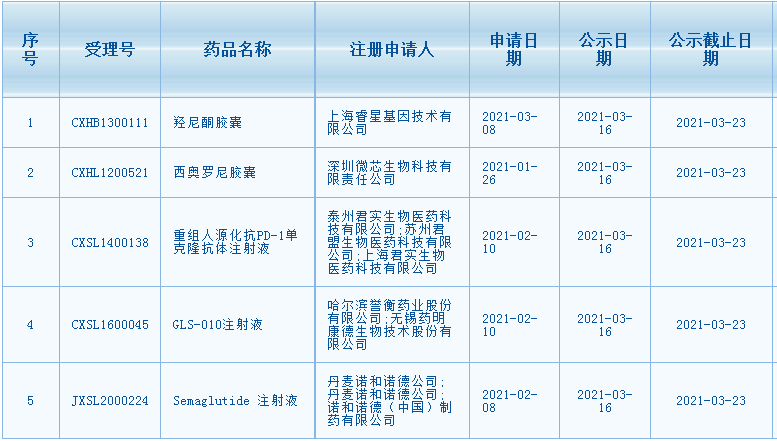
On March 16, the CDE website announced that five drugs were proposed for Breakthrough Therapy Designation by the Center for Drug Evaluation (CDE), including: Novo Nordisk’s subcutaneous semaglutide injection, Yuheng Pharmaceutical’s zimberelimab, Junshi Biosciences’ PD-1 monoclonal antibody, Chipscreen Biosciences’ chidamide capsules, and Shanghai Ruixing Gene’s hydroxyprogesterone caproate capsules. These candidates have been proposed for inclusion in the Breakthrough Therapy program and are now open for public comment.
Source: CDE Official Website
1. Semaglutide Injection: Semaglutide is a long-acting GLP-1 receptor agonist (GLP-1 RA) developed by Novo Nordisk. The semaglutide injection (brand name: Ozempic) was first approved for marketing in the United States in December 2017 to improve glycemic control in adults with type 2 diabetes. In January 2020, the FDA also approved a new indication for reducing the risk of major adverse cardiovascular events in adults with type 2 diabetes and cardiovascular disease. The marketing application for semaglutide injection for the treatment of type 2 diabetes in China is currently under review and is expected to be approved for marketing this year. The indication for subcutaneous semaglutide injection proposed for inclusion in the Breakthrough Therapy designation is the treatment of non-alcoholic steatohepatitis (NASH).
2. GLS-010 Injection (Zimberelimab): Yuheng Pharmaceutical’s zimberelimab is the first fully human anti-PD-1 monoclonal antibody in China developed through natural selection using a transgenic rat platform. The indication proposed for inclusion in the Breakthrough Therapy designation is for the treatment of recurrent or metastatic cervical cancer with PD-L1 positive expression (CPS ≥ 1) that has progressed after first-line or later platinum-based standard chemotherapy.
3. Toripalimab Injection: Junshi Biosciences’ independently developed anti-PD-1 monoclonal antibody is the first domestically produced PD-1-targeted monoclonal antibody drug approved for marketing in China. It has been approved for two indications: the treatment of unresectable or metastatic melanoma in patients who have failed prior systemic therapy, and the treatment of recurrent/metastatic nasopharyngeal carcinoma in patients who have failed second-line or higher lines of systemic therapy. The indication proposed for inclusion in the Breakthrough Therapy designation is first-line treatment of advanced mucosal melanoma.
4. Xioloni Capsules: Chiothionib capsules are a Class 1 innovative drug independently developed by Chipscreen Biosciences. The indication proposed for inclusion in the Breakthrough Therapy designation is the combination with weekly paclitaxel therapy for the treatment of platinum-refractory or platinum-resistant recurrent ovarian cancer. Chiothionib exerts its anti-tumor effects by inhibiting tumor angiogenesis and tumor cell mitosis through two distinct mechanisms: regulation of tyrosine kinases (VEGFR1/2/3, PDGFRα/β, c-Kit)-mediated tumor cell growth and serine/threonine kinase (Aurora B)-mediated cell cycle processes. Meanwhile, by inhibiting Aurora B kinase, it has the potential to reduce genomic instability in tumor tissues and suppress tumor cell metastasis. Previously, the indication of Chiothionib monotherapy for small cell lung cancer patients who experienced disease progression or recurrence after two lines of systemic chemotherapy was also granted Breakthrough Therapy designation by the CDE.
5. Hydroxyprogesterone Caproate Capsules (F351): Hydroxynicotinone is a derivative of the marketed drug pirfenidone and can inhibit liver fibrosis by suppressing hepatic stellate cell proliferation and the TGF-β signaling pathway. GNI Group holds key global patents for F351 in multiple countries and regions, including China, Japan, Australia, Canada, the United States, and Europe. Shanghai Ruixing Gene is a subsidiary of GNI Group. The indication proposed for inclusion in the Breakthrough Therapy designation is the treatment of liver fibrosis associated with chronic hepatitis B.

Responsible Editor: Liuli
Disclaimer: This article is compiled by Yaozhi.com. The copyright belongs to the original author. The purpose of this article is to convey more information and does not represent the views of this platform. If there are any issues related to the content, copyright, or other matters, please leave a message on our website, and we will remove the content promptly.