

Xi'an Janssen Supports the Third ADHD Awareness Week and Launches the Adolescent Mental Health Guardian Initiative

Johnson & Johnson
Healthcare Product Manufacturers, Health Service Providers

Xian Janssen
Pharmaceutical R&D and Manufacturer
Beijing, April 24, 2021 /PRNewswire/ -- The "3rd Attention-Deficit/Hyperactivity Disorder (ADHD) Care Week and Launch Ceremony of the Adolescent Mental Health Guardian Program," jointly organized by the China Youth Development Foundation, CHINA YOUTH PRESS, and other parties with support from Xian Janssen Pharmaceutical Ltd., the pharmaceutical subsidiary of Johnson & Johnson in China, was officially launched in Beijing. The theme of this year's ADHD Care Week is "Advocating for Scientific Diagnosis and Treatment to Enhance Learning Abilities," aiming to further raise public awareness of attention-deficit/hyperactivity disorder (commonly known as ADHD), promote the establishment of standardized diagnosis and treatment protocols, and help children with ADHD improve their learning capabilities.

Group Photo of the Launch Ceremony
Attention Deficit Hyperactivity Disorder (ADHD), commonly known as hyperactivity disorder, has seen a comprehensive upgrade in this year’s ADHD Care Week, building on the foundation of the previous two editions. On one hand, the “Adolescent Mental Health Guardian Program” will be launched simultaneously, aiming to call for societal support for adolescent mental health and to enhance public awareness of the disease as well as the importance of standardized scientific diagnosis and treatment. On the other hand, Professor Ke Xiaoyan from Nanjing Brain Hospital, Director of the WHO Collaborating Center for Research and Training in Child Mental Health, will share preliminary findings from the Chinese Urban School-Age Children ADHD Survey initiated last year. These survey results, which will be published in the future, will constitute the first multicenter ADHD survey report covering seven major geographical regions nationwide. In addition, free online and offline clinical consultations and various science popularization activities will continue to be held.
Another major highlight of the project is the further enhancement of last year’s “integration of medical and educational services” model, which encourages physicians to enter schools to help teachers and parents understand ADHD symptoms and equip them with the knowledge and skills for self-assessment and medical follow-up.
Guo Meijian, Secretary of the Party Committee and Chairman of the China Youth Development Foundation, stated, “During last year’s second Attention-Deficit/Hyperactivity Disorder (ADHD) Care Week, we launched the ‘Campus Tour for Adolescent Mental Health’ project. This initiative provides public welfare services, including psychological counseling and popular science education on mental health, to children and adolescents nationwide. Nearly 300 campus science lectures were held in more than 30 cities across China, reaching nearly 200,000 families. These efforts have significantly promoted the development of the social psychological service system, with a focus on cultivating self-esteem, confidence, and a positive, healthy mindset among children and adolescents. This year’s ‘Alliance Plan for Guardians of Adolescent Mental Health’ mobilizes broader social forces. With primary schools as the main platform, the plan aims to leverage the demonstrative role of collaboration between the Communist Youth League and educational authorities, as well as the integration of medical and educational resources. It focuses on enhancing school functions and prioritizes the prevention and resolution of mental health issues in adolescents’ learning and daily lives.”
According to a 2017 meta-analysis, the prevalence of ADHD among children and adolescents in China is approximately 6.3%, with an estimated 23 million affected individuals.[1]. Due to insufficient disease awareness and a lack of professional healthcare personnel, data from the 2015 "Chinese Guidelines for the Prevention and Treatment of Attention-Deficit/Hyperactivity Disorder" indicate that the current consultation rate for ADHD patients in China is very low, at less than 10%.[2], fewer than one-third of patients receive standardized, evidence-based treatment[3]. Additionally, ADHD is a common neurodevelopmental disorder in children and a chronic condition that affects individuals throughout their lifespan.[1], commonly seen in school-age children, but 70% of affected children have symptoms that persist into adolescence, and 30%-50% have symptoms that persist into adulthood[1]. Children and adolescents with attention-deficit/hyperactivity disorder (ADHD) primarily exhibit age-inappropriate distractibility, narrowed attention span, excessive activity and emotional impulsivity across various settings, accompanied by cognitive impairments and learning difficulties.[1]. Without scientific diagnosis and treatment, the condition will have a serious impact on the academic performance of affected children, thereby reducing their self-confidence and interpersonal skills.
Professor Ke Xiaoyan, Director of the WHO Collaborating Center for Research and Training in Child Mental Health and affiliated with Nanjing Brain Hospital, shared the findings of the “Survey on Attention-Deficit/Hyperactivity Disorder (ADHD) among School-Aged Children in Urban China” at the launch ceremony. This survey represents the first multi-center study conducted across seven major geographic regions nationwide. She stated, “China bears a heavy burden of ADHD, yet the healthcare-seeking rate remains low. In daily life, teachers may spend more time with children than parents do, placing them in a unique position to identify psychological or behavioral abnormalities at an early stage. Therefore, it is particularly important to enhance teachers’ awareness and understanding of ADHD. Last year, we organized and participated in 52 scientific research activities on ADHD across the country, and we plan to compile and publish these findings in a report in the future, aiming to provide correct and standardized guidance on daily living and medical care for families of children with ADHD in China.”
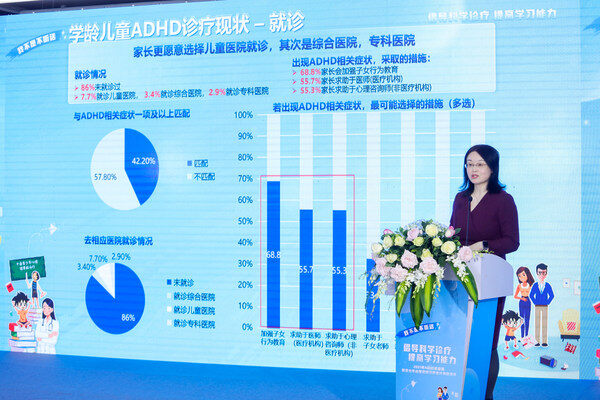
Address by Professor Ke Xiaoyan, Director of the WHO Collaborating Center for Research and Training in Child Mental Health, and Director of the Child Mental Health Research Center at the Affiliated Brain Hospital of Nanjing Medical University
Xian Janssen is implementing the “Healthy China Action – Action Plan for Mental Health of Children and Adolescents (2019–2022),” aiming to take actions to improve the mental health of children and adolescents, including those with ADHD. Through this initiative, we hope to establish comprehensive mental health services and further build and refine a collaborative mechanism involving schools, communities, families, media, medical institutions, and all sectors of society, so as to safeguard the mental health of children and adolescents.
Zheng Lei, President of Xian Janssen Pharmaceutical Ltd., stated, “The ‘ADHD Care Week’ series of activities, supported by Xian Janssen and hosted by the China Youth Development Foundation, represents a significant contribution to the ‘Healthy China Action’ initiative. By leveraging our expertise in the pharmaceutical sector and uniting efforts across various stakeholders, we are committed to delivering more innovative and optimized disease management solutions for children and adolescents with ADHD in China, thereby safeguarding their comprehensive physical and mental well-being.”
[1] Wang T, et al. BMC Psychiatry. 2017 Jan 19;17(1):32.
[2]Zheng Yi, Liu Jing, eds. Guidelines for the Prevention and Treatment of Attention-Deficit/Hyperactivity Disorder in China (2nd ed.). Chinese Medical Electronic Audio-Video Publishing House. 2015.
[3]Jin Xingming. Journal of Educational Biology. 2015;3(1):1-3.