

Neuros Medical Announces IPO Filing: Pioneering High-Frequency Nerve Block Technology for Chronic Pain Treatment

Neuros Medical
Neuros Medical
In today’s fast-paced modern society, changes in lifestyle and work patterns have accelerated the prevalence of chronic pain among the population. For instance, prolonged sedentary office work has exacerbated conditions such as lumbar muscle strain and shoulder and neck pain. An increasing number of people are now forced to confront the challenge of chronic pain.
Chronic pain refers to pain lasting for more than one month (previously defined as three months or six months), encompassing a variety of pain conditions such as trigeminal neuralgia, glossopharyngeal neuralgia, neck, shoulder, waist, and leg pain, osteoporosis, cancer-related pain, frozen shoulder, and post-traumatic or post-surgical pain.
Globally, there is limited understanding and low awareness of chronic pain.The International Association for the Study of Pain (IASP) holds that, on the one hand, chronic pain is not recognized as a serious chronic health issue; on the other hand, there remains substantial room for advancement in areas such as pain research and education, the development of pain medicine, and therapeutic medications.
Although public awareness of chronic pain remains somewhat limited, treatment modalities are diversifying. These include not only traditional pharmacological analgesia and non-pharmacological therapies (such as interventional procedures, acupuncture, physical therapy, and nerve blocks), but also emerging technology-driven interventions like virtual reality (VR) therapy and digital therapeutics.
Neuros Medical, which is to be introduced in this article, is aA company dedicated to developing proprietary neuromodulation therapies to eliminate various types of chronic pain.
Neuros Medical: Always on the Path of Neuromodulation Therapy
Neuros Medical is a company based in Ohio, USA, founded in 2008. Its patented platform technology—high-frequency nerve block—is focused on eliminating various types of chronic pain, including neuroma/residual limb pain, chronic post-surgical pain, and chronic migraine.
Nerve Block
1. Product: The Altius®, High-Frequency Nerve Block Technology
Neuros Medical’s neuromodulation technology was co-founded by Dr. Kevin Kilgore and Dr. Niloy Bhadra of the Department of Biomedical Engineering at Case Western Reserve University, together with Metro Health Medical Center; its development was funded by the National Institute of Biomedical Imaging and Bioengineering.
This technology alleviates pain by delivering high-frequency electrical signals to the sensory nerves of the peripheral nervous system, thereby blocking pain signals from reaching the brain.
The product developed by Neuros Medical is named The Altius® System. This system consists of an implantable pulse generator (IPG) with an integrated rechargeable battery, a cuff electrode placed around the peripheral nerve, and external devices (including a Programming Wand for physicians, a patient controller, and a charger).
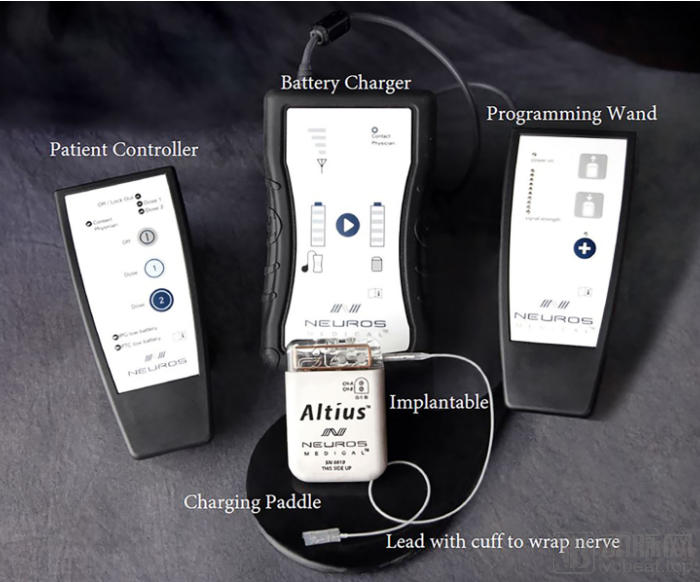
Source: Neuros Medical Official Website
In 2018, Crain's reported that research by Neuros Medical indicated that the device achieved a pain reduction rate of approximately 80% to 85%.
2. Study: QUEST, a Clinical Study on Post-Amputation Pain
Currently, Neuros Medical is conducting a clinical study named QUEST on post-amputation pain (phantom limb pain, residual limb pain, and neuroma pain).
This randomized controlled study evaluated the performance of the Altius System in 180 patients across 25 clinical trial sites in the United States. The objective of this clinical trial was to assess the efficacy and safety of the Altius System, specifically determining whether electrical nerve block is a safe and effective treatment for post-amputation pain.
The trial will involve implanting a pulse generator in participants, which, together with cuff electrodes (wrapped around the nerve), will deliver electrical signals to the nerve to block neural transmission, thereby alleviating limb pain in amputees. The Altius system will be considered effective if the treatment reduces pain episodes by 50% in more than 50% of the patients enrolled in the trial.
According to its official website, the study actually commenced in 2014 and has been ongoing for over six years to date. Neuros Medical anticipates that the preliminary completion date will be late January 2022, with final completion scheduled for late January 2027.
3. Capital: 11 rounds of financing, exceeding RMB 80 million
Over the 12 years from 2009 to the present, Neuros Medical has completed 11 rounds of financing, raising a total of $80.5 million. According to PrivCo data, as of November 3, 2020, its valuation was between $100 million and $500 million.
Based on Neuros Medical’s multiple rounds of financing, the funds raised were primarily allocated to the development of neuromodulation technologies.Its most recent financing round was a Series B round conducted in January 2021, with the $38.5 million raised to be used for completing enrollment in the QUEST study and submitting a premarket approval application.
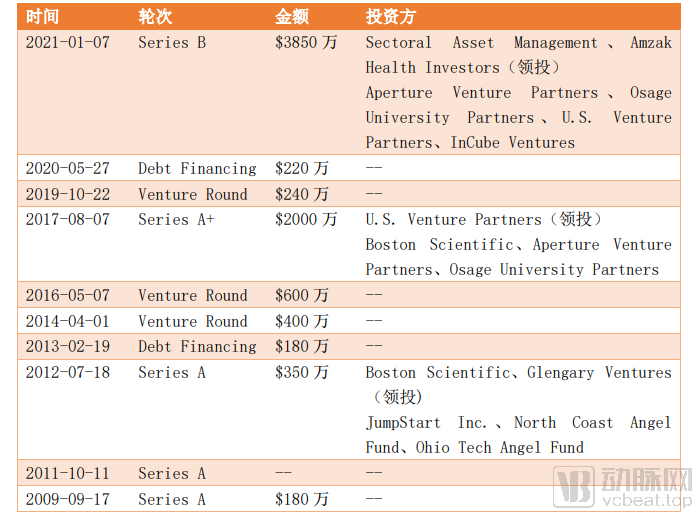
Source: Crunchbase
In the United States, there are nearly 2 million amputees, with 185,000 new amputation surgeries performed annually. The management of post-amputation pain represents a significant unmet medical need.
In a joint statement, Joyce Erony of Amzak Health and Marc-Andre Marcotte of Sectoral Asset Management, the latest investors in Neuros Medical, stated thatThe Altius system could become a critically important therapeutic option, providing treatment for a large population of patients with chronic pain and reducing their ongoing reliance on opioids.
"The Road Is Long and Arduous": The Current Status of Chronic Pain Treatment in China
In China, public awareness of chronic pain is relatively weak, with three main misconceptions.
First, endure it; pain is not a disease.Many people do not regard chronic pain as a disease or fail to give it sufficient attention, believing that it will resolve itself if endured. However, chronic pain is itself a disease and a sign of impaired bodily function.
Second, giving up halfway and self-abandonment.Chronic pain is characterized by a prolonged course and recurrent episodes. It requires repeated treatment, with therapeutic outcomes often limited to symptom relief rather than complete pain elimination. Consequently, patients may prematurely discontinue therapy upon slight improvement or abandon treatment altogether due to the slow pace of efficacy.
Third, patients engage in indiscriminate pain relief, relying on folk remedies or excessive medication.At this point, one should seek medical attention at a hospital and receive targeted treatment.
In fact, specialized departments have been established within China's healthcare system to treat chronic pain.In 2007, China added "Pain Medicine" as a first-level clinical specialty, with its primary scope of practice focusing on the diagnosis and treatment of chronic pain. However, the current state of chronic pain management remains less than optimistic.
In November 2020, at the Third China International Import Expo, the first blue book on China’s strategy for pain prevention and control and health promotion—“Report on the Development of Pain Medicine in China (2020)” was released. This blue book provides a comprehensive interpretation of the field of pain in China, summarizing the current status of basic research and clinical practice in the discipline of pain medicine.
Data shows that there are over 300 million chronic pain patients in China, with an annual increase of 10 to 20 million. However, the awareness rate among Chinese patients is only 14.3%, and the consultation rate is less than 60%. After treatment, the complete remission rate is less than 20%.
Furthermore, a search conducted in the VCBeat database using “chronic pain” as the keyword yielded the following results, which are provided for reference only.
Among the included companies, there are a total of 68 enterprises related to chronic pain. Of these, 64 are foreign companies, while only 4 are domestic Chinese companies. Although this data is not comprehensive, it still demonstratesGlimpsing the Deficiencies in Attention and Development Required for China’s Chronic Pain Market
Among the four Chinese companies, three are engaged in the production of pain-related medical devices, and one is a treatment institution. They are: Dejia Zhilian, which focuses on postpartum rehabilitation; Aipeng Medical, a manufacturer of public-use medical devices and system integrator; Renxian Medical, an information service provider specializing in analgesia with its wireless analgesic pump system as the core; and Sanqi Zhengkang, which manages chronic diseases and sub-health conditions to alleviate and cure chronic pain.