Pfizer Halts Patient Enrollment in BCMA×CD3 Bispecific Antibody Trial Amid Safety Concerns

Pfizer
Pharmaceutical R&D Developer
On May 4, Pfizer announced its Q1 2021 financial results. The company’s revenue for the first quarter reached $14.6 billion, a year-over-year increase of 42%. The primary driver of this performance was the COVID-19 vaccine developed in collaboration with BioNTech, which generated a remarkable $3.462 billion in vaccine revenue during the quarter. Some analysts believe that, given the robust global demand for COVID-19 vaccines, Pfizer’s strong financial performance will be sustained for at least the next two years.
Despite the company’s remarkable progress in COVID-19 vaccines, enrollment of new subjects has been suspended for its BCMA×CD3 bispecific antibody product, Elranatamab, due to three cases of peripheral neuropathy observed in Phase I clinical trials. The safety profile of bispecific antibodies has once again come under scrutiny. In fact, while the efficacy difference between bispecific antibodies and two-drug combination therapies is not significant, bispecific antibodies are expected to substantially reduce adverse events induced by combination therapies, thus drawing considerable attention to drug safety.
Currently, there are three bispecific antibody drugs approved for marketing worldwide, including Trion Pharma’s catumaxomab (Removab), which targets CD3 and EpCAM; Amgen’s blinatumomab (Blincyto), which targets CD3 and CD19; and Roche’s emicizumab (Hemlibra), which targets FIX and FX. Among these, both Removab and Blincyto utilize CD3 as one of their targets. At this juncture, it is highly meaningful to review the globally marketed bispecific antibody products, reflecting on their development history and adverse event profiles.
(1) Catumaxomab
Catumaxomab is the world’s first commercialized bispecific antibody drug and also the first bispecific antibody to be withdrawn from the global market. Developed by Trion Pharma under the brand name Removab, catumaxomab simultaneously targets CD3, a surface antigen receptor on T cells, and EpCAM, a marker on cancer cells.

Image source: Lingteng Pharmaceutical
Figure 1: Structure of catumaxomab
In 2009, Removab received EMA approval for marketing authorization to treat malignant ascites caused by EpCAM-positive tumors. Malignant ascites refers to diffuse lesions of the thoracic and abdominal visceral walls resulting from systemic or intra-abdominal malignancies or cancerous pathologies, and is one of the complications of advanced-stage cancer. Various diseases can cause malignant ascites, such as ovarian cancer, gastric cancer, and colorectal cancer.
However, Removab performed poorly in the market after its launch. It was eventually withdrawn from sales in 2014, and its delisting was officially announced in June 2017. The company attributed the delisting to poor market performance, noting that the indication for malignant ascites easily relegated Removab to an expensive adjuvant therapy. Furthermore, the company failed to establish reasonable pricing and marketing strategies for Removab, and did not adequately promote its efficacy in extending patient survival as a key selling point, ultimately leading to its commercial failure.
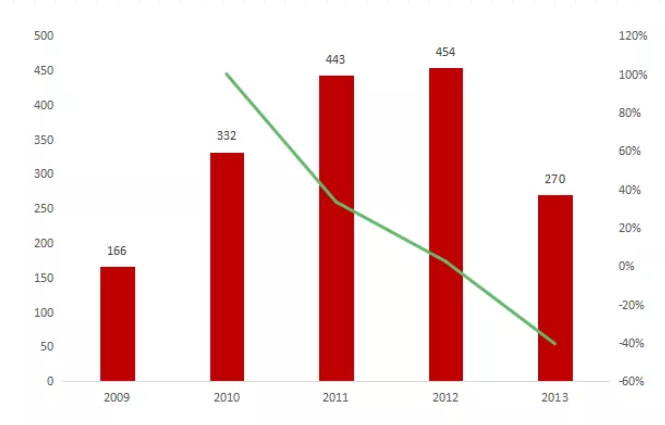
Image source: Compiled from public data
Figure 2: Market Performance of Removab from 2009 to 2013 (in ten thousand USD)
In addition to commercial failure, the drug’s design may also have inherent drawbacks. Removab is a rat-mouse chimeric bispecific antibody that can elicit human anti-mouse antibody responses. Furthermore, CD3, as an important T-cell target, is prone to inducing cytokine release syndrome (CRS). CRS, a non-antigen-specific toxicity resulting from high-grade immune activation, is associated with elevated circulating levels of cytokines, including IL-6 and IFN-γ. The inflammatory response mediated by these inflammatory mediators can cause tissue damage, leading to microvascular pathology, heart failure, and even death.
This is evident from clinical data. Phase I/II clinical trials indicated that the most common acute adverse reactions to catumaxomab included: fever (83%), nausea (61%), vomiting (57%), abdominal pain (39%), lymphopenia (26%), and abnormal liver function tests, particularly elevated levels of alkaline phosphatase (ALP), aspartate aminotransferase (AST), gamma-glutamyl transferase (GGT), and bilirubin. Phase II/III clinical trial reports stated that 15% of patients experienced treatment-related serious adverse events.
(2) Bonatumab
Blinatumomab (Blincyto) is a bispecific CD19-directed CD3 T-cell engager molecule that targets CD3 on the surface of T cells and CD19 on the surface of malignant B lymphocytes. Blincyto is a bispecific antibody developed based on Amgen’s BiTE platform. BiTE is a tandem single-chain antibody that lacks an Fc region, has a low molecular weight, and exhibits high permeability, enabling it to reach sites and bind antigens that are difficult for large-molecule antibodies to access. Its drawback is a short half-life, necessitating frequent administration.
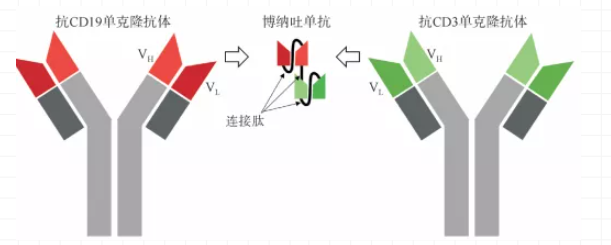
Image source: Amgen
Figure 3: Molecular Structure of Blincyto
In 2014, Blincyto received FDA approval for the treatment of relapsed or refractory precursor B-cell acute lymphoblastic leukemia in adults and children; in 2018, its indications were expanded to include minimal residual disease (MRD)-positive precursor B-cell acute lymphoblastic leukemia. In December 2020, Blincyto was approved by the NMPA for the treatment of relapsed or refractory precursor B-cell acute lymphoblastic leukemia (ALL) in adults. In China, BeiGene holds the rights for its development and commercialization.
Following its launch in the United States in 2014, Blincyto achieved continuous sales growth driven by its significant efficacy, with global sales reaching $379 million in 2020. However, Blincyto is priced at a premium, with the cost for two treatment cycles in the U.S. market set at $178,000.
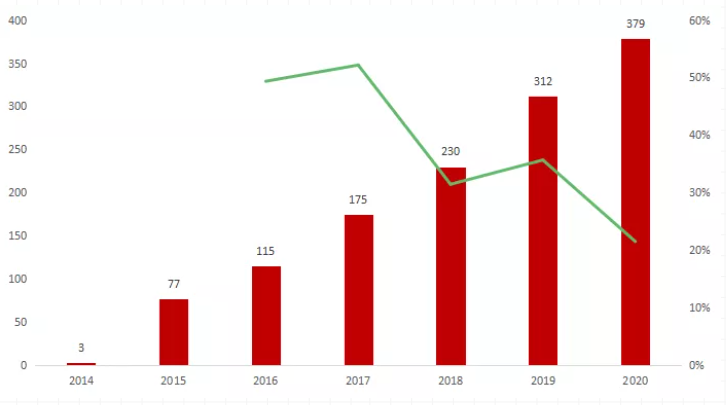
Image source: Amgen
Global Sales of Blincyto (2014–2020) (in million USD)
From a safety perspective, common adverse reactions to Blincyto include fever, headache, and infection. However, the prescribing information also includes a black box warning regarding the risks of cytokine release syndrome (CRS) and neurotoxicity. In brief, CRS is closely associated with T-cell activity, depending on target antigen-mediated T-cell activation, proliferation, and functional response, which is highly consistent with the CRS commonly observed in CAR-T cell therapy. Given that interleukin-6 (IL-6) is considered a key mediator in the pathogenesis of CRS, tocilizumab is frequently used for its clinical management.
(3) Emicizumab
Emicizumab (Hemlibra), developed by Roche, is a recombinant humanized IgG4 bispecific monoclonal antibody. Hemlibra promotes thrombin generation by bridging FIXa and FX, thereby restoring the coagulation process in patients with hemophilia A and achieving hemostasis at bleeding sites in patients with hemophilia A who have impaired FVIII function or complete FVIII deficiency.

Image source: Roche
Figure 3: Structure of Emicizumab
On December 4, 2018, Hemlibra was approved by the NMPA for routine prophylactic treatment in adult and pediatric patients with hemophilia A who have factor VIII inhibitors. In late March 2021, the regulatory review status of Hemlibra’s second indication—routine prophylactic treatment for patients with hemophilia A without factor VIII inhibitors—was updated to “under review,” with approval expected imminently.
Emicizumab, as the only drug worldwide capable of treating all types of hemophilia A, holds significant clinical importance. In 2020, Hemlibra achieved remarkable sales of CHF 2.19 billion, securing its place among the top 100 global drugs. However, its drawback lies in the excessively high price, with annual treatment costs reaching hundreds of thousands of RMB.
From a safety perspective, common adverse reactions to Hemlibra include injection site reactions, headache, and arthralgia. The FDA has also added a boxed warning regarding the risk of thrombotic events to its labeling, which warrants attention from both physicians and patients.

Responsible Editor: Sanqi
Disclaimer: The views expressed in this article are solely those of the author and do not represent the position of Yaozhi.com. Comments and supplementary discussions are welcome in the comment section. If reprinting, please be sure to cite the author and source.