

ZSFab, China's First 3D-Printed Orthopedic Implant Company FDA-Approved, Files IPO Prospectus

ZSFab
Orthopedic Instrument Manufacturer
In January 2021, ZSFab achieved a milestone start to the year as its independently developed ZSFab Cervical Interbody Fusion Device received clearance from the U.S. Food and Drug Administration (FDA). This accomplishment made ZSFab the first Chinese company specializing in 3D-printed orthopedic devices to obtain FDA approval. During an interview, Zhang Jing, CEO of ZSFab, expressed immense pride and joy. The company began preparing its submission in 2019, filed the application materials in 2020, and secured one-time approval for its product in early 2021. The approval timeline was reduced by one-quarter compared to similar competing products.
This FDA-approved cervical fusion cage is a spinal orthopedic implant developed by ZSFab using digital materials. Its fatigue strength surpasses that of over 95% of similar products approved by the FDA, and its safety performance regarding powder shedding far exceeds FDA standards.
ZSFab, founded in 2017 and headquartered in Boston, USA, is an innovative medical technology company specializing in high-performance, personalized solutions for orthopedic surgery and sports health. The company has independently developed a core algorithmic platform for "digital materials"—materials whose properties are customized through structural design in a digital manner to efficiently meet application requirements while ensuring reliable manufacturability. Leveraging 3D printing as its manufacturing method, ZSFab provides professional solutions to users in the healthcare sector.

Dr. Zhang Jing, Founder of ZSFab
Dr. Jing Zhang, founder of ZSFab, studied under Professor Behrokh Khoshnevis, a member of both the US National Academy of Engineering and the American Academy of Arts and Sciences, known as the "Father of 3D-Printed Construction." With a background in physics, Dr. Zhang transitioned into the field of advanced manufacturing, specializing in 3D printing, throughout his undergraduate, master’s, and doctoral studies. During his master’s program, he worked under Professor Lin Feng at the Additive Manufacturing Laboratory of the Department of Mechanical Engineering, Tsinghua University—the first 3D printing laboratory in China—where he developed forming equipment and processes. Dr. Zhang’s like-minded team comprises experts in algorithms, healthcare, and engineering from top international institutions, including Tsinghua University, Harvard University, the Massachusetts Institute of Technology (MIT), and the University of Southern California. The team has established extensive databases and resources in the fields of 3D printing, mechanical analysis and simulation, and medical applications.
Precision Design of Digital Materials: 3D Printing Reconstructs Orthopedic Implants
Titanium alloys, regarded as the biocompatible metallic materials with the best performance, are the primary material for bone implants; however, there is a significant discrepancy between the biomechanical properties of solid metal structures and the organic composition of human bone, which inevitably leads to serious side effects after metal orthopedic implants are placed in patients. After in-depth discussions with over 400 orthopedic surgeons, the ZSFab team focused on the core pain points urgently needing resolution in clinical practice, using these insights as the foundation for product design and strategic layout.
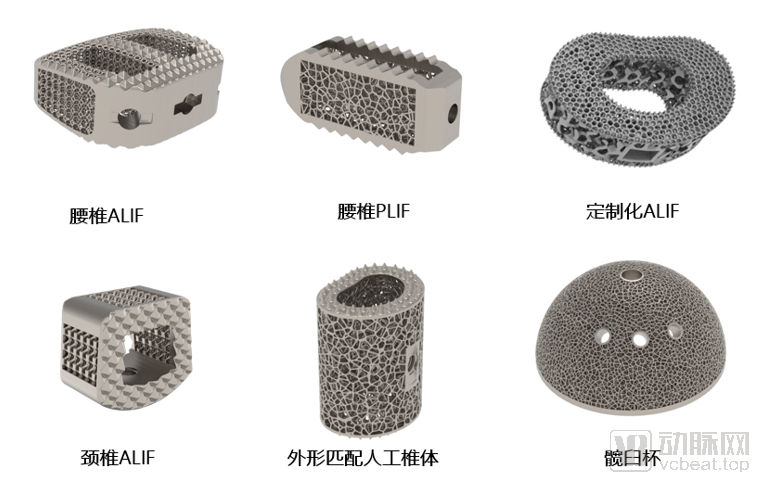
Selected Products from ZSFab
After comparing polymer materials with other bioactive materials still in the stage of basic research, Zhang Jing, CEO of ZSFab, stated that titanium alloys have undergone more than 50 years of clinical validation. Undoubtedly, they are the optimal clinical choice in terms of biocompatibility safety and osseointegration performance. To address pain points such as postoperative mechanical mismatch and the need for rapid, deep bone ingrowth, ZSFab has pursued a novel, cross-disciplinary innovation strategy. By focusing on material structure, the company precisely reconstructs the modulus, porosity, and strength of orthopedic implants, thereby resolving challenges related to both initial and long-term stability following implantation.
“We addressed the severe biomechanical mismatch by modifying the structure of metallic materials to make implant performance more closely resemble that of human bone,” introduced Zhang Jing. “ZSFab’s strategy is based on independently developed digital materials, precisely controlling microporous structures to ensure the mechanical properties of the implants are highly compatible with bone. Furthermore, through optimization of pore size and porosity, osteocytes can grow into the interior of the implant, forming an integrated device-bone complex, or osseointegration. This structure creates a composite material of the implant and bone, which is bioactive.”
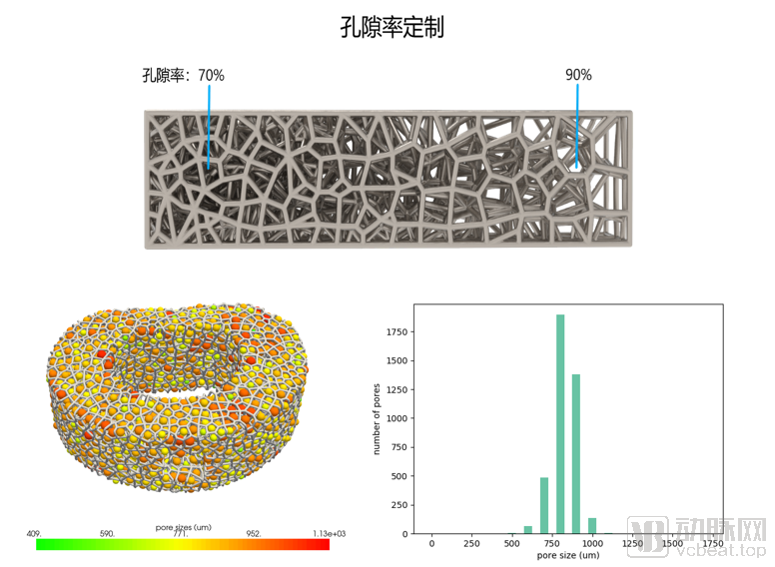
Schematic Diagram of Pore Structure
In designing orthopedic implants, ZSFab has conducted in-depth research on parameters such as the structure, morphology, and size of human bones, enabling faster and deeper bone ingrowth into the internal structure of the implants under near-physiological simulated conditions. Furthermore, through precise design of material structures, advanced manufacturing processes, and post-processing techniques, the company has eliminated residual metal particles from the printing process. This technology has been validated in ZSFab’s FDA-cleared cervical interbody fusion devices, with powder shedding safety performance far exceeding FDA regulatory requirements.
Based on the current product development progress of ZSFab, its first commercially launched product, the “ZSFab Cervical Fusion Cage,” is a spine-focused device. The company plans to sequentially introduce a series of orthopedic implants targeting joints and other anatomical regions in the future. Regarding the rationale behind initially focusing on spinal orthopedic products, Zhang Jing outlined ZSFab’s strategic logic as follows:
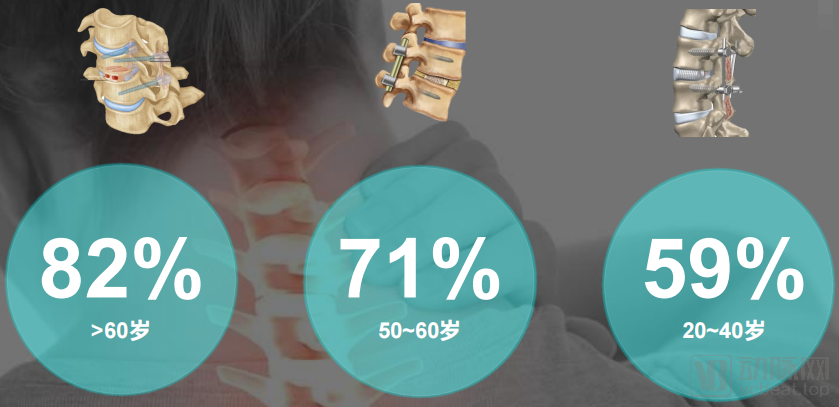 Incidence of Spinal Diseases by Age Group
First, from a clinical perspective, spinal orthopedic implants present the most significant challenges, with a higher prevalence of complications in East Asian populations. While conventional joint implants typically have a service life of 10–15 years, independent third-party data from Europe and the United States indicate that the complication rate for spinal implants within 3–5 years is approximately 15–20%. The underlying reason for this lies in the hydrophobic nature of current mainstream implant materials, an intrinsic property that hinders their effective integration with bone tissue.
Secondly, with the widespread adoption of smart electronic devices, it has become commonplace for young people to look down at their phones or hunch over desks for work. Consequently, spinal disorders among this demographic are becoming increasingly prevalent. Due to their higher levels of physical activity, young people naturally have higher demands for the quality and performance of spinal intervention products compared to the elderly. However, current spinal implants fail to provide long-term, effective solutions for young patients with severe conditions. Therefore, ZSFab has strategically prioritized the research and development of orthopedic implants tailored to spinal disorders.
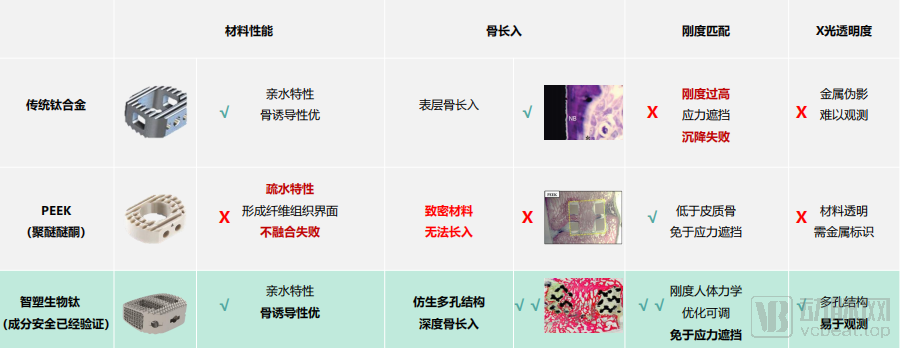
Comparison of ZSFab's Bio-Titanium with Other Performance Materials
ZSFab’s Bio-Titanium products (digital material modification of titanium alloys) innovate through optimizations in material properties and mechanical structure, effectively addressing the aforementioned pain points. Animal experimental data for the company’s pioneering product, the ZSFab Cervical Fusion Cage, demonstrate superior bone ingrowth and more efficient healing.
Notably, unlike other 3D-printed medical device companies, ZSFab possesses independent core proprietary technologies across its entire R&D platform—from algorithm design to final product manufacturing. The company currently holds 12 Chinese patents and 2 U.S. patents, with an additional 24 PCT patents pending application.
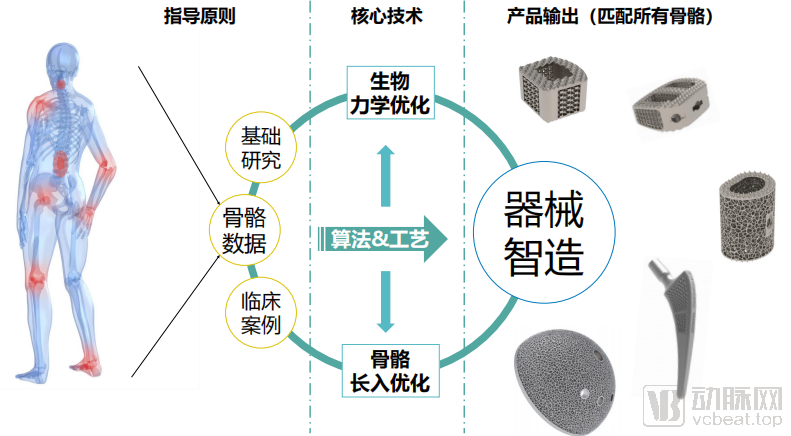
ZSFab's Comprehensive R&D Strategy
Founder Zhang Jing told VCBeat that the company is establishing and refining its end-to-end platform, with full completion expected by 2022. Once the design-to-production workflow is finalized, it will significantly boost ZSFab’s product output efficiency. Leveraging its in-house capabilities, the company will also offer CDMO services for medical device design, development, and 3D-printed manufacturing to external clients. By pursuing both proprietary flagship products and outsourced CDMO services, ZSFab adheres to a dual-pronged strategy to ensure long-term, stable growth.
ZSFab has secured tens of millions of yuan in financing and is currently undergoing a new round of funding. The proceeds will be primarily allocated to research and development, as well as market expansion. ZSFab remains committed to its mission of addressing clinical needs through advanced technological solutions, thereby better serving customers in the fields of orthopedics and sports medicine.