Metagenomi Secures $75 Million Series A Funding to Advance High-Efficiency Gene Editing Platform Based on Metagenomics

Metagenomi
Gene Technology Researcher
Recently,Gene Editing CompanyMetagenomi Announces Completion of Series A+ Financing Round,PlaceTotal Series A Funding AmountFromfrom $65 million in November 2020 to $75 million. Metagenomi stated that the proceeds from this financing round will be used to expand its team and advance the development of its therapeutic pipeline.
Metagenomi’s science is primarily based on metagenomics, which derives from natural microbial environmentsscreened thousands of genomes and used them to construct a set of based onCRISPR Gene-Editing Tools. Its unique gene-editing capabilities enable the rapid identification of novel nucleases. Metagenomi aims to leverage this expanded gene-editing toolkit to develop entirely new therapeutic approaches for patients with currently incurable genetic diseases.
In 2018, Metagenomi was officially established in Emeryville, California, USA. It was founded by the University of California, Berkeley'sChief Metagenomics ResearcherCo-founded by Brian Thomas and Jillian Banfield.

Image source: Metagenomi official website
Thomas graduated from the University of Kansas, where he earned a Bachelor’s degree in Cellular and Molecular Biology and a Ph.D. in Biochemistry.Later, inUnder the guidance of Norman Pace, Thomas completed his postdoctoral research at the University of California, Berkeley.
After graduation, ThomasChose to stay and work in Berkeley, where I have remained ever since.20 years. Perhaps Thomas himself did not expect to forge such a profound bond with Berkeley. In the initial years, Thomas’s work primarily involved collaborating with professors at the University of California’s business school to research and develop bioinformatics software.
In 2007, Thomas joined Jillian Banfield’s laboratory. Here, Thomas's research focus has shifted to discovering newCRISPR Enzymes. After years of investigation and research, Thomas and Banfield jointly developed a powerful, cutting-edge system that leverages bioinformatics and big data analytics to understand environmental microbes.
Banfield is a distinguished scientist. Born in Australia, she is a member of the U.S. National Academy of Sciences and the Australian Academy of Science, as well as a Fellow of the Royal Society. Currently, Banfield holds appointments in the Departments of Earth and Planetary Science, Environmental Science, Policy, and Management, and Materials Science and Engineering at the University of California, Berkeley. Her primary research interests include microbial ecology and metagenomics.
Why is Banfield considered outstanding? BanfieldHas been awarded by UNESCO2011 L'Oréal-UNESCO For Women in Science Awards. This award is granted to only five female scientists annually. It is the only global program dedicated to honoring women in science, and is often referred to as the "Nobel Prize for Women."
Thomas and BanfieldLeads annuallyApproximately 20 to 30 graduate and doctoral students collected samples from diverse environments across the globe, including acid mine drainage, sediments, soil, water, and human subjects. Over the years, they have published more than 100 papers in the fields of metagenomics or microbiome research.
ForMetagenomi, Thomas stated that his goal isLarge-scale application of machine learning to mine microbial genomes for discovering novel nucleases suitable for gene therapy. Currently,Metagenomi has discovered hundreds to thousands of potential enzymes.
Although the official authorities have not yet disclosed the current progress or results of their research,Thomas stated: "Metagenomi’s enzymes outperform current systems in editing efficiency. Metagenomi’s editing efficiency exceeds 90%, sometimes even surpassing 95%.”
Thomas also stated, “This is primarily attributable to metagenomics.”
When we talk about Metagenomi and Thomas, gene editing and metagenomics are always central to the conversation. So, what exactly is gene editing? And what is metagenomics?
Gene editing is an emerging form of genetic engineering that enables the modification of specific target genes within an organism’s genome.Technology. This is a game-changing technology. If successful, scientists can quickly and easily edit any genome.
Early gene engineering techniques could only randomly insert exogenous or endogenous genetic material into the host.Genome,Gene editing, on the other hand, can leverage a“Molecular Scissors” for Targeted Genome Editing.“Molecular scissors” are nucleases engineered through genetic modification.。
The key to gene editing lies in creating double-strand breaks (DSBs) at specific sites within the genome. To better generate DSBs at targeted loci, researchers have developed four different types of nucleases (meganucleases, ZFNs, TALEN、CRISPR/ Cas system) underwent bioengineering modification.
Among these, ZFNs, TALENs, and meganucleases were selected by Nature Methods as the Method of the Year 2011. The CRISPR/Cas system was recognized by the scientific community as the Breakthrough of the Year 2015. Within the CRISPR/Cas systems, the CRISPR/Cas9 system is currently the most extensively studied and technologically mature category. It is also the gene-editing tool with the greatest potential in the medical field today.
CRISPR/Cas9 is characterized by its precision, cost-effectiveness, and ease of use; however, it is not a flawless technology. CRISPR/Cas9 has certain limitations, such as off-target effects, chromosomal translocations, and immunogenicity. Metagenomi aims to address these challenges.
Metagenomitechnology can be used4-Point Summary:
1) From the environmentDNA Reconstruction of Microbial Genomes;
2) ApprovedAI Discovers New Gene-Editing System;
3) High-Throughput Characteristicsand development;
4) Authorize the development of new therapeutic pipelines.
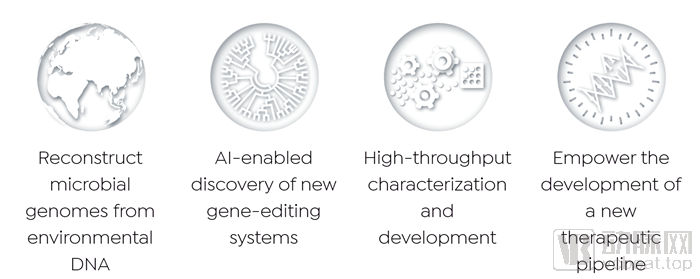
Image source: Metagenomi official website
Currently,Metagenomi is developing novel nucleases based on CRISPR and non-CRISPR gene-editing systems. Metagenomi stated that these enzymes will surpass the currently most prevalent CRISPR/Cas9 protein in the field of gene editing.
Metagenomi leverages its proprietary discovery engine to unlock billions of years of microbial evolution from vast metagenomic datasets, thereby identifying novel gene-editing systems.
This specialized engine leverages AI-powered cloud computing to rapidly identify andEnhance Natural Enzyme Systems.Metagenomi has tested hundreds of novel gene editors and validated their applications in the development of human therapeutics.
Metagenomics involves cloning the total DNA (i.e., the metagenome) of all microorganisms in a specific environment, followed by constructing metagenomic libraries and screening to obtain novel bioactive substances.Alternatively, primers can be designed based on the rDNA database to obtain information on the genetic diversity and molecular ecology of microorganisms in this environment through phylogenetic analysis.
Unlike genomics or proteomics, metagenomics involves the study of entire microbial communities in samples such as soil, feces, and water. This field is vast and complex. Professor Rob Knight once stated, “There are more than 10^30 microbes on Earth, a figure that is nine orders of magnitude greater than the number of known stars in the universe!”
In recent years, metagenomics research has permeated various fields, from oceans to land and air; from termites to mice and the human body; from fermentation processesto bioenergy, and then toEnvironmental governance, etc.
Widespread applications have gradually brought metagenomics into the scientific spotlight, garnering significant attention from countries worldwide. In recent years, numerous research initiatives on metagenomics have been advanced both domestically and internationally.
In the early years, the European Union launched the MetaHIT project (Metagenomics of the Human Intestinal Tract) to study the genomes comprising the gut microbiota, with a total investment exceeding €20 million. During the same period, the United States initiated the decade-long Human Microbiome Project (HMP), with a total budget of up to $215 million.
In 2005, Cann investigated horse feces by constructing a metagenomic library. Ultimately, Cann identified 233 distinct viral genotypes. Among these, 52% belonged to the family Siphoviridae, 26% were unclassified phages, 17% to the family Myoviridae, 4% to the family Podoviridae, and 2% to vertebrate orthopoxviruses.
Cases like Cann’s are commonplace abroad. In China, research on metagenomics is also advancing step by step. Dr. Qin Nan from Zhejiang University employed quantitative metagenomic techniques to study the gut microbiota of 98 patients with liver cirrhosis and 83 healthy individuals. Dr. Qin established the first reference gene set for liver cirrhosis, encompassing 2.69 million genes, including over one million novel genes.
In addition, Zhao Jing, Yang Xiangsheng, and colleagues from Xiamen University collected sludge from the sewage outlet of the Zhongshan Station in Antarctica and constructed a metagenomic library. They screened and identified a substance with antitumor effects using the Differential DNA Repair Test (DDRT).
On August 31, 2020, Metagenomi entered into a collaboration with Vor Biopharma to jointly develop hematopoietic stem cell therapies. Vor Biopharma will evaluate whether Metagenomi’s gene-editing technology can be used to treat blood cancers, such as acute myeloid leukemia.
VOR33 is Vor Biopharma’s lead candidate, composed of engineered hematopoietic stem cells (eHSCs) lacking the CD33 protein. Vor Biopharma stated, “Once these cells are transplanted into cancer patients, we believe that by making CD33 a more cancer-specific target, it will be possible to avoid the toxicity to normal blood and bone marrow associated with CD33-targeted therapies.”
Vor Biopharma aims to subtly expand the clinical benefits for patients with acute myeloid leukemia by improving the therapeutic window and efficacy of CD33-targeted therapies. Dr. Tirtha Chakraberty expressed the hope that “cancer patients can receive treatments that have a potent effect on cancer cells while minimizing impact on other cells.”
The progress of the collaboration has not yet been disclosed. Following the establishment of the partnership, Metagenomi promptly completed a $65 million Series A financing round. This Series A round was led by Bayer and Humboldt Fund. Other investors included Sozo Ventures, Agent Capital, InCube Ventures, and HOF Capital.
Following the securing of funding, Metagenomi promptly proceeded with personnel expansion. To further propel the company’s development, Metagenomi recruited three leading experts in clinical and basic research in immuno-oncology from the Fred Hutchinson Cancer Center: Philip Greenberg, Aude G. Chapuis, and Thomas Schmitt.
Dr. Greenberg is an internationally recognized expert in cancer immunotherapy. He stated, “Metagenomi is a highly unique team. I am deeply interested in its work, which translates metagenomics research into the therapeutic development of novel gene-editing systems, potentially driving innovation in immunotherapy.”
Dr. Chapuis also stated, “With its suite of innovative gene-editing capabilities, Metagenomi has the potential to achieve high efficiency and low off-target toxicity, offering unique advantages in accelerating the development of CAR-T and other next-generation cell therapies.”
Dr. Chapuis is an expert in adoptive T-cell immunotherapy and hematopoietic stem cell transplantation. Dr. Schmitt is a colleague of Dr. Greenberg and Dr. Chapuis. He is an expert in T-cell differentiation and T-cell/TCR-mediated cancer elimination.
In March 2021, Jian Irish joined Metagenomi as Chief Operating Officer. Dr. Irish has 20 years of leadership experience in biopharmaceutical operations and drug development.
Dr. Thomas stated, “Metagenomi’s gene editing system has demonstrated excellent specificity and efficiency, with next-generation capabilities surpassing those of the first-generation technology. As we intensify our discovery and manufacturing efforts and advance the development of our pipeline of potential therapeutics, Jian’s insights and global acumen will be invaluable.”
April 2021, at RA Capital Managementwith the assistance of,Metagenomi Raises Series A Funding to $75 Million