

Nalu Medical Secures Over $100 Million in Series A Funding to Revolutionize Chronic Pain Treatment with Miniaturized, Battery-Free Neurostimulation System

Nalu Medical
Medical Device Developer
Compared to terrifying conditions such as cancer, cardiovascular and cerebrovascular diseases, or respiratory disorders, chronic pain may seem less harmful. It neither resolves or disappears with the treatment of underlying pathologies, as seen in toothache-like pain, nor can it be rapidly alleviated through methods such as anesthesia, as is possible with acute pain.
As one of the most prevalent health issues today, chronic pain severely impacts patients' quality of life. A 2019 WHO report indicated that chronic pain affects 30% of the global population. According to the "Report on the Development of Pain Medicine in China (2020)," there are over 300 million chronic pain patients in China, with the number growing rapidly by 10 to 20 million annually, and the patient demographic showing a trend toward younger ages.
The complexity of the etiology and pathogenesis of chronic pain has led to suboptimal efficacy of many therapeutic interventions, while the widespread use of opioid analgesics further exacerbates the rise in drug resistance and addiction. In recent years, based on the "Gate Control Theory of Pain,"Spinal Cord Stimulation (SCS)andPeripheral Nerve Stimulation (PNS)Have become internationally recognized as two advanced therapies for the treatment of chronic pain.
According to data from QYR’s Medical and Health Research Center, Medtronic, Abbott, and Boston Scientific are the three major giants in this field. In the Spinal Cord Stimulation (SCS) segment alone, their respective market shares are approximately 34% for Medtronic, 29% for Abbott, and 23% for Boston Scientific. Due to high technological barriers in the industry, the neurostimulation sector is predominantly led by companies in Europe and the United States, which collectively account for over 70% of the market.
In February 2022, Nalu Medical, a medical technology company focused on developing minimally invasive solutions for patients with chronic neuropathic pain, completed a $104 million angel financing round. The round was led by MVM Partners and Gilde Healthcare, with participation from Pura Vida Investments, Aperture Venture Partners, and existing seed-stage investors Advent Life Sciences, Decheng Capital, Endeavor Vision, and Longitude Capital.
According to a report by Global Info Research (GIR), global revenue from implantable neurostimulators amounted to approximately $6.8322 billion in 2021 and is projected to reach $13.93 billion by 2028. In the highly competitive field of neuromodulation technology for chronic pain, dominated by industry giants, what has enabled this company to attract investor favor and secure an angel financing round exceeding $100 million?
Nalu Medical was founded in 2014 and is headquartered in California, USA. After completing its seed funding round in 2015, the company did not proceed to its angel round until 2022, with the total amount raised across these two rounds reaching $115.9 million. Prior to the angel round, Nalu Medical had filed an application with the U.S. Securities and Exchange Commission (SEC), planning to raise $100 million and aiming for an initial public offering on NASDAQ.
In 2019, Nalu Medical’s neurostimulation product, the Nalu Neurostimulation System (hereinafter referred to as “Nalu”), received FDA approval for the treatment of chronic pain in the back, legs, and neuropathic pain. According to available data, its revenue reached $1.4 million in the first quarter of 2021. Nalu filed for an initial public offering (IPO) in July of that year but ultimately withdrew the application in December.
Just over a year after its official market launch, Nalu Medical was confident enough to submit a marketing application, owing to the superiority of its product, Nalu, which is compatible with both Spinal Cord Stimulation (SCS) and Peripheral Nerve Stimulation (PNS) technologies. Both SCS and PNS are implantable neuromodulation techniques used to treat chronic, intractable pain, and their clinical efficacy has been validated.
SCS technology, also known as an analgesic pacemaker, is commonly used to treat chronic, intractable pain. Through interventional surgery, electrodes are implanted into the epidural space of the spinal canal. After confirming their precise location via fluoroscopy, pulsed electrical currents are used to stimulate specific segments of the spinal nerves. This replaces pain signals transmitted by peripheral sensory nerves with a tolerable tingling sensation at the spinal level, thereby blocking the transmission of pain signals to the central nervous system and effectively alleviating chronic, intractable pain caused by various conditions.
According to relevant reports from Grand View Research, Spinal Cord Stimulation (SCS) is the largest segment in the neuromodulation device market, accounting for approximately 55% of the market share. Data from Probe Capital indicates that the global SCS market size reached $3.2 billion in 2020, with a Compound Annual Growth Rate (CAGR) of approximately 8%.
Peripheral Nerve Stimulation (PNS) is a derivative technique developed on the basis of Spinal Cord Stimulation (SCS). In the early 21st century, the invention of percutaneous puncture technology facilitated the widespread application of PNS in the field of pain management. The procedure involves implanting electrodes subcutaneously near the peripheral nerves innervating the painful area. Pulsed electrical currents are used to stimulate sensory neurons of the peripheral nerves, thereby exerting endogenous analgesic effects and promoting the self-repair of damaged nerves. Common electrode implantation sites include the supraorbital, infraorbital, occipital regions, and the foramen ovale.
Deep Brain Stimulation (DBS), Motor Cortex Stimulation (MCS), Spinal Cord Stimulation (SCS), Peripheral Nerve Stimulation (PNS), and implanted drug pumps are effective treatments for chronic, intractable pain, and for certain types of pain, they may even be the only effective therapeutic options.
Currently, implantable neuromodulation devices have been clinically validated; however, existing market products still suffer from high patient out-of-pocket costs, poor patient comfort, and a steep learning curve for physicians, resulting in a certain gap with clinical needs. At the product implementation level, two primary issues are involved: the discomfort caused to patients by the surgical procedure and how to extend battery life during use.
Generally, implantable neuromodulation devices primarily consist of an Implantable Pulse Generator (IPG), electrodes, extension leads, a test stimulator, a patient programmer, a patient programmer charger, and a clinician programmer. Nalu’s electrical stimulation system, which has received FDA and CE approval, mainly comprises a micro-IPG, extension leads, a wearable therapy disc, and a mobile app for remote control of therapy modes. It is approved for both Spinal Cord Stimulation (SCS) and Peripheral Nerve Stimulation (PNS) therapies.
SCS is primarily used for the management of chronic, refractory pain in the trunk or limbs, including unilateral or bilateral pain. PNS is indicated for adults with severe, refractory pain of peripheral nerve origin, or as an adjunctive therapy to other treatment modalities, but excludes pain management in the craniofacial region.
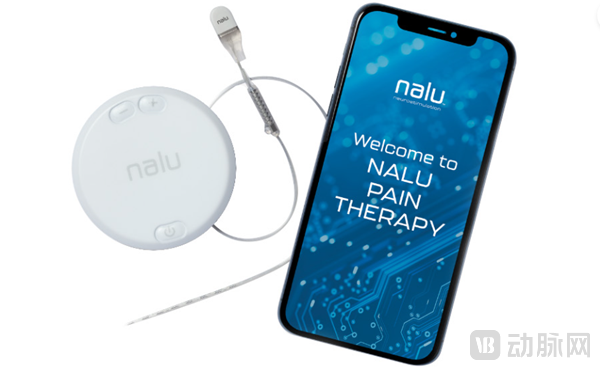 The Nalu Neurostimulation System (Image source: Nalu Medical official website)
Electrical Stimulation Therapy: During the specific treatment process, patients generally need to undergo two surgeries:
The first surgery involves implanting a trial electrode into the target location within the patient’s spinal canal, followed by connection via leads to an external temporary stimulator for trial therapy (≤30 days). If the patient demonstrates satisfactory response during the trial phase, a second surgery for implantation of an implantable pulse generator (IPG) may proceed; otherwise, the electrode is surgically removed. The second surgery, performed after successful trial evaluation, entails replacing the trial electrode with a permanent one and implanting the IPG subcutaneously, with the electrode and IPG connected via leads routed through a subcutaneous tunnel.
Surgical procedures involve operational considerations: the size of the implant directly affects the feasibility of minimally invasive surgery and the reduction of patient discomfort. The Nalu micro-IPG contains microelectronic components, ensuring the same therapy modes, current waveforms, upgradability, and therapeutic efficacy as larger IPGs.Its volume is 27 times smaller than the largest IPG on the market., capable of performing minimally invasive surgery to promote rapid wound healing and minimize scarring.
Implantable Pulse Generators (IPGs) can irritate surrounding tissues in the body, causing pain and discomfort for patients. A clinical study has shown that smaller-volume IPGs are more effective at reducing the likelihood of such pain and discomfort, thereby minimizing disruption to patients’ daily lives.
Once the surgery is completed, a second question arises: How long can the implant be used? Does the battery need to be replaced during use? The batteries in traditional IPG products are limited by their capacity. If high-frequency electrical stimulation and burst stimulation, which offer better therapeutic effects, are employed, the battery life will face significant challenges, leading to more frequent replacements.
To address this issue, Nalu does not implant the battery subcutaneously; the implant consists solely of the micro-IPG and extension leads, while the battery and control system are integrated into a wearable therapy disc. During treatment, the wearable therapy disc can be secured to the skin surface overlying the micro-IPG using an adhesive clip, allowing remote adjustment of treatment protocols and modes via a smart app. When the battery is depleted, the therapy disc can simply be replaced with a charged unit. The disc can also be removed at any time as needed or in accordance with medical advice.
The battery is not implanted subcutaneously, thereby avoiding the need for additional battery replacement surgeries; furthermore, since the therapy module is external, its treatment modes are upgradable without requiring further surgical intervention to replace electrodes. In 2021, the FDA approved an expanded label for Nalu’sThe Nalu micro-IPG implant has an extended expected service life of 18 years, making it the chronic pain implantable pulse generator with the longest FDA-approved expected service life.
Electrical stimulation, as the name suggests, requires pulsed current. In addition to conventional pulsed current, Nalu features a proprietary multidimensional pulsed stimulation pattern (PSP). According to the latest clinical trial data disclosed by Nalu Medical, PSP demonstrated higher response rates for back and leg pain compared to traditional spinal cord stimulation (SCS) pulsed current (61% vs. 48% and 78% vs. 50%, respectively). During the 90-day follow-up, leg pain was reduced by an average of 79% and lower back pain by an average of 76% compared to baseline.
After submitting its listing application in 2021, SeekingAlpha disclosed information that Nalu Medical fromBoston Scientific、Longitude Venture Partners、Decheng Capital China, secured at least $116 million in equity investment from investors including Advent Life Sciences and Endeavor Medtech.
Among these developments, VCBeat noted the capital injection by Boston Scientific and Decheng Capital China. As one of the three major players in the same sector, Boston Scientific’s move, alongside domestic capital’s focus on innovative enterprises in chronic pain, may signal that the neuromodulation segment within the chronic pain field is poised for significant growth.
In China, the first domestically developed spinal cord stimulation (SCS) device, manufactured by PINS Medical, received approval last year. According to data from the Medical Device Data Cloud, there are currently only five SCS products with valid registration in China: two from PINS Medical, two from Medtronic, and one from St. Jude Medical. At present, there are no percutaneous nerve stimulation (PNS) products with valid registration in China.
With the growing elderly population and rising prevalence of chronic diseases, the number of patients suffering from chronic pain continues to increase. Coupled with the expanding workforce of healthcare professionals in the field and rising disposable incomes among residents, public awareness of pain management is steadily deepening. Although significant market barriers remain, regions such as Guangdong, Yunnan, and Beijing have already included Spinal Cord Stimulation (SCS) in their basic medical insurance coverage.
References:
Fan Bifa, Feng Zhiying, Gu Ke, Jia Donglin, Jin Yi, Liu Hongjun, Mao Peng, Song Tao, Sun Tao, Wan Li, Wu Dasheng, Xiao Lizu, Xie Chaohui, Xu Fenghe, Mao Peng. Expert Consensus on Spinal Cord Stimulation for the Treatment of Chronic Pain [J]. Chinese Journal of Pain Medicine, 2021, 27(06):406-409.