Neuralink Receives Approval for First-in-Human Brain-Computer Interface Trial

Neuralink
Brain-Computer Interface System Developer

Neuralink, Elon Musk’s brain-computer interface startup, announced on Tuesday that it had received approval from an independent review board to conduct its first human trial, implanting devices in the brains of paralyzed patients.
According to Neuralink, this human clinical trial will last for six years. Participants will first engage in an 18-month study, after which they will dedicate at least two hours per week to brain-computer interface research.
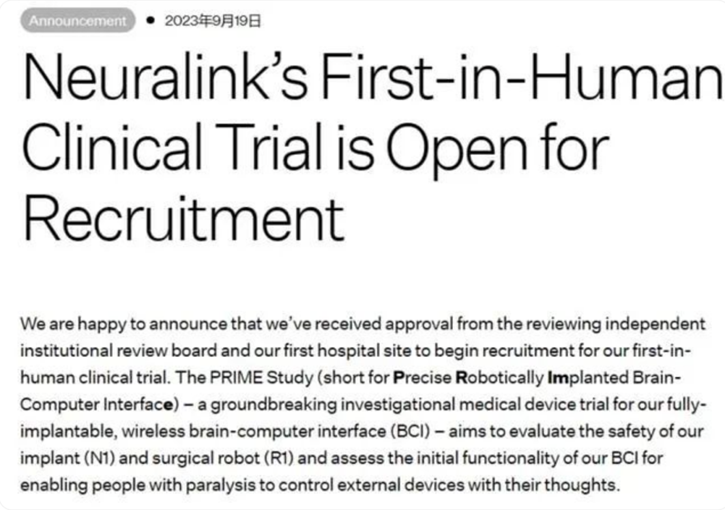
According to Neuralink, this human trial will last for six years. Participants will first take part in an 18-month study, after which they will spend at least two hours per week on brain-computer interface research.
Elon Musk has stated that Neuralink’s short-term goal is to enable paralyzed individuals to type using their thoughts, with future applications including restoring mobility to the paralyzed and vision to the blind, ultimately achieving a “human-machine symbiosis.”
Why Is Musk Obsessed with Implanting Chips in the Human Brain? What Stories Lie Behind the Founding of Neuralink? The newly released global edition of “Elon Musk” in September reveals the original intention behind the establishment of Neuralink.
In the digital age, the most significant technological leap involves advancements in the mode of communication between humans and machines, known as the “human-computer interface.” Joseph Licklider, a psychologist and artificial intelligence expert, studied air defense systems that tracked aircraft on display screens. In 1960, he authored a groundbreaking paper titled “Man-Computer Symbiosis,” demonstrating how display screens could enable “computers and humans to think together.” Licklider further stated, “It is hoped that in the near future, human brains and computers will be integrated very closely.”
Hackers at the Massachusetts Institute of Technology (MIT) used display screens to create a game called “Spacewar!,” which spawned commercial games with highly intuitive interfaces that required virtually no input commands. (“Step 1: Insert 25 cents; Step 2: Dodge Klingons” was the only instruction in Atari’s first Star Trek game.) The purpose of designing such foolproof operation was to enable even intoxicated college students to pick up and play the game.
Doug Engelbart combined this display with the mouse, enabling users to interact with computers by pointing and clicking. With the assistance of Alan Kay at Xerox PARC, this technology evolved into a user-friendly graphical interface that closely resembled the computer desktops we later adopted. Steve Jobs incorporated this interface into Apple’s Macintosh computers. At his final board meeting in 2011, shortly before his death, he completed testing for another major leap in human-computer interaction: an application named Siri, which enables voice-based interaction between humans and computers.
Despite these advances, technological progress in input and output remains surprisingly slow. During a trip in 2016, Musk was typing on his phone with his thumb and began to complain about how time-consuming typing was. The information transfer rate from the brain to completing typed input on a device is only about 100 bits per second. Musk said, “Imagine if you could integrate your thoughts directly into machines, as if establishing a straightforward, high-speed connection between your mind and the machine.” Leaning forward, he asked Sam Teller, who was riding with him, “Can you find a scientist in the field of neuroscience to help me deepen my understanding of brain-computer interfaces?”
Musk realized that the ultimate human-machine interface would be a device capable of directly connecting computers to the brain, such as by implanting chips within the human skull. These chips could transmit brain signals to computers and receive signals in return, thereby increasing the speed of bidirectional information flow by a factor of one million. Musk stated, “This would allow us to achieve true human-machine symbiosis.” In other words, it would ensure that humans and machines work in synergy.
To achieve this goal, Musk founded Neuralink Corp at the end of 2016, with its business focused on implanting small chips into the human brain to enable a mental fusion between humans and computers.
Like Optimus, Neuralink’s concept was inspired by science fiction, particularly Iain Banks’ space opera series “Culture,” which features a brain-computer interface technology called “neural lace” that, when implanted in the human body, can link all of a person’s mental activities to a computer. Musk stated, “When I first read Banks’ works, it suddenly struck me that this idea could potentially serve as our shield against artificial intelligence.”
Elon Musk’s lofty goals are generally paired with pragmatic business models. For instance, he developed the Starlink satellite constellation, a venture that helps fund SpaceX’s Mars launch missions. Similarly, he plans to use Neuralink’s brain-computer interface chips to assist individuals with neurological disorders, such as those with amyotrophic lateral sclerosis (ALS), enabling them to interact with computers. Musk stated, “If we can identify viable commercial applications to fund Neuralink, then in a few decades we will be able to closely integrate the human world with digital machines, thereby achieving our ultimate goal: safeguarding humanity against malicious artificial intelligence.”
Neuralink’s co-founding team includes six top neuroscientists and engineers, with brain-computer interface researcher Max Hodak serving as President. The only member of the founding team who has worked with Elon Musk for an extended period and endured high-pressure and turbulent environments is Dongjin Seo, who moved from South Korea to Louisiana, USA, at the age of four. Due to his limited English proficiency in his youth, he acutely experienced the frustration of “having ideas but being unable to express them.” “How can I convey the thoughts in my mind as efficiently as possible?” he began to ask himself. “It must be a small device implanted in my brain.” During his studies at the California Institute of Technology and the University of California, Berkeley, he developed what he called “neural dust,” a tiny implantable device that can be placed in the brain to transmit signals.
Musk also recruited Shivon Zilis, a sharp-eyed tech investor. Growing up near Toronto, she excelled in hockey, but after reading Ray Kurzweil’s 1999 book The Age of Spiritual Machines, she became a tech geek. After graduating from Yale University, she worked at several startup incubators, supported some artificial intelligence startups, and also became a part-time advisor to OpenAI.
During the period when Musk was setting up Neuralink, he invited Zilis out for coffee, asked her to join the team, and assured her, “Neuralink is not just about conducting research; it aims to build a real device.” Zilis quickly realized that this opportunity was more interesting and meaningful than continuing her career as a venture capitalist. She said, “I found that I learned more unique knowledge from Elon every minute than from anyone else. It would be foolish of me not to work with someone like him.” Initially, she devoted her energy to all three of Musk’s companies, including the artificial intelligence projects at Tesla and SpaceX. However, she ultimately chose only two roles: transitioning into an executive position at Neuralink and becoming Musk’s close romantic partner (more details on this will be provided in the book).
# “Don’t Become the Cyborgs in Horror Movies”
The underlying technology of the Neuralink chip is based on the Utah Array, invented by the University of Utah in 1992. It is a microchip embedded with 100 needles that can be implanted into the brain. Each needle detects the activity of a single neuron and transmits data via wires to a box mounted on the human skull. Given that the brain contains approximately 86 billion neurons, this represents only a small step toward achieving brain-computer interfaces.
In August 2019, Musk published a scientific paper describing how Neuralink would improve upon the Utah Array to create what he called an “integrated brain–machine interface platform with over 3,000 channels.” Neuralink’s chip features more than 3,000 electrodes arranged across 96 threads. As always, he focused not only on the product itself but also on its manufacturing and deployment. High-speed robots drill a small hole in the human skull, implant the chip, and insert the electrode filaments into the brain.
In August 2020, Elon Musk unveiled an early version of the device during a public presentation by Neuralink. The team implanted a chip into the brain of a pig named Gertrude and demonstrated via video how the chip detected neural signals as the animal walked on a treadmill, transmitting them to a computer. Musk held up the chip, which measures just 0.25 inches in size. Designed to be placed beneath the skull, it wirelessly transmits data, ensuring that users do not appear as unsettling as cyborgs from horror films.
“I could implant a Neuralink right now without you even noticing,” Musk said. “Maybe I’ve already done it.”
A few months later, Musk visited Neuralink’s laboratory, located near Tesla’s factory in Fremont. The engineers presented their latest device, which featured four independent chips, each with approximately 1,000 threads. These implants were to be placed in different areas of the skull and connected via wires to a router embedded behind the ear. Musk remained silent for nearly two minutes, while Zilis and her colleagues looked on in silence. He then delivered his verdict: he hated this version, deeming the design overly complex, with too many wires and too many connections.
At the time, he was eliminating various connections on the Raptor engine, reasoning that each additional connection introduced another potential point of failure. “It must be an integrated device,” he told the disheartened Neuralink engineers, “presented as a complete, streamlined package—no wires, no connectors, no routers.” After all, there is no law of physics or fundamental principle prohibiting the implementation of all functionalities within a single integrated unit. As the engineers attempted to explain why retaining a router was necessary, Musk’s expression grew grave. “Remove it, remove it, remove it, remove it,” he said.
After the meeting, the engineers experienced typical “Post-Musk Anxiety Disorder”: first confusion, then anger, and finally anxiety. But within a week, they became obsessed with the idea, as they realized that this new technological approach might actually be feasible.
A few weeks later, when Musk returned to the lab, they showed him an integrated chip capable of processing data from all threads and transmitting it to a computer via Bluetooth—no wires, no connections, no router. One of the engineers said, “We initially thought it was impossible, but now we have full confidence in this device.”
One major challenge they faced at the time was meeting the requirement that “the chip must be extremely small,” which made it difficult to achieve long battery life or support a large number of threads. Musk asked, “Why does it have to be so small?” Someone mistakenly replied that it was a previous requirement imposed on them. Upon hearing this, Musk became animated and began outlining his work methodology: the first step is to question every requirement. He then urged the team to reconsider the fundamental scientific principles regarding chip size: since the human skull is spherical, could the chip protrude slightly? Could its diameter be larger? They concluded that accommodating a larger chip within the human skull was entirely feasible. Once the new device was ready, they implanted it into Pag, a macaque monkey in their laboratory. They taught him to play the video game Pong, rewarding him with a fruit smoothie whenever he performed well.
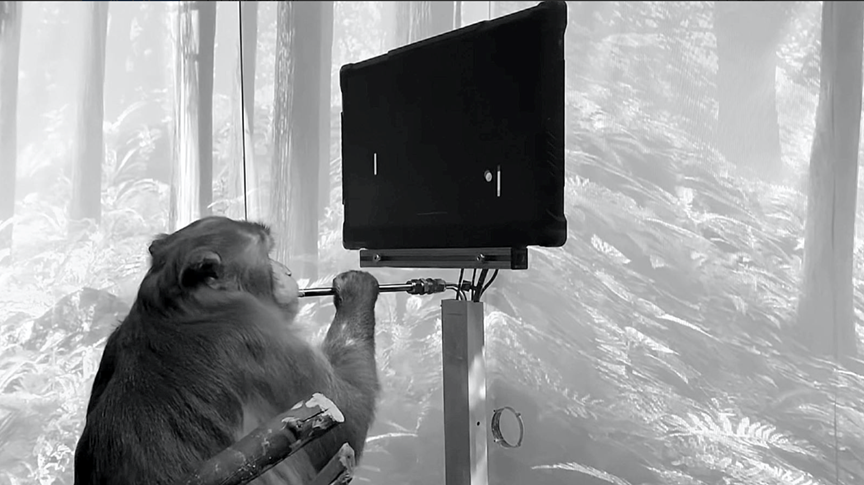
Image source: Illustration from "Elon Musk," showing a monkey playing the video game Pong using brainwaves
The Neuralink device recorded which neurons fired each time the joystick was moved in a certain way. Subsequently, the joystick was deactivated, and signals from Pag’s brain began to control the gameplay. Musk’s goal is to establish a direct connection between the brain and machines, and this experiment marked a significant step forward. Neuralink Corp uploaded the video to YouTube, where it garnered 6 million views within a year.
# Miracles
In late 2021, during a visit to the pigsty, Elon Musk expressed dissatisfaction with Neuralink’s progress. The company had already implanted a chip into a monkey’s brain and trained it to play the video game Pong using brainwaves. However, up to that point, Neuralink had merely garnered significant views on YouTube with these demonstrations, without making substantial headway in its brain-computer interface (BCI) program. “Guys, how are we going to explain this to outsiders? How can we truly capture people’s attention?” he said as he walked. “Someday, a paralyzed person might be able to move a cursor on a computer screen using their brain. That sounds cool, especially for someone like Stephen Hawking. But it’s not enough; most people remain indifferent.”
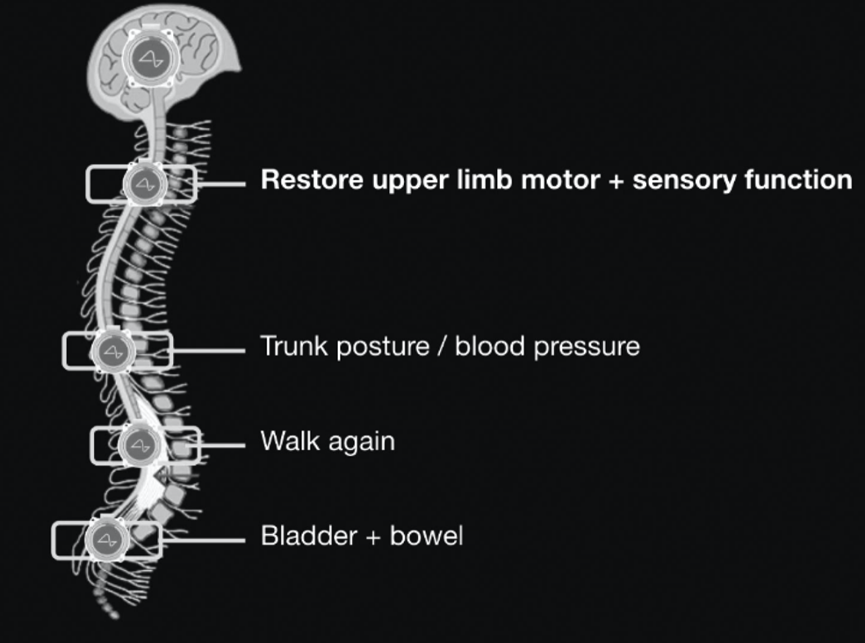
At this point, Musk began steering Neuralink toward a new objective: enabling paralyzed individuals to regain control of their limbs. The brain implant could bypass spinal cord blockages or neurological impairments, sending signals directly to the relevant muscles. He returned from the pig barn to “Axon House,” gathering his core team members in Austin, with their colleagues in Fremont joining online. Musk announced this newly added mission: “If we can help people in wheelchairs walk again, everyone will immediately grasp the significance of Neuralink’s endeavor. It will surely strike a chord—bold and audacious, which is a good thing.”
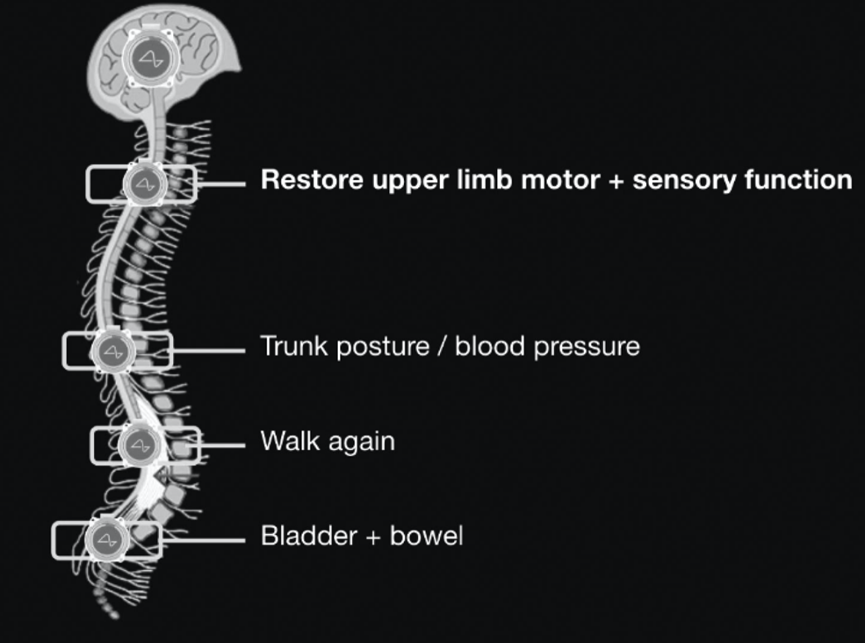
Image source: Illustration from “Elon Musk,” showing a slide of Neuralink’s future goals
Elon Musk visited Neuralink’s laboratory every week to attend review meetings. Before one such meeting in August 2022, Jeremy Barenholtz, the chief engineer, sat at the coffee bar waiting for the session to begin. A year earlier, he had graduated from Stanford University with a master’s degree in computer systems science, yet his rust-red curly bangs and sparse beard gave him a youthful appearance reminiscent of a middle-school science fair participant. “Elon believes that while controlling computers with thoughts is impressive, enabling paralyzed individuals to walk again resonates more strongly with the general public, so we have been focusing on this initiative,” Barenholtz said. He showed me various muscle stimulation techniques and boldly discussed his understanding of how brain signals are transmitted: he argued that brain signals propagate through the chemical diffusion of charged molecules, rather than via electromagnetic waves as traditional theory suggests.
After Musk finished sending emails and tweets on his phone, more than a dozen young engineers gathered in the conference room. Everyone, including Ziliris, was wearing black T-shirts, similar to Musk's usual attire. Barenholz passed around samples of hydrogel that resembled the soft tissue of the cerebral cortex and showed videos of two experimental pigs moving their legs under the influence of electrical signals. Musk said, "We must distinguish between pain responses and muscle movements; otherwise, even if we can enable people to walk again, they will feel painful. But it does prove that the principle behind our goal of enabling paralyzed individuals to walk again does not violate the laws of physics, which is truly incredible and akin to a miracle."
Musk asked whether they could still achieve other miracle-like goals. Barenholtz suggested considering audiovisual stimulation—in other words, enabling the deaf to hear and the blind to see. “The simplest approach is to address deafness through cochlear implant stimulation,” said Barenholtz. “But visual stimulation is more intriguing; to achieve high-fidelity visual perception, you need to interface with a large number of neural channels.”
“So the promises we can make to humanity would be truly incredible, right?” Musk added. “Want to see infrared? Want to see ultraviolet? Want to see radio waves and radar signals? Exactly, this kind of visual enhancement is so cool.” He suddenly burst out laughing. “I watched Life of Brian again.” He was referring to a film by Monty Python, citing a scene in which a beggar complains that Jesus cured his leprosy, making it much harder for him to beg for food. “I was limping along, begging for my meal, when he suddenly came and healed me! One minute I was a leper with a livelihood, and the next minute my livelihood was gone. He didn’t even say ‘Sorry!’ ‘You’re healed, brother.’ That damn good man.”
# The first goal is to restore vision
By the end of September, Musk had grown impatient again. He had been pressing Zilis and Bahuleyan to publicly demonstrate their progress, but they kept saying they were not ready. Musk’s demeanor grew increasingly grim. “If we don’t accelerate, we will achieve nothing in our lifetime,” he warned them, promptly setting the date for the demonstration: Wednesday, November 30. As it turned out, he was scheduled to visit Tim Cook at Apple that day.
When Musk arrived at the venue that evening, 200 chairs had already been set up in the office space of “Axe House.” Lex Fridman, the host of Musk’s favorite podcast, also attended the event, as did Justin Roiland, the director of the animated TV series Rick and Morty. The “Three Musketeers”—James, Andrew, and Ross—had not received invitations, but they entered through the back door.
Musk hopes that this demonstration will not only highlight his ambition to solve humanity’s ultimate challenges but also showcase some of his short-term strategic goals. Musk told the audience, “My primary motivation for founding Neuralink is to create a universal input/output device capable of interfacing with all aspects of human brain signals.” In other words, this represents the ultimate mind-machine merger between humans and machines, serving as a safeguard against unchecked actions by artificial intelligence systems. “Even if AI is benevolent, can we still keep pace with it and stay current?”
Subsequently, Musk unveiled Neuralink’s new short-term objectives: “The first goal is to restore vision. Even in cases of congenital blindness, we believe we can help patients regain sight.” He then addressed individuals with paralysis, stating, “Although it may sound miraculous, we believe it is possible to restore full-body motor function in people with spinal cord injuries.” The presentation lasted three hours, with Musk and his engineers remaining on-site until 1 a.m. He later remarked that taking a temporary break from the chaos at Twitter provided a rare opportunity for relaxation.
In September 2022, Musk once again visited Neuralink’s laboratory, where he focused on studying the mechanical dynamics and signal processes involved in locomotion. Shivon Zilis, Dongjin Xu, and Jeremy Barenholtz donned lab coats and shoe covers before leading him into a windowless room containing a pig named “Mint,” which was walking on a treadmill and receiving apple slices dipped in honey as rewards. At regular intervals, the machine delivered electrical stimuli to induce muscle twitches. They were attempting to decode the actuators involved in the animal’s gait.
In the last week of April 2023, Neuralink completed its final round of animal experiments and began collaborating with the U.S. Food and Drug Administration (FDA), seeking approval to implant its chip into the brains of human trial participants. Approval was granted four weeks later. Musk urged the team to publicly showcase their progress, stating, “We want the public to understand everything we are doing so that they will support us. This is also why we live-stream the Starship launches, even though we all know it is highly likely to explode mid-air.”
—— End ——
Portions of this article are derived from *Elon Musk*.
Reference: Big Data Digest
For academic sharing only. If there is any infringement, please leave a message, and it will be deleted immediately!
More Reading
University of Glasgow PhD Student from China Proposes Computational Ghost Imaging Architecture
Expert Opinion: What Is the True Meaning of Neuralink’s Recent FDA IDE?
The Medical Device Path of Implantable Brain-Computer Interface Technology
The First Author of LMDA-Net Personally Explains Its Design Philosophy
The Relationship Between Reaching Motor Imagery Training and Reaching-to-Grasp Imagery

Join the Community
Welcome to the Brain-Computer Interface Community Group Chat,
Exploring Topics in the Field of Brain-Computer Interfaces: Real-Time Tracking of Frontiers in Brain-Computer Interface Technology.
Join the WeChat group:
Add WeChat: RoseBrain [Note: Name + Industry/Profession].
Join QQ Group: 913607986
Call for Papers
1. Submissions welcome. For submission inquiries, please contact us on WeChat: RoseBrain
2. To join the community as a part-time creator, please contact us on WeChat: RoseBrain